
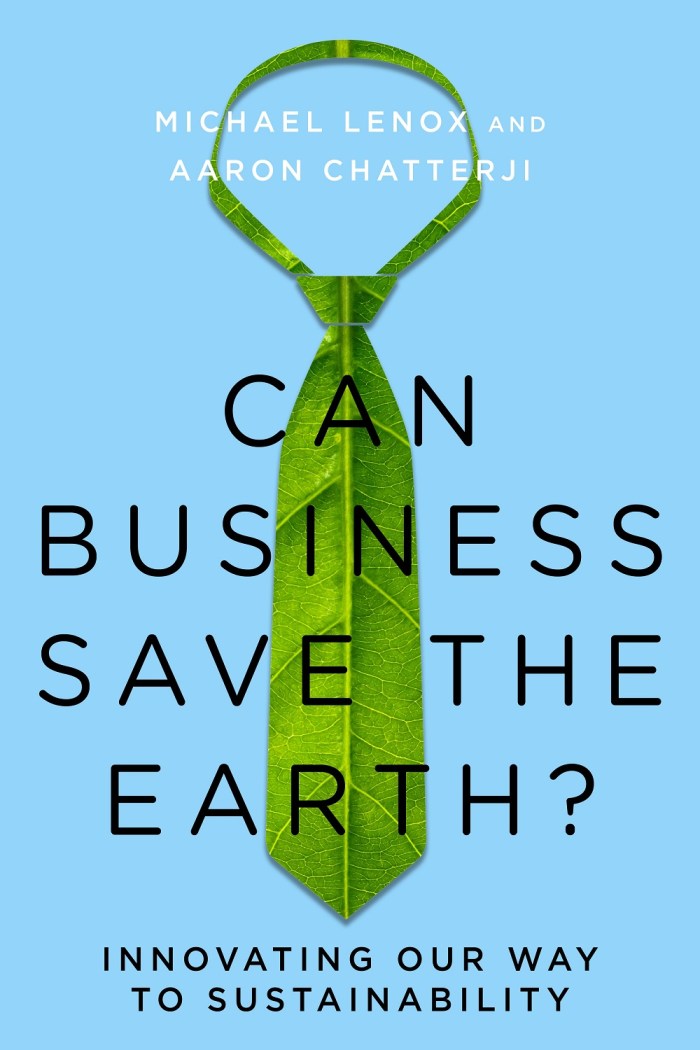
Michael Lenox is the Tayloe Murphy Professor of Business Administration and Senior Associate Dean and Chief Strategy Officer at the University of Virginia’s Darden School of Business. His work has been cited by the New York Times, the Financial Times and the Economist. Aaron Chatterji is Associate Professor of Business and Public Policy at Duke University’s Fuqua School of Business. His research has also been cited by the New York Times, CNN, the Wall Street Journal and the Economist. Together they are the authors of ‘Can Business Save the Earth? Innovating Our Way to Sustainability’ now available everywhere. They share their findings on how multiple sectors can minimize environmental impact while driving economic growth.
‘Can Business Save the Earth?’ begins with a Preface that does not shy away from explaining how climate change poses a threat to humanity’s ability to flourish on this planet. Dealing with this issue will require action by not only business but by scientists, inventors, investors, customers, policy makers and activists. The book’s objective is to figure out how to bring these industries together to create the innovations that will address the current environmental crisis and make a difference. Each group is a chapter, Chapter 1 is Business as Savior, Chapter 2 is Innovator as Genius and so forth, that illustrates how each can help make this a greener planet.
Climate change is at the heart of ‘Can Business Save the Earth?’ and the authors do an impressive job of laying out how to start making a difference. With more than a decade of research in the subject, they conclude that it takes work and dedication from companies and individuals who care enough about the planet. The topic of business might seem boring, but the language is down to earth and easy to understand so that anyone who is interested in climate change, sustainability and green matters can appreciate the content. They notate their research at the end with a Notes section that is divided by chapters. Chapter 2, Innovator as Genius, stands out because it summarizes that even if one person comes up with a solution, it is not enough because it takes everyone from the corporate R & D office to the consumer, to make ultimately save the Earth. It is a must read for anyone who is serious about climate change and honestly wants to learn how the system works in creating greater sustainability.
“We all have the power, in one way or another, to serve as catalyst. The question before us, all of us, is whether we will take the actions today to create the conditions under which the innovation system can thrive.”
*A copy of this book was given for an honest review. The opinions expressed here are solely the author’s.
 SA Examiner