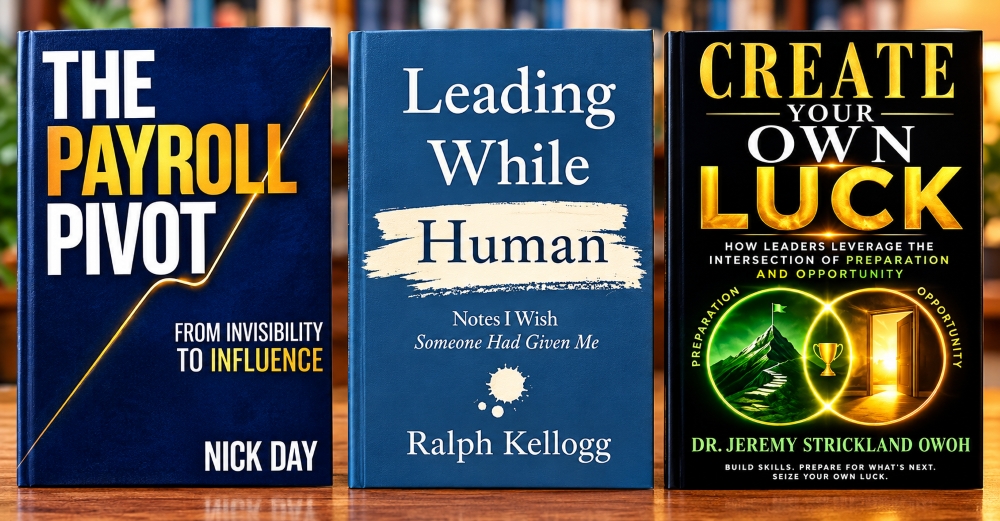
Books of the Week: Essential Reads for Modern Business Leaders
Whether you are looking to redefine your leadership strategy, elevate an undervalued function, or navigate the deeply human side of management, this week’s book spotlight offers invaluable insights. Consider these three powerful reads designed to help you lead with purpose, impact, and authenticity.
1. Create Your Own Luck: How Leaders Leverage the Intersection of Preparation and Opportunity
By Dr. Jeremy Strickland Owoh
The concept of luck carries various implications, often shaped by individual experiences, and perspectives. From a spiritual realm, there has also been some controversy about whether there is really such a thing as luck. Throughout his leadership journey, the author has contemplated its true meaning and has come to define luck as the intersection of preparation and opportunity. (Barnes & Noble, 2026)
If there is one principle that sums up his leadership experience, it’s an unwavering commitment to preparation, ensuring that he is ready to seize any opportunity that arises. His journey has been shaped not only by diligence and readiness but also by the profound influence of grace and mercy.
About the Author: Dr. Jeremy Strickland Owoh is a transformational educational leader and superintendent of the Jacksonville North Pulaski School District, where he leads with a clear focus on Academics, Behavior, and Culture (ABC). With experience spanning teacher, principal, district, and state leadership, he has consistently driven innovation, improved outcomes, and expanded opportunities for students and educators alike.
2. The Payroll Pivot: From Invisibility to Influence
By Nick Day
Payroll controls up to 80% of an organization’s operating expenditure and holds compliance risks worth millions. It’s the primary reason every employee trusts their employer enough to show up tomorrow. And yet, it remains one of the most strategically undervalued functions in business. The Payroll Pivot exists to change that. (Barnes & Noble, 2026)
Nick Day has spent 24 years placing over 10,000 payroll professionals, conducting more than 400 podcast conversations with industry leaders, and coaching payroll executives across the globe. This book distills everything he has learned about why brilliant professionals stay invisible, and what happens when they stop.
“Payroll professionals who pivot will shape the future. Those who don’t will be shaped by it. This is your pivot.”
About the Author: Nick Day is a keynote speaker, executive coach, and author ranked the number one Global Payroll Thought Leader in the world by Thinkers360. He holds the PayrollOrg Global Vision Award and Reward Strategy Personality of the Year 2023. As founder of JGA Recruitment Group and host of The Payroll Podcast, The HR L&D Podcast, and Mindful Paths Podcast, he sits at the intersection of payroll, leadership, and human performance. He is also the creator of The Fear Equation™, a framework that helps professionals turn hesitation into decisive action.
3. Leading While Human: Notes I Wish Someone Had Given Me
By Ralph Kellogg
Leadership is rarely what we imagine it will be. It’s not defined by how polished we appear, but by how consciously we choose to show up. (Barnes & Noble, 2026)
Most people enter leadership believing it will bring clarity, confidence, and authority—that experience will quiet doubt and success will resolve uncertainty. Instead, leadership often magnifies the very things we hoped it would erase: fear, pressure, responsibility, identity, and the constant awareness that our decisions affect others in profound ways.
This book is not a manual on strategy, productivity, or performance metrics. It’s an exploration of the human side of leadership—the parts rarely discussed in meetings or executive coaching sessions. Through deeply honest essays drawn from real workplace experiences, the author examines how leadership is shaped by lived experience rather than just training and ambition.
Written for current and emerging leaders (or anyone who works with others), this book offers a thoughtful examination of what “leadership” actually requires: not perfection, certainty, or control, but awareness, humility, and courage.
About the Author: Ralph Kellogg is a senior human resources executive, speaker, and advocate for mentally healthy workplaces with over two decades of experience leading people operations across complex organizations. A TEDx speaker exploring the cost of silence and unseen struggles in the workplace, Ralph frequently delivers keynotes on human resources leadership, workplace inclusion, and building organizational cultures rooted in trust and psychological safety.