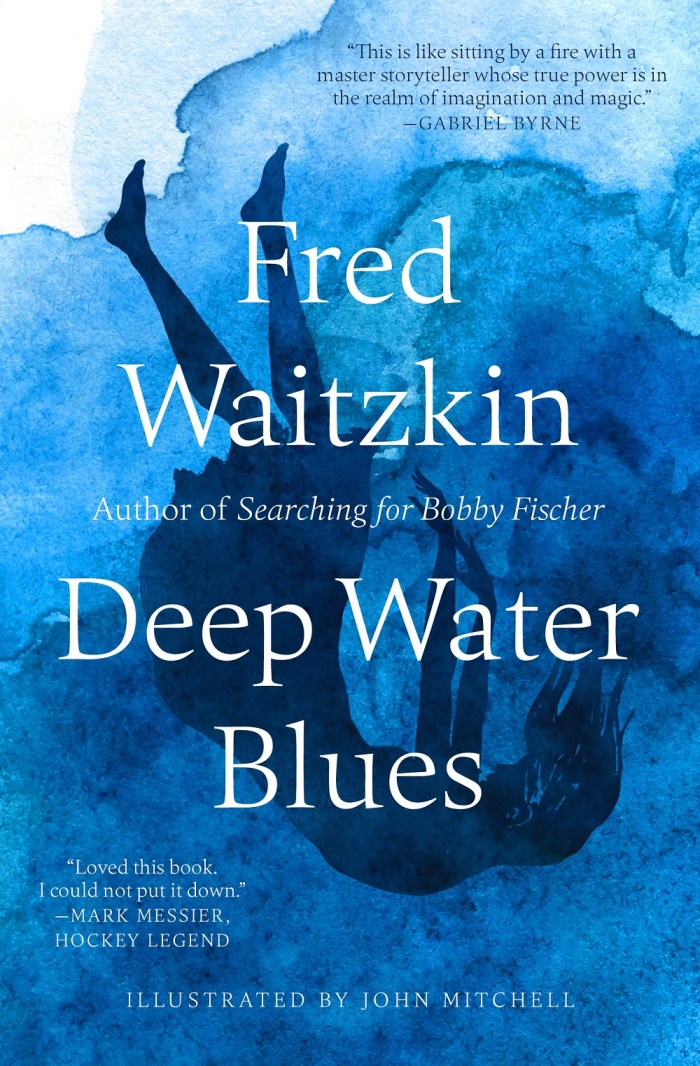
Book review: ‘Deep Water Blues’ by Fred Waitzkin

deepwaterblues
‘Deep Water Blues’ is the new novel by Fred Waitzkin. Courtesy photo: used with permission. 

Fred Waitzkin is an American novelist and writer for The New York Times, Sunday Magazine, New York and Esquire. His works include the books “Mortal Games,” “The Last Marlin” and “The Dream Merchant” but he is best known for his memoir “Searching for Bobby Fischer” about his son Josh Waitzkin, a chess prodigy. It was made into the 1993 Academy Award nominated movie of the same name. His new book “Deep Water Blues” is based on a true story about a Bahamian island that becomes a battleground for a savage private war. Illustrations courtesy of American artist John Mitchell.

“Deep Water Blues” takes place on the Bahamian island of Rum Cay, where Bobby Little, a charismatic character who is loved by many, uses his gifts to create businesses where rich tourists can live it up. He has many friends, but like anything else, his success elicits jealousy from others. The tranquility of this fisherman’s haven is spoiled when tragedy strikes. A boat transporting Haitian refugees crashes into the reef and capsizes, spilling everyone into the sea. Bobby and his friends try to help but end up burying most of them. The former paradise is now engulfed in gloom and horror and soon after, Bobby leaves for his annual European trip. He returns to find shoal covering the marina entrance, the beaches deserted and the small cemetery desecrated with bones sticking up through the sand. To top it off, someone has begun to develop the marina and undoing everything that Bobby had done. Dennis, his old friend, is responsible for all the changes and at first Bobby takes it lightheartedly but soon, he and Dennis lock horns and all hell breaks loose.

Fred Waitzkin successfully translates his love of the ocean, boats and fishing onto the written page in this delightful new book. By combining poetic prose “Stella’s dark blues were thickly textured like roiling ocean with intimations of agony rising from below like the cries of drowning sailors” and deep character development, readers get a front row seat to the majesty that is the beach life. His real boat, the Ebb Tide, makes an appearance, as do his friends, especially John Mitchell, whose drawings punctuate the storyline. The only downer is when some of Bobby’s dogs are poisoned but he eventually bounces back from that. The language is easy to understand and the story flows easily without any extraneous narration. With colorful characters and beautiful beach scenery, “Deep Water Blues” is the perfect summer beach read. It is a small book, only 140 pages, but its enchanting yet haunting story is recommended for fans who appreciate plot twists where good triumphs over evil.

*The author received a copy of this book for an honest review. The views and opinions expressed here belong solely to her.

Book review: ‘The Shaman’s Guide to Power Animals’ by Lori Morrison

poweranimals
‘The Shaman’s Guide to Power Animals’ by Lori Morrison is an informative and inspirational book on power animals. 

Lori Morrison is a best-selling author, inspirationalist and mystic who, combining her skills as a coach, spiritual counselor, healer and medical intuitive, has built a successful alternative wellness practice in Sedona, Arizona. She works with clients from around the world in supporting those who are looking for a renewed approach in dealing with physical and mental health issues. Her first book and memoir “Lori: The Disintegration of my Ordinary Reality” is a winner of four prestigious book awards, including the 2017 Gold Medal winner in the Living Now Book Awards. “The Shaman’s Guide to Power Animals” is her current book and a cross-cultural journey into the mystical symbolism and stories of almost 200 birds, fish, insects and mammals drawn from ancient and indigenous cultures worldwide.

“The Shaman’s Guide to Power Animals” begins with a Preface by the author in which she recounts her early childhood’s exposure to nature and animals courtesy of her father. These experiences influenced her adulthood as she and her husband shared a love of wildlife that took them to places like Yellowstone National Park and Alaska. The book is divided into two parts: Part One: The World of Shamans and their Power Animals that has sections with extensive information about The Three Worlds, the Types of Power Animals, Determining Your Power Animal and Calling in Your Power Animal; and Part Two: A to Z Guide to Power Animals where the reader can either read through each animal to learn about its characteristics and powers, or just use it to read up on his or her particular power animal. Towards the end, there is a List of Endangered Species, a Table of Powers and Minerals, a summary of the A to Z Guide and References, a list of reference material for anyone interested in learning more about the subjects presented.

Lori Morrison’s impressive new book is an extensive encyclopedia of knowledge regarding shamanism, the spiritual world and power animals. For readers who are interested in these subjects but are not too familiar with the basics, it explains in detail what the non-ordinary reality is (“a supernatural place…where we can connect to spirits and experience the past, present and future simultaneously”); The Three Worlds (Upper, Middle and Lower) that are accessed through chanting, drumming, dancing or consuming of medicinal plants; and how to determine what an individual’s  spirit animal is. It is insightful and thought provoking because even if readers have no interest in actually getting involved in spiritual ceremonies, they will walk away with a deeper understanding of how important it is for humans to be connected to nature and animals, which should be viewed as sisters and brothers instead of creatures to be mastered and manipulated for selfish gains. “The Shaman’s Guide to Power Animals” is recommended for fans of the mystical arts or anyone with an open mind who is willing to enrich their lives by learning more about nature, Mother Earth and the variety of animals and their characteristics and strengths.

“We need to interact with or observe animals in natural settings in order to truly see the planet as a whole. Perhaps the root cause of our planetary dysfunction and imbalance in this era of history is the disintegration of humanity’s connection to the spirit world in everyday life.”

*The author received a copy of this book for an honest review. The views and opinions expressed here belong solely to her.

Book review: ‘Dark Blossom’ by Neel Mullick

darkblossom
‘Dark Blossom’ is the exciting debut novel by Neel Mullick. Courtesy photo, used with permission. 

Neel Mullick is the Head of Product and Information Security at a Belgian family-office technology company and has degrees in Software Engineering from Carnegie Mellon, USA and Business Administration from INSEAD, France. He mentors women entrepreneurs through the Cherie Blair Foundation for Women, is involved in raising a generation of digital and socially-aware leaders with the Steering for Greatness Foundation (Nigeria), supports improvement in the quality of life of domestic workers at Emprendedoras del Hogar (Peru) and is helping IIMPACT (India) break the cycle of illiteracy plaguing young girls from socially and economically impoverished communities. In his new book “Dark Blossom,” the lives of Cynthia, a therapist, and Sam, her new client, intertwine in a story that shows a glimpse of what lies under the surface of apparently normal people.

“Dark Blossom” begins as Sam, who is struggling to deal with his son’s death a day before his thirteenth birthday, shows up at Cynthia’s office, seemingly ready to start counseling. His depressed demeanor and volatile mood say another story. Tragically, his son and wife were killed in an automobile accident which cruelly shattered his world. Cynthia has recently restarted her counseling practice after taking half a year to deal with a bitter divorce, so she sees in Sam a sort of kindred spirit who so desperately needs her help. At first she tries to brush off the similarities between them as coincidence, but when he meets her daughter Lilly, the pieces of the puzzle start coming together. Sam knows too much about their personal lives and as it turns out, he as well as Lilly have secrets. She has more to do with the death of Sam’s family than anyone knows and his presence in Cynthia and Lilly’s life is no accident.

Neel Mullick’s debut novel is part thriller/part drama and offers readers an inside view of a therapist’s mind as she deals with patients and how to properly treat them. Told in the first-person point of view of Cynthia, it starts off as a routine trip to a therapist’s office and soon unravels as situations are more complicated than they seem. Sam clearly is resisting Cynthia’s help, but it becomes evident that he has plans of his own. Even though it is a short book, the character development is excellent as it gives the necessary background needed to propel the plot forward. It is well written, with easy to understand language and the author tells the story without any extraneous information. Since this emotional rollercoaster of a novel is fast paced and a page turner, it can easily be read in a few days, but the plot twist and surprise ending will dwell in readers minds for days. To interact with them, the author has created a competition where readers can chime in with their opinions. Details and rules are available online. “Dark Blossom” is a suspenseful novel that packs an emotional punch and is recommended for readers who enjoy getting lost in the inner workings of the mind.

*The author received a copy of this book for an honest review. The views and opinions expressed here belong solely to her.

Book review: ‘The Book of Mistakes’ by Skip Prichard

bookofmistakes
‘The Book of Mistakes’ is Skip Prichard’s new book on creating a successful future. Courtesy photo, used with permission. 

Skip Prichard is an accomplished CEO, growth-oriented business leader and keynote speaker. He has spoken on topics such as leadership, personal development, growth strategies, culture, corporate turnarounds and the future of publishing. In his new book “The Book of Mistakes: 9 Secrets to Creating a Successful Future” he shares the nine mistakes that prevent many people from achieving their goals and how to overcome them to help reinvent their lives.

“The Book of Mistakes” begins with a Prologue set in England in 1425 where an unnamed monk is on a mission to hide the last of the ten copies he had transcribed from an ancient manuscript. His goal is to keep them from falling into the wrong hands until they can be distributed to the nine Teachers and the new Keeper. From there, the stories take off: one is in the present where David is living a generic life that includes an unreliable job, until he meets a young woman who jump starts a journey that changes his life forever. The other story take place in the American colonies in 1771 and centers around Aria, a teenager who is trying to fulfill her sick Uncle Raymond’s last wish. She needs to retrieve a manuscript from the family home and protect it at all costs. The two stories eventually coincide as David crosses paths with several strangers he names the Playwright, the Bartender, the Artist and so on, who each give him one “mistake” that he can learn from to improve his life. These include, among others, “working on someone else’s dream,” “allowing some else to define your value” and “surrounding yourself with the wrong people.” As he gets each life lesson, he finds his life slowly improving until he is ready to share them with others.

At first glance, it seems that this is a self-help book, which it is. But it is a self-help book cleverly disguised as an adventure complete with an ancient origin story and a scavenger hunt of sorts. This makes learning fun as the reader goes along with David as he meets these strangers who share their knowledge with him, eagerly flipping pages to get to the next “mistake.” Without giving too much of the content away, the advice that Skip Prichard gives may sound like common sense, but sometimes it is necessary to be reminded that it is indeed a mistake to “stay in your comfort zone” and “blend in instead of standing out.” He does so without sounding condescending and in language that is easy to understand and filled with details and imagery. Since the sections are conveniently divided by Mistakes and Laws, it is easy to refer back to them as needed. Highlights include Mistake #9: Believing You Have All the Time in the World and Mistake #6: Allowing Temporary Setbacks to Become Permanent Failures. Self-help books tend to be dry and boring and therefore difficult to get through to get much needed advice, but this is a fast-paced book, similar to Dan Brown’s “The DaVinci Code.” “The Book of Mistakes” brilliantly combines advice and a storytelling to get the message across and is recommended for readers who enjoy a suspenseful story jam-packed with life lessons.

“…on the one hand, live each day as if it’s your last and, on the other, as if it’s your first. Your last keeps you focused on what really matters…Your first is important because you also must have a longer view, or you will never accomplish the goals that are hard and take longer.”

*The author received a copy of this book for an honest review. The views and opinions expressed here belong solely to her.

Book review: ‘Let Go of Emotional Overeating’ by Arlene B. Englander

emotionalovereatingArlene B. Englander, LCSW, MBA is a Columbia University trained licensed psychotherapist who has created health promotion programs on stress management, emotional overeating and other subjects for hospitals, corporations and law firms. Currently in private practice in North Palm Beach, she specializes in helping emotional overeaters move past their emotional issues to lead happier and healthier lives. “Let Go of Emotional Overeating and Love Your Food: A Five-Point Plan for Success” is her psychologically centered program to help people learn to eat whatever they like and stop just at the point of satisfaction without overeating.

Emotional overeating is “eating neither for enjoyment nor for the satisfaction of hunger, but in a desperate attempt to distract oneself from painful thoughts and feelings.” As a former emotional overeater, the author offers psychologically sound techniques for recognizing the symptoms of overeating and methods for addressing it in effective and enjoyable ways.

“Let Go of Emotional Overeating” begins with an Introduction, where she lists the sobering statistics from a 1999 article in American Demographics that stated that 54% of Americans clean their plates even when they are full and that 19% continue to eat even when they are stuffed. Her main purpose in writing this book is to help readers cope with life’s stressors without using food as a crutch and instead get more enjoyment out of food and life. The book is divided into ten chapters: the first two deal with the difference between truly tasting and savoring food versus using it as a stress reliever and how destructive diets really are; the rest explain how to deal more effectively with stress, how to learn to love exercise and how to eat at parties, vacations and with friends and family.

The subject of overeating can be hard to navigate but it is helpful to have someone who has been there and understands the struggles involved. This gives Arlene Englander the credibility to write such an insightful book that gives readers hope that they too can successfully manage the issue. Mindfulness has become mainstream lately and that, along with self-awareness, is the breakthrough method of dealing with overeating. She effectively uses her own experiences, case illustrations and humor to relate to her readers. The language is plain and simple to understand without too much medical and psychological terminology. Highlights include Chapter 3, where she explains how readers can spot the symptoms of excessive stress and Chapter 5 which gives readers the RAFT technique she uses to enjoy a meal so that they too can determine when they are full so they can stop eating. Also helpful is Chapter 6, as it gives helpful tips on learning to eat healthier foods. “Let Go of Emotional Overeating” is an incredibly useful resource guide and is recommended for readers who wants to learn how to stop letting food control their lives.

“The beauty of learning to soothe ourselves-on our own, or with the help of others-is that it enables us to seize the power that food once held for us.”

*The author received a copy of this book for an honest review. The views and opinions expressed here belong solely to her.

Book review: ‘The Hidden Worlds’ by Sandra Ingerman and Katherine Wood

hiddenworlds
‘The Hidden Worlds’ by Sandra Ingerman and Katherine Wood is an interesting look at friendship and magic. Courtesy photo: used with permission. 

Sandra Ingerman is an award-winning author of twelve books, including ‘Soul Retrieval: Mending the Fragmented Self,’ ‘Medicine for the Earth’ and ‘The Book of Ceremony: Shamanic Wisdom for Invoking the Sacred into Everyday Life.’ She is also a renowned teacher on shamanic journeying, healing and using spiritual methods to reverse environmental pollution. Katherine Wood taught reading and writing to middle and high school students for 31 years. She is a shamanic practitioner and teacher as well as an avid reader, writer and journeyer who loves to travel in both ordinary reality and in the hidden worlds. They are co-authors of ‘The Hidden Worlds,’ a novel for young readers about four middle school students who work together for a common purpose even though they are completely different people.

The protagonists in ‘The Hidden Worlds’ are middle school aged students. It begins with a look into Isaiah’s life, complete with home and school drama. Then come Magda, the popular soccer star whose goal in life is to get a soccer scholarship for college, George, the quiet boy who is frequently bullied because he requires “special services” and Rose, the Chinese girl who is always angry and gets into trouble for fighting. One day, they are playing near the forest when they come across several dead birds and are compelled to work together and find out what is poisoning and killing off the wildlife. They get together and brain storm in shared dreams, where they each find their power animal: Isaiah has a great grizzly bear, George an octopus, Rose a giraffe and Magda a black panther. Their dreams lead to real life adventures when they discover a toxic waste plant illegally disposing of poisons. Strangers in the beginning, their friendships grow as they work together with their Power Animals to close down the plant.

Isaiah, George, Rose and Magda are normal middle schoolers who are dramatically different but have similar interests that bring them together as they work for a common cause – the environment. In ‘The Hidden Worlds,’ shamanism is introduced in a nonchalant way when they need guidance and feel no one can help them when they desperately want to make a difference. Wikipedia defines Shamanism as “a practice that involves reaching altered states of consciousness in order to perceive and interact with the spirit world and channel those transcendental energies into this world.” The chapters are short and the story is easy to read and understand. It may be a small book, but it touches on important topics such as bullies and the importance of standing up for yourself, school drama, puberty, environmental concerns and shamanism. Stand out chapters include Chapter 16: Organizing, which explains how cause and effect works when the environment is concerned and Chapter 13: Journeying – it explains what journeying means and the kids learn what the Hidden Worlds are and how shamans help people communicate with spirits. Aside from having the usual teen drama such as school, family life and personal issues, ‘The Hidden Worlds’ also touches on magic, spirit guides, power animals and journeying. It is recommended for readers of any age with an interest in these topics and who have an open mind and are willing to discover new ways of seeing the world.

*The author received a copy of this book for an honest review. The views and opinions expressed here belong solely to her.

Book review: ‘Cyber Smart’ by Bart R. McDonough

cybersmart
“Cyber Smart” is the new book by Bart McDonough on the subject of cyber security. Courtesy photo, used with permission.

Bart McDonough attended the University of Oklahoma and received his undergraduate degree from the University of Connecticut. He is CEO and Founder of Agio, a hybrid managed IT and cybersecurity services provider where he and his more than 250 employees have developed cybersecurity and managed IT tools tailored to protect businesses’ most precious assets: money and reputation. Bart is currently on the board of two cybersecurity firms, TwoSense.AI and Magnus Cloud and has just released his debut book “Cyber Smart: Five Habits to Protect Your Family, Money, and Identity from Cyber Criminals.” This easy to read guide simplifies good cyber hygiene and debunks common cybersecurity myths to help readers protect themselves and their families from identity theft, fraudulent schemes, hacking and more.

Cybersecurity can be a complicated subject because the Internet has overtaken everything, from banking, healthcare and personal communication. As an expert in the cybersecurity field, in “Cyber Smart,” Bart McDonough “combines his knowledge with real-world examples of cyberattacks and how to prevent them as well as how to recover from them.” It begins with the Introduction, where the author provides specific recommendations anyone can use to protect themselves against cyberattacks and scams including: Update Your Devices, Enable Two-Factor Authentication, Use a Password Manager, Install and Update Antivirus and Back-Up Your Data. The book is divided into twenty-one chapters, proof that he covers almost every subject imaginable, including Overview of Cyber Risks, Attack Targets and Goals, Attack Methods, Incident Response, Protecting Your Identity, Protecting Your Money and Protecting Your Social Media.

“Cyber Smart” makes cybersecurity accessible to the general public by being easy to read, informative and extremely organized. Readers can read it cover to cover to gain valuable information to protect their daily digital lives or pick a subject/chapter, by using the Index, to increase their knowledge and become better prepared to deal with the risks. This useful guide not only touches on the risks associated with an increasingly plugged-in society, but gives insights into how hackers think, why they do what they do, and what they do with stolen information. In Chapter 5: Attack Targets and Goals, Mr. McDonough explains that in the healthcare industry, stolen ‘personally identifiable information’ (PII) is used to gain access to healthcare treatment, prescription dugs and medical equipment. It is best to keep in mind that these attacks are not personal, that “bad actors are looking to get rich off the attacks they perform.” Stand out chapters include Chapter 4: Attack Methods where he explains the different scams, including Malware, Crypto mining and Spyware and recommends using multiple email addresses for different purposes, such as banking, social media and shopping; and Chapter 9: Incident Response where he goes into details about what to do once an attack occurs. The definitive reference guide for cybersecurity, “Cyber Smart” is recommended for readers who understands that the risks are out there and are looking to arm themselves with the knowledge to protect their digital lives.

“There are around 4,000 data brokers in the United States that are in the business of purchasing and selling personal information – things we would normally not share with others, let alone give knowing permission to corporations to store and resell it.”

*The author received a copy of this book for an honest review. The views and opinions expressed here belong solely to her.

Book review: Tug Wyler Mystery series by Andy Siegel

andysiegel
Andy Siegel is a personal injury lawyer and author of the Tug Wyler Mystery series. 

Andy Siegel is a graduate of Tulane University and Brooklyn Law School and a personal injury and medical malpractice attorney in New York City. His many trial successes have regularly placed those outcomes among the “Top 100 Verdicts” reported in the state annually. After sharing a trial story with a mom at his kids’ baseball game, he was encouraged to write them down, which led to the Tug Wyler Mystery series. The series consists of ‘Suzy’s Case,’ ‘Cookie’s Case,’ which was selected as a Conversations Book Club Top 10 Beach Read, ‘Nelly’s Case,’ ‘Elton’s Case’ and ‘Jenna’s Case.’ At the heart of each is Tug Wyler, a colorful, cocky and self-deprecating personal injury lawyer.

‘Jenna’s Case’ is about Jenna Radcliff, a teenager who is the victim of a cosmetic surgeon willing to put greed above his oath to do no harm. It begins as she is going in to surgery and has flashbacks of how she got there. She is a competitive double-Dutch rope-jumper who is self-conscious about being big-breasted and agrees to a reduction surgery set up by her con-man step-father. Instead, she gets a total breast reduction that leaves Jenna not only physically scarred but a shell of the bright and energetic teenager she used to be. Her scheming step-father will do anything to get the money Jenna has inherited, including putting her life at stake.

The client in ‘Nelly’s Case’ is Nelly Rivera, a young woman who, because of dental anxiety, goes to Dr. Grad, know as the Painless Dentist, who uses general anesthesia. Shortly after being hooked up to the IV, she stops breathing and is rushed to the hospital where she falls into a coma. Eventually she comes out of it, but Dr. Grad insists that it was an unfortunate anaphylactic reaction. Rather than drag litigation out and risk his career and family, he settles out of court but ends up being sued by the city for negligence. The money trail targeted Nelly who was recently set to inherit a large sum of money from her father’s life insurance after he died in a house fire.

‘Elton’s Case’ is the case involving Elton Jerome Cribbs, who was wrongly convicted of a crime. His situation goes from bad to worse when he is injured during a prison transport and left paraplegic. Now in a wheelchair, he is seeking justice for his wrongful imprisonment while rejecting any kind of pity. The City of New York offers him millions to settle but maintains their stance that he is faking his injuries. It turns out they were right and Tug is stuck in the middle, struggling to distinguish the bad guys from the guys and truth from fiction.

Personal injury lawyers tend to get a bad reputation and their efforts to get justice often goes unnoticed, until Tug Wyler came along. This is a fascinating series centered around a flawed, but charming lawyer who frequently admits his mistakes and schemes and simply says “at least I admit it.” His lies frequently catch up to him and he is haunted by his past but in his mind he does what he has to do. He has been kidnapped, assaulted, held in contempt of court and blackmailed into taking cases he does not want. The novels start with ‘The Unfortunate Event’ and are written in the first-person point of view of Tug in plain English and are easy to understand and follow. There is courtroom drama with details of the cases including medical backgrounds and insight into Tug’s mind and analysis of his actions. The characters are well developed and sometimes other cases are mixed in to emphasize how lawyers usually handle more than one case at a time. These page-turners and are recommended for fans of courtroom dramas similar to John Grisham as well as mysteries and medical dramas.

“It’s common to diss personal injury lawyers-ambulance chasers they call us. But just remember: anyone, in an instant, can become a victim. Even you.” – Andy Siegel

*The author received a copy of this book for an honest review. The views and opinions expressed here belong solely to her.

Book review: ‘Becoming Starlight’ by Sharon Prentice, PhD

becomingstarlightSharon Prentice, PhD is a Licensed Clinical Pastoral Counselor and a Board-Certified Spiritual Counselor. Soon after completing her graduate studies in psychology, Dr. Prentice found the world of secular psychology lacking – her patients needed “something more.” She set out to investigate and explore alternative methods in the field of mental health that would incorporate that “something special” she believed existed in each and every individual soul. Because of her unusual experience with death, she developed an interest in death and dying and investigated and interviewed patients who were in the dying process and people who had experienced Near Death Experiences or Shared Death Experiences. Her new book “Becoming Starlight: A Shared Death Journey from Darkness to Light” is a thought-provoking book that opens the conversation regarding the afterlife, including NDEs and SDEs.

A Near Death Experience is defined as a personal experience associated with death or impending death that includes feelings of detachment from the body, feelings of levitation, total serenity, security and warmth, among others. A Shared Death Experience is similar, but occurs not to the person dying, but to someone who is physically well and completely unaware that a loved one is close to dying. They witness the aftermath of death via powers outside their control. The author experienced such an SDE which was tied to the passing of her husband.

“Becoming Starlight” begins with A Note from the Author and a Foreword by Dr. Raymond Moody where he explains that, aside from discussing NDE and SDE, “the book will also bring comfort to those who are feeling unrelenting grief over lost loved ones.” The Introduction serves to define what NDEs and SDEs are and how they are similar. There are fifteen chapters in all and the first few chronicle her personal life and the deep losses that brought her to the point where she was angry at God and viewed death as cold and inflexible. Chapter 11: Becoming Starlight describes her Shared Death Experience that changed her perspective on life, death and God.

In this deeply personal book, Sharon Prentice shares her long and difficult journey to find inner peace and cope with the death of her daughter and husband, all while trying to reconnect with God. Even though the subject matter may be difficult at times, including the details of her husband’s illness and deteriorating health, some readers may find solace in knowing that others, like themselves, have also experienced such hardships. The language is easy to understand and the story flows from chapter to chapter and makes it a page turner for the target audience. In this case, it is the religious community that may find themselves questioning their faith and are looking for reassurances that in the end, their faith is not in vain. Sometimes the tone is unforgiving to scientists, science and those who do not believe in the afterlife and may turn off some readers. Regardless, the highlight is definitely the author’s description of her Shared Death Experience as it comes across as a beautiful experience that surrounded her with love, hope and comfort when she needed it most. “Becoming Starlight” is recommended for readers who are genuinely interested in the afterlife and need the comforting words of someone who, despite heartbreaking losses, came out a better person.

“Becoming Starlight is….an account, my account, of a Soul’s journey that leads to an unraveling of a lifetime of beliefs about God and our very existence in this universe.”

*The author received a copy of this book for an honest review. The views and opinions expressed here belong solely to her.

Book review: ‘Say What You Mean’ by Oren Jay Sofer

saywhatyoumean
‘Say What You Mean’ is the intriguing new book by Oren Jay Sofer on improving communication skills. Courtesy photo, used with permission. 

Oren Jay Sofer is the founder and Guiding Teacher of Next Step Dharma, an innovative online course focused on bringing the tools of meditation to daily life, and co-founder of Mindful Healthcare. He holds a degree in comparative religion from Columbia University and is a Somatic Experiencing Practitioner, a Certified Trainer of Nonviolent Communication and leads mindful communication retreats and workshops throughout the United States. His new book “Say What You Mean: A Mindful Approach to Nonviolent Communication” is a practical guidebook for having more effective and satisfying conversations.

Communication is an important part of everyday life with speech being one of the most effective and widely used forms of communication. Words have the power to heal or destroy and it is up to the individual to determine what kind of vibe he or she wants to give out to the world. In the Introduction, Oren Jay Sofer writes that during his life’s journey, he has worked to integrate his understanding of Buddhist meditation and Nonviolent communication. The book as a whole is a collection of three distinct streams of practices: mindfulness, Nonviolent Communication and Somatic Experiencing (emphasizes the role of the nervous system regulation in resolving trauma). They are tools for deepening self-understanding and transforming habits of communication. The three steps of communication include: lead with presence, come from curiosity and care and focus on what matters. These steps form the basis of “Say What You Mean” and divide the book into four parts: The first step: lead with presence, The second step: ‘come from curiosity and understanding,’ The third step: ‘focus on what matters’ and ‘bringing it all together.’ Useful indices at the end include Notes by Chapter, Glossary, Resources and Index of Practices by Topic.

There is always room for improvement when it comes to communication. In “Say What You Mean,” Oren Jay Sofer offers the reader a practical and useful guide to improving this often overlooked but vital skill. In today’s volatile environment, it has become more important than ever to be able to communicate clearly and in a non-violent manner to ensure everyone is heard. The author has done an impressive job of laying out the elements of communication in simple and easy to understand terms. Highlights include ‘emotional agility’ in Part Three where it states that defining emotions is a critical part of communication and ‘the flow of dialogue’ in Part Four where the author summarizes the different components of dialogue: speak, listen and rest in presence. The chapters are peppered with practice exercises, Q and A from real people, principles and key points to summarize the material along the way. Especially helpful are the quick reference guides at the end: Summary of Principles and Useful Communication Phrases. “Say What You Mean” is recommended for readers who wish to improve their communications skills as well as their interpersonal skills while getting to know themselves.

“If you take nothing else from this whole book, I hope you will take with you the importance the intention to understand, to come from curiosity and care, has in your interactions.”

*The author received a copy of this book for an honest review. The views and opinions expressed here belong solely to her.