
The San Antonio Museum of Art (SAMA) recently announced that it will present Roman Landscapes: Visions of Nature and Myth from Rome and Pompeii in February 2023, the first exhibition in the United States to explore landscape scenes as a genre of ancient Roman art. Serving as a contrast to the typical works of antiquity with which most museum audiences are familiar—the larger-than-life statues venerating gods or heroes, or scenes of battle or ritual found on friezes or pottery—these works instead depict artists’ idyllic visions of a countryside dotted with seaside villas and rural shrines, where gods and mythological heroes mingle with travelers, herdsmen, and worshippers. (San Antonio Museum of Art, 2023)
Organized by and presented exclusively in San Antonio, Roman Landscapes features more than 65 works, including major loans from museums in Italy, France, and Germany, many of which have never before been shown in the United States. The exhibition was curated and organized by Jessica Powers, SAMA’s Interim Chief Curator and Gilbert M. Denman, Jr., Curator of Art of the Ancient Mediterranean World, and will be on view at SAMA from February 24 through May 21, 2023.
Roman Landscapes will be accompanied by a richly illustrated catalogue published by the museum, featuring essays by Powers; Bettina Bergmann, Professor Emeritus of Art History at Mount Holyoke College; Verity Platt, Professor of Classics and History of Art at Cornell University; Lynley J. McAlpine, Mellon Foundation Postdoctoral Curatorial Fellow at SAMA; Timothy M. O’Sullivan, Professor of Classical Studies at Trinity University; and Thomas Fröhlich, Director of the Library at the German Archaeological Institute in Rome. In conjunction with the exhibition, Trinity University will dedicate its spring Lennox Seminar Lecture Series to subjects explored in the museum’s presentation.
Developed through several years of research that began with Powers’ explorations of works in SAMA’s own notable collection, Roman Landscapes will feature an array of wall paintings, sculptures, mosaics, and cameo glass and silver vessels created in Roman Italy between 100 BC and AD 250. The exhibition will introduce visitors to their cultural and archaeological contexts and highlight the artistic conventions that distinguish Roman landscape scenes, including fluid, almost impressionistic brushwork and the use of bird’s-eye perspective.
The exhibition is organized around five thematic sections. The first, “Garden Landscapes,” brings together paintings and sculptures from houses in Pompeii and nearby villas on the Bay of Naples to evoke the experience of a Roman peristyle garden. “Coastal Views and Cultivated Landscapes” and “Sacred Landscapes” present mural paintings and relief sculptures that depict seascapes and rustic shrines, images that show how landscape scenes once decorated lavish Roman residences. In “The Dangerous Landscapes of Myth,” mythological paintings then reveal landscape scenes as settings for hazardous encounters between humans and the gods, presenting visually the oft-told stories that served as warnings about individual or community behavior. The last section, “Landscapes in the Tomb,” compares wall paintings from communal tombs in Rome with those from houses and explores the adaptation of landscape imagery for funerary settings.
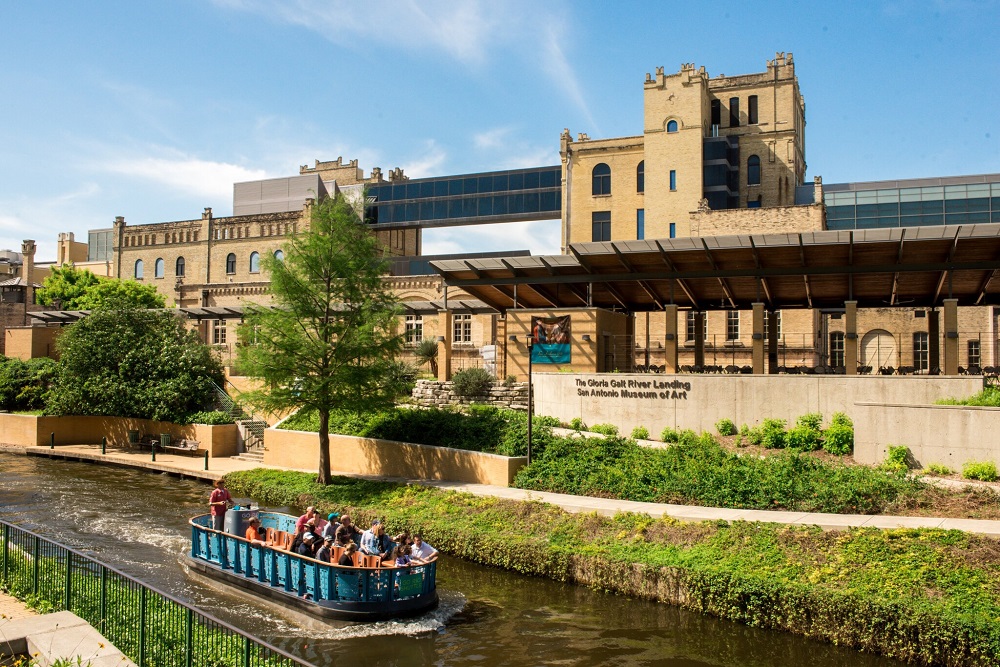
San Antonio is the nation’s seventh-largest city and is consistently listed as one of its fastest-growing. The Museum is housed in the historic Lone Star Brewery on the Museum Reach of San Antonio’s River Walk and is committed to promoting the rich cultural heritage and life of the city. It hosts hundreds of events and public programs each year, including concerts, performances, tours, lectures, symposia, and interactive experiences. As an active civic leader, the Museum is dedicated to enriching the cultural life of the city and the region, and to supporting its creative community.
 SA Examiner