
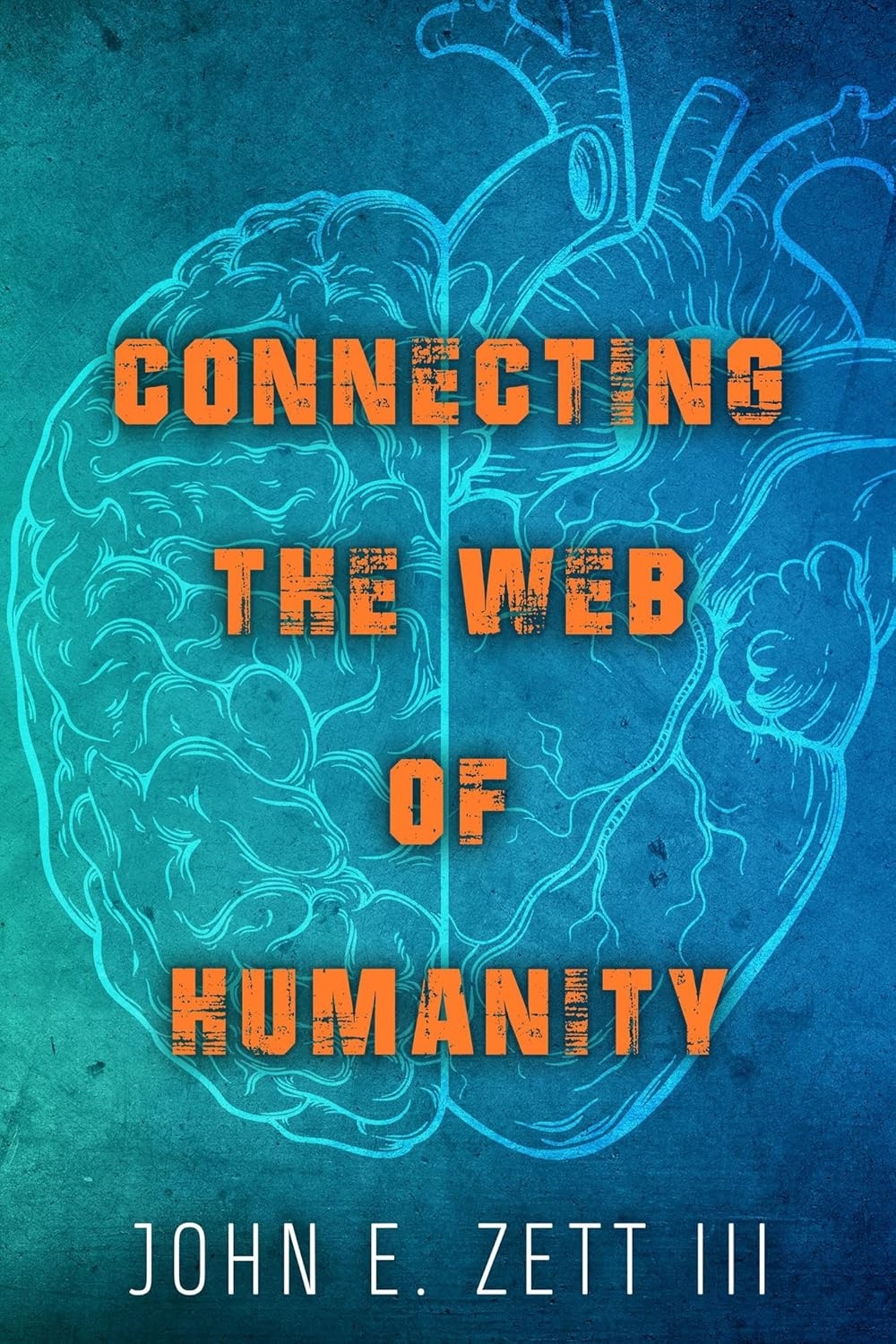
“Connecting the Web of Humanity” by John E. Zett III is an exploration of the human condition as it relates to love, sex, and interpersonal relationships.
Set up as a journal/memoir, it begins on Sunday November 3, 2002 where Zett establishes that authors don’t write books, that instead, they write manuscripts that publishers turn into books that hopefully sell copies. This sets the tone upfront as he combines his personal story of becoming a published author with reflections on topics such as human sexuality, the intricacies of the human soul, the challenges facing the book industry, and the ongoing debate about marijuana legalization.
His philosophical musings center around the three sides of our humanity: the body, mind, and soul, and how if we go through life with an open mind, we can establish a deeper connection with others. By sharing his personal struggles, such as the challenges of owning a small business with his wife, dealing with his father’s health problems, and balancing work and family, he connects with readers on a deeper level.
I appreciate his candidness and his ability to approach complex and often controversial subjects with a sense of depth and understanding. He doesn’t shy away from his own vulnerabilities, offering an authentic and sometimes raw portrayal of his experiences. This book challenges readers to reconsider societal norms and rethink their own perspectives on issues like sex and the soul. Especially insightful is his ‘live and let live’ view of life, but he also emphasizes personal accountability: “If you don’t hold onto your personal reins, who does?”
One of the most fascinating aspects is his commentary on the book industry, giving readers a behind-the-scenes look at what it takes to become a published author in today’s rapidly changing world. His unique insights make the book a valuable resource for aspiring writers and anyone interested in the evolving landscape of the literary world.
By using a stream-of-consciousness narrative style that he calls Extreme Creative Nonfiction, and presented in a memoir/journaling format, he relates to readers in an informal and personal way. It’s almost as if he’s speaking to them directly, albeit with a few curse words here and there. Be advised that his discussions on sex can get honest but descriptive.
The language is vivid and humorous: “Sometimes, I go off like the popcorn kernels in a microwavable bag of Explode-O-Pop Popping Corn…” Since the narrative switches back and forth between his personal story and his professional struggles to make it as an author, it can be hard to follow at times, but it fits with the journal-like presentation.
Overall, “Connecting the Web of Humanity” is an engaging, thought-provoking work that will resonate with readers interested in exploring life’s biggest questions. It is recommended for fans of philosophy and social sciences who also appreciate learning about the reality of getting published.
“Everybody is their own individual. Everything is what it is. And we are what we are. People are people.”
*The author was contacted for an honest review of this book. The views and opinions expressed here belong solely to her.


 SA Examiner