Book review: ‘Can Business Save the Earth?’ by Michael Lenox and Aaron Chatterji

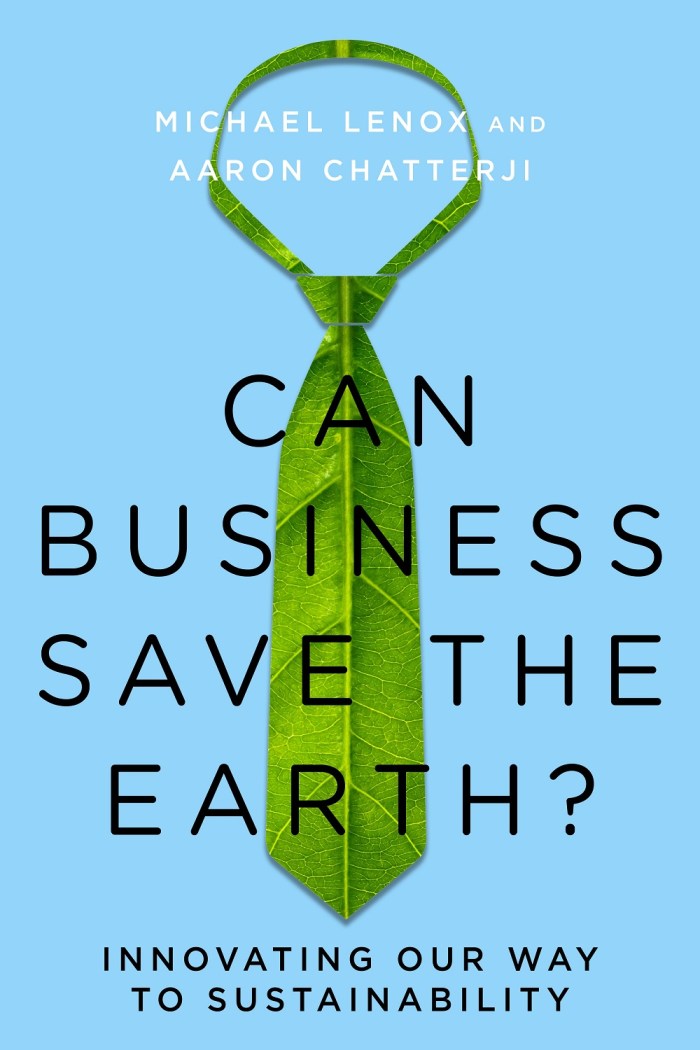
canbusinesspic
‘Can Business Save the Earth?’ tackles the subject of climate change and how businesses can make a difference.  Courtesy photo, used with permission.

Michael Lenox is the Tayloe Murphy Professor of Business Administration and Senior Associate Dean and Chief Strategy Officer at the University of Virginia’s Darden School of Business. His work has been cited by the New York Times, the Financial Times and the Economist. Aaron Chatterji is Associate Professor of Business and Public Policy at Duke University’s Fuqua School of Business. His research has also been cited by the New York Times, CNN, the Wall Street Journal and the Economist. Together they are the authors of ‘Can Business Save the Earth? Innovating Our Way to Sustainability’ now available everywhere. They share their findings on how multiple sectors can minimize environmental impact while driving economic growth.

‘Can Business Save the Earth?’ begins with a Preface that does not shy away from explaining how climate change poses a threat to humanity’s ability to flourish on this planet. Dealing with this issue will require action by not only business but by scientists, inventors, investors, customers, policy makers and activists. The book’s objective is to figure out how to bring these industries together to create the innovations that will address the current environmental crisis and make a difference. Each group is a chapter, Chapter 1 is Business as Savior, Chapter 2 is Innovator as Genius and so forth, that illustrates how each can help make this a greener planet.

Climate change is at the heart of ‘Can Business Save the Earth?’ and the authors do an impressive job of laying out how to start making a difference. With more than a decade of research in the subject, they conclude that it takes work and dedication from companies and individuals who care enough about the planet. The topic of business might seem boring, but the language is down to earth and easy to understand so that anyone who is interested in climate change, sustainability and green matters can appreciate the content. They notate their research at the end with a Notes section that is divided by chapters. Chapter 2, Innovator as Genius, stands out because it summarizes that even if one person comes up with a solution, it is not enough because it takes everyone from the corporate R & D office to the consumer, to make ultimately save the Earth. It is a must read for anyone who is serious about climate change and honestly wants to learn how the system works in creating greater sustainability.

“We all have the power, in one way or another, to serve as catalyst. The question before us, all of us, is whether we will take the actions today to create the conditions under which the innovation system can thrive.”

*A copy of this book was given for an honest review. The opinions expressed here are solely the author’s.

Book review: ‘Quietus’ by Vivian Schilling

quietuspic
‘Quietus’ is a suspenseful thriller by Vivian Schilling.  Courtesy photo used with permission.

Vivian Schilling is an American novelist, screenwriter, actress and independent filmmaker. The award-winning author has written the novels ‘Sacred Prey’ and ‘Quietus,’ both of which take place in a supernatural setting and tackle the themes of immortality, existentialism and religious conflict. ‘Quietus’ is a psychological thriller about a young woman brought back from the brink of death to find the world around her forever altered. It will be reissued on Tuesday February 27, 2018.

At the beginning of ‘Quietus,’ Kylie O’Rourke, her husband Jack, her best friend Amelia Blackwell and her husband Dix Hamilton are aboard a small plane headed for Boston through the White Mountains. The flight is uneventful until the weather takes a turn for the worse and the plane goes down in sub-freezing temperatures. Kylie wakes up in the hospital still groggy from the medication and afterwards starts having memories of the crash and events the other survivors do not remember. Putting all that aside, she returns to her normal life, but the memories, nightmares and visions remain, and she starts questioning the events of that night and her own sanity. As the other survivors start dying from suicide, accidents and other tragic deaths, she becomes increasingly paranoid and desperate to filter the real from the imaginary in a desperate attempt to escape a supernatural force determined to even the scales of fate.

It is difficult to describe exactly what type of novel ‘Quietus’ is. Part psychological thriller, part sci-fi/fantasy, it is a suspenseful tale that grabs the reader and does not let go until the shocking conclusion. The language is easy to understand and at 500-plus pages, the action does not falter. As each character succumbs to the inevitable in the Final Destination-like storyline, it is heart-breaking to see them go. Fans of art history are in for a treat in Book Two, Chapter Eighteen when one of Kylie’s clients, an art connoisseur, starts explaining the background of the statues that have Kylie so intrigued. Beautifully written, the fantasy sequences are incredibly realistic and haunting. The personification of Death as someone from Kylie’s past is genius, and, in the end, Death collects the souls it is due because they were never meant to survive the accident. ‘Quietus’ is recommended for fans of gothic novels who appreciate aspects of fantasy, suspense and psychological thrillers mixed in just to keep things interesting.

*A copy of this book was given for an honest review. The opinions expressed here are solely the author’s.

Book review: ‘All Systems Down’ by Sam Boush

allsystemsdown
‘All Systems Down’ is the debut novel by Sam Bousch.  Courtesy photo: used with permission.

Sam Boush is a novelist and award-winning journalist who has worked as a wildland firefighter and as owner of a mid-sized marketing agency. He is a member of the Center for Internet Security, International Information Systems Security Certification Consortium and Cloud Security Alliance. ‘All Systems Down,’ his first novel, is a cyber war thriller that unites a group of strangers whose must depend on each other’s skills to survive the oncoming chaos.

‘All Systems Down’ begins aboard the USS Gerald R. Ford where Lieutenant Kelly Seong and Lieutenant Orion Bether are in the middle of 4a.m. drills. After their communication radios malfunction, they are forced to head back to the supercarrier and are shocked when its lights start shutting down and the instruments aboard their jets start to fail. This is only the beginning of mass cyber-attacks that cause electrical grids to fail, satellites to crash to earth and widespread cell phone and internet crashes. With massive black blackouts across America and a foreign enemy creeping up on its shores, survivors like Brendan Chogan, whose job interview was interrupted by an outage, and Ireana and Annalore, who were on a camping trip, will have to work together to get through the next few days. They are the innocent victims of the North Korean military determined to topple the enemy’s infrastructure.

With his debut novel, Sam Boush proves that he deserves to be listed with the likes of Tom Clancy, David Baldacci and Dan Brown. Right from the beginning, readers are in for a thrill ride as the lives of every day people are abruptly interrupted by a series of computer viruses. Both heroes and villains are well-developed and include various nationalities. The action flows easily from chapter to chapter and even though there is some military and computer jargon involved, it is easy to follow and understand. As cities fall, the scariest animal is a cornered and scared human. Despite being a work of fiction, it is not hard to envision a real-life scenario where worldwide destruction comes via a keyboard. It is a must-read and recommended for fans of thrillers and suspense novels with apocalyptic/disaster storylines. With a subtitle of ‘The Cyber War – Book 1’ hinting of more to come, this series, with its compelling characters and every-day heroes will keep readers asking for more.

*A copy of this book was given via NetGalley for an honest review. The opinions expressed here are solely the author’s.

Book review: ‘If I Understood You, Would I Have This Look on My Face?’ by Alan Alda

alanaldabook
‘If I Understood You, Would I Have This Look on My Face?’ is the best selling book by Alan Alda about the importance of communication.

Most people know Alan Alda from the classic television series M*A*S*H, but he is also a writer and director. He hosted the award-winning series Scientific American Frontiers for eleven years and founded the Alan Alda Center for Communicating Science at Stony Brook University. His previous books include “Never Have Your Dog Stuffed: And Other Things I’ve Learned” and “Things I Overheard While Talking To Myself.” “If I Understood You, Would I Have This Look on My Face?: My Adventures in the Art and Science of Relating and Communicating” is his most recent release. In it, he tells the story of his quest to learn to communicate better and to teach others to do the same and how to develop empathy.

The central theme in “If I Understood You, Would I Have This Look on My Face?” is communication and the author gives readers creative ways they can improve their skills. It is divided into two parts: 1. Relating Is Everything with chapters like The Mirror Exercise, Listening from the Boardroom to the Bedroom and Training Doctors to Have More Empathy and 2. Getting Better at Reading Others with chapters like Working Along on Building Empathy, Dark Empathy and Reading the Mind of the Reader. He uses examples from his own life to demonstrate the importance of being able to communicate with each other and what happens when wires get crossed. His aim is to teach people to develop their empathy skills because this is where cooperation and understanding is born. This can be done by looking for clues in another’s face and learning to read the other person.

In simple terms and easy to understand language, Alan Alda has written an excellent guide for anyone who wants to improve their interpersonal skills. His personal anecdotes are entertaining and informative. A standout chapter is Working Alone on Building Empathy where he discusses meditation and bonding to start improving oneself. Overall, it is an interesting take on the importance of communication skills that is as useful in today’s atmosphere as it ever was. It is a highly recommended read, especially for those on a journey of self-discovery and improvement.

*A copy of this book was given for an honest review. The opinions expressed in this article are solely the author’s.

Book review: ‘Grief Cottage’ by Gail Godwin

griefcottage
‘Grief Cottage’ is Gail Godwin’s novel about a young boy sent to live with his great aunt on a South Carolina island.

Gail Godwin is a novelist and short story writer whose body of work includes 14 novels, two short story collections, three non-fiction books and ten musical works. A three-time National Book Award finalist, she has written more than a dozen critically-acclaimed books including the novels “Flora,” “Father Melancholy’s Daughter” and “Evensong.” Her most recent novel is “Grief Cottage,” a book about a young boy who goes to live with his great aunt when his mother is killed in an automobile accident.

The main character in “Grief Cottage” is Marcus, an eleven-year-old boy who is sent to live on a small South Carolina island with his great aunt Charlotte. Charlotte is a woman of few words and a reclusive painter with a haunted past. Since she spends most of her time in her studio painting and dealing with her own demons, Marcus is often by himself. As he explores the island, he becomes intrigued with the dilapidated empty cottage the locals call ‘Grief Cottage;’ named so because a boy and his parents disappeared from it during a hurricane fifty years earlier. Their bodies were never found and it has been empty since. He visits the cottage daily, each time getting closer even after the missing boy’s ghost appears to him. By getting to know his story, Marcus learns more about himself, his family and the memories that haunt people’s lives.

The story is told through Marcus’ point of view which gives readers an insight into his young life. He is wise beyond his years and that gives him an edge as he deals with the loss of his mother and his great-aunt’s tumultuous life. Ironically, he is often Charlotte’s caregiver when life beats her down. The book is mostly character driven and the narrative prose makes it an outstanding piece of modern literature. The author expertly balances the ghost story with Marcus’ personal growth. It is recommended for fans of coming of age literature and ghost stories.

*A copy of this book was given for an honest review. The opinions expressed in this article are solely the author’s.

Book review: ‘Fitter Faster’ by Robert J Davis

fitterfaster
‘Fitter Faster’ is the new exercise reference guide by health journalist Robert J Davis

Robert J Davis, Ph. D is an award-winning health journalist whose work has appeared on CNN, PBS, WebMD, and The Wall Street Journal. He has a master’s degree in public health from Emory and a PhD in health policy from Brandeis University. His past books include “Coffee is Good for You” and “The Healthy Skeptic.” “Fitter Faster: The Smart Way to Get in Shape in Just Minutes a Day” is his most recent release written with Brad Kolowich, Jr, a certified personal trainer. A science-backed guide, it gives readers information on living a healthy lifestyle.

“Fitter Faster” is divided into four parts: Part I, ‘Get Ready’ focuses on the benefits of exercise, Part II, ‘Get Smart,’ gives readers a rundown on aerobic exercise, strength training and stretching, Part III, ‘Get More Out of Exercise,’ discusses what kinds of food to eat to complement workouts and how to prevent exercise-related pain and Part IV, ‘Get Going,’ provides detailed workout plans with descriptions and photos of each exercise. Throughout the chapters, there are also sections titled ‘Fitness Journey’ which highlight real stories of real people who have improved their lives through exercise.

This reference guide gives well-balanced information for anyone looking to get healthy for the new year. From stretching and workout routines to proper equipment, dietary supplement and post-workout protein shakes, each part stands on its own. Standouts include Chapter 8 ‘Eat and Run’ which has useful information about what to eat to improver performance and Chapter 10, ‘The Workouts.’ After reading it, it is easy to go back and re-read whatever information needs refreshing. The language is down to earth and easy to understand without any unnecessary medical jargon. It is recommended for anyone who needs a fitness guide book that is easy to understand and does not fat shame.

*A copy of this book was given for an honest review. The opinions expressed in this article are solely the author’s.

Book review: ‘It’s Not Yet Dark’ by Simon Fitzmaurice

itsnotyetdark
‘It’s Not Yet Dark’ is the life-affirming memoir by writer and film director Simon Fitzmaurice.

Simon Fitzmaurice is an award-winning writer and film director. His films have been screened in film festivals all over the world and have won numerous prizes including Best Short Film at the Cork Film Festival and the Belfast Film Festival. His short fiction has been short-listed for the Hennessy Literary Award and his poetry has appeared in the quarterly publication West 47. “It’s Not Yet Dark” is his first memoir and upon its release in Ireland it was a best seller. In it, the author expresses him thoughts about relationships and family and what it means to be alive.

“It’s Not Yet Dark” is Simon Fitzmaurice’s personal journey that includes living with ALS. In 2008, he was diagnosed with ALS, or Lou Gehrig’s disease and was given four years to live. Faced with lung function collapse in 2010, he determined that it was not his time to die and made the difficult decision to ventilate to stay alive. He had a full life with his wife and five children and a satisfying career in film that he was not ready to give up. Written using an eye-gaze computer, the author pulls the reader into a world filled with ups and downs. It begins with the exciting news that his film was picked to be screened at the Sundance Film Festival. And with the turn of a page he begins the shocking revelation of how he was diagnosed with ALS.

This is not a depressing book about someone suffering and dying from a debilitating disease. It is a beautiful and heartwarming story of a man whose life is touched by a disease but somehow manages to see the positive in life. Told in lyrical prose that includes imagery and metaphors, it is a well-balanced narrative about a life lived to its fullest. The language is simple and easy to understand and it being a small book, can easily be read in a day or two. Fans of autobiographies, memoirs and poetry will find it hard to put down. Even though it goes into detail about his struggles with ALS, it is inspiring and uplifting and highly recommended.

*A copy of this book was given for an honest review. The opinions expressed here are solely the author’s.

Book review: ‘Tides: The Science and Spirit of the Ocean’ by Jonathan White

tidespic
In his new book ‘Tides: The Science and Spirit of the Ocean,’ Jonathan White explores the science and spirit of ocean tides.  Photo: Barnes & Noble

Jonathan White is a marine conservationist, a sailor, surfer and author. He has written for publications like the Christian Science Monitor, The Sun, Orion and Surfer’s Journal. His first book, “Talking on the Water: Conversations about Nature and Creativity” is a collection of interviews exploring human relationships with nature. After a boating incident involving tides while on a seminar in Southeast Alaska, he vowed to learn more about tides and their powerful forces. In his new book, “Tides: The Science and Spirit of the Ocean” he shares what he learned during his years of research that took him across the world; from the Arctic, to China, France, Chile, Scotland, Panama and Venice.

In “Tides,” Jonathan White writes about that all-important force that keeps earth’s waters in constant motion. With global warming making headlines worldwide, he explores how tides are affecting sea level and people’s livelihoods. The book is divided into nine chapters that give readers unique stories about tides such as: The Perfect Dance: Birds and Big Tides in the Bay of Fundy and Fast Water: How Tidal Currents Slow the Earth and Bend Time. He uses pictures, scientific figures, line drawings, brilliant color pictures and personal anecdotes to share his knowledge of what tides are and how they work. It is a combination of travel log, personal journal and scientific textbook.

Jonathan White’s love and respect for the ocean comes through in every story and scientific discovery he shares. The material is interesting and easy to understand although sometimes it can get too technical for the lay reader. Thankfully, he does an excellent job of balancing the science and the personal stories so that everyone can get something out of it. It is recommended for readers who enjoy learning about oceans, tides and wildlife along with interesting cultural history.

*A copy of this book was given for an honest review. The opinions expressed here are solely the author’s.

Book review: ‘KNOLL: The Last JFK Conspiracist’ by Stephen Hillard

knollpic
‘KNOLL: The Last JFK Conspiracist” is the new novel by Stephen Hillard.  Photo: Barnes & Noble

Stephen Hillard is a private equity entrepreneur, attorney, television producer and author. He co-wrote the eight-book epic fantasy series Chronicles of Ara with Joel Eisenberg. His first novel, “Mirkwood: A Novel About JRR Tolkien,” was published in 2011 and was surrounded by controversy from the beginning. “KNOLL: The Last JFK Conspiracist” is his most recent novel and it was just released last week. It is a political thriller that revolves around the events surrounding the JFK assassination as William “Bus” McIntyre investigates his father’s possible involvement.

In “KNOLL,” Banner McCoy is an NSA data analyst who is on the run after she finds out the truth about the project she is working on. Known as project KNOLL, it was supposed to gather evidence regarding the JFK assassination but in truth, it is out to destroy any remaining evidence of a conspiracy. It is doing this by detecting and destroying anyone with new information about the conspiracy to assassinate JFK. William “Bus” McIntyre is a small-town attorney who is haunted by his father’s murder. When he receives his father’s personnel file that contains a note about his involvement in Dallas, he becomes KNOLL’s latest target. Louie Diamond is a hit man working for the late Carlos Marcello and his latest assignment is to eliminate anyone with knowledge of the assassination. Their paths  cross in a small Louisiana town that still hides its secrets.

The author does an exemplary job with the characters. Banner’s and Bus’ stories are told in first person narrative which makes them more relatable and makes their stories more impactful. Bus is an intelligent and well-read small-town lawyer as evident in his narrative when he makes literary references to “Moby Dick,” Shakespeare and George Orwell’s “1984.” Banner connects with people via a blog and when she describes the company she worked for in San Antonio it is hard for anyone living there not to Google the place, especially since she encourages her readers to do so. By contrast, Louie’s story is told in third person and this makes him more detachable, menacing and with a sole purpose: to kill. The action is fast paced and since it is based on real events, it might bring back memories for readers who lived through the JFK assassination. “KNOLL” is part political thriller, part mystery and part historical fiction with just enough of each genre to appeal to most readers.

*A copy of this book was given for an honest review. The opinions expressed here are solely the author’s.

Book review: ‘Attending: Medicine, Mindfulness and Humanity’ by Ronald Epstein MD

attendingpic

Dr. Ronald Epstein is a practicing family physician, a professor of family medicine, psychiatry and oncology at the University of Rochester School of Medicine and Dentistry where he also co-directs Mindful Practice programs. His landmark article “Mindful Practice” has revolutionized the way physicians view their work and how it affects patients across the board. Mindfulness is one of the topics of his new book “Attending: Medicine, Mindfulness and Humanity” and it shines a light on how doctors think and how they can provide safe, effective, patient-centered and compassionate care.

Mindfulness has become popular recently as people look for ways to deal with the stresses of everyday life. Webster defines it as “the quality or state of being conscious or aware of something” and “a mental state achieved by focusing on the present moment, while calmly acknowledging and accepting one’s feelings, thoughts, and bodily sensations, used as a therapeutic technique.” In his first book, Dr. Epstein brings his innovative programs in mindful practice and combines it with clinical stories to give patients a voice. He gives healthcare professionals a guide to refocus their approach to medicine. By using the four foundations of mindfulness which include Attention, Curiosity, Beginner’s Mind and Presence, he concludes that they can make the biggest impact by simply looking inward. He begins by defining Mindfulness and each of these foundations becomes a chapter where he further defines what they are and how they can impact patient care.

Dr. Ronald Epstein learned a valuable lesson as a third-year medical student that brought medical practice into perspective. He learned that focus is one thing and that mindfulness is another. It can mean the difference between just going through the motions and giving a patient the quality healthcare they deserve because it makes them less stressed, more effective and more human. In down to earth language, he shares how mindfulness-based skills benefits everyone from physicians to patients and the healthcare system. With its personal anecdotes and insights into the mind of physicians it reaches a wide audience and makes healthcare easier to navigate.

*A copy of this book was given for an honest review. The opinions expressed here are solely the author’s.