

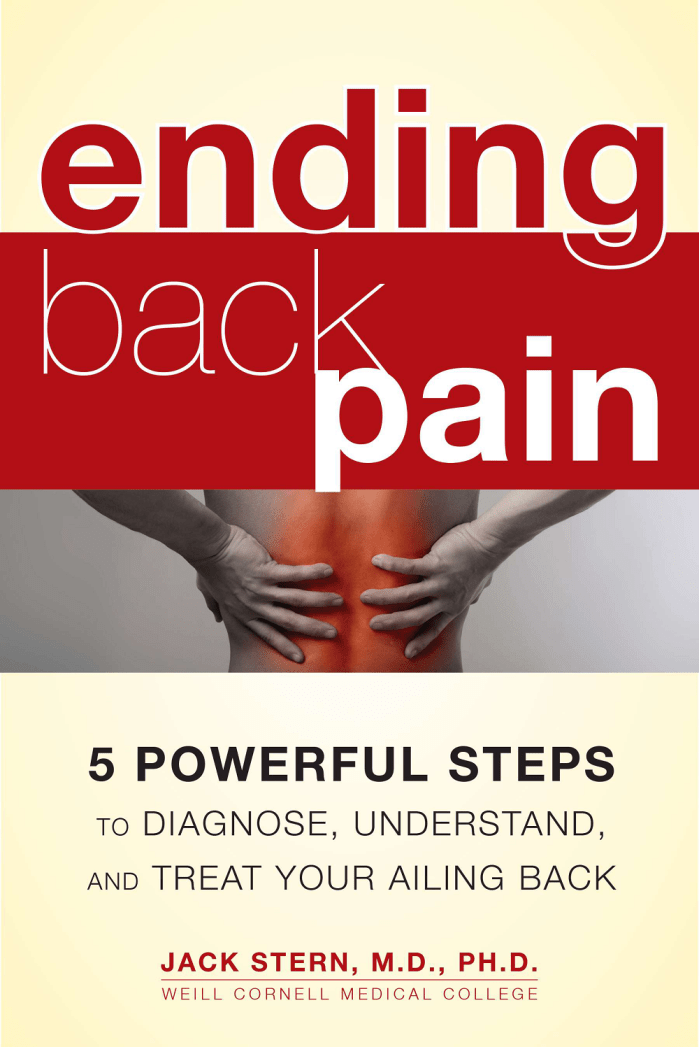
Ending Back Pain
by Jack Stern, M.D., Ph.D.
Excerpted from “Ending Back Pain: 5 Powerful Steps to Diagnose, Understand, and Treat Your Ailing Back.” Copyright © by Jack Stern, M.D., Ph.D. Published by Avery. All rights reserved.
Most feelings of discomfort in life have clear solutions. For a stuffy nose, decongestants do the trick. For a pounding headache, aspirin or Tylenol comes in handy. But what do you do about a relentlessly aching back? As most of us know, the answer is not nearly as clear-cut as we’d wish. And unlike infectious diseases that often have targeted remedies (think antibiotics for bacterial infections and vaccines for viruses), ailing backs are like misbehaving, obnoxious family members—we can’t easily get rid of them or “fix” them. They also have a tendency to stick around and bother us nonstop, lowering our quality of life considerably and indefinitely.
Perhaps nothing could be more frustrating than a sore or hurting back. It seems to throw off everything else in our body, and makes daily living downright miserable. With the lifetime prevalence approaching 100 percent, virtually all of us have been or will be affected by low back pain at some point. Luckily, most of us recover from a bout of back pain within a few weeks and don’t experience another episode. But for some of us, the back gives us chronic problems. As many as 40 percent of people have a recurrence of back pain within six months.
At any given time, an astounding 15 to 30 percent of adults are experiencing back pain, and up to 80 percent of sufferers eventually seek medical attention. Sedentary people between the ages of forty-five and sixty are affected most, although I should point out that for people younger than forty-five, lower back pain is the most common cause for limiting one’s activities. And here’s the most frustrating fact of all: A specific diagnosis is often elusive; in many cases it’s not possible to give a precise diagnosis, despite advanced imaging studies. In other words, we doctors cannot point to a specific place in your back’s anatomy and say something along the lines of, “That’s exactly where the problem is, and here’s how we’ll fix it.” This is why the field of back pain has shifted from one in which we look solely for biomechanical approaches to treatment to one where we have to consider patients’ attitudes and beliefs. We have to look at a dizzying array of factors, because back pain is best understood through multiple lenses, including biology, psychology, and even sociology.
The Challenge
So, why is back pain such a confounding problem? For one, it’s lumped into one giant category, even though it entails a constellation of potential culprits. You may have back pain stemming from a skiing accident, whereas your neighbor experiences back pain as the consequence of an osteoporotic fracture. Clearly, the two types of back pain are different, yet we call them “back pain” on both accounts, regardless. Back pain has an indeterminate range of possible causes, and therefore multiple solutions and treatment options. There is no one-size-fits-all answer to this malady. That is why diagnosing back pain, particularly persistent or recurrent pain, is so challenging for physicians.
Some people are able to describe the exact moment or series of moments when they incurred the damage to their back—a car accident, a slip and fall, a difficult pregnancy, a heavy-lifting job at work, a sports-related injury, a marathon, and so on. But for many, the moment isn’t so obvious, or what they think is causing them the back pain is far from accurate.
The Two Types of Back Pain
If you are going to experience back pain, you’d prefer to have the acute and temporary kind rather than the chronic and enigmatic kind. The former is typically caused by a musculoskeletal issue that resolves itself in due time. This would be like pulling a muscle in your back during a climb up a steep hill on your bicycle or sustaining an injury when you fall from the stepladder in the garage. You feel pain for a few weeks and then it’s silenced, hence the term self-limiting back pain. It strikes, you give it some time, it heals, and it’s gone.
The second type of back pain, though, is often worse, because it’s not easily attributed to a single event or accident. Often, either sufferers don’t know what precipitated the attack, or they remember some small thing as the cause, such as bending from the waist to lift an object instead of squatting down (i.e., lifting with the legs) or stepping off a curb too abruptly. It can start out of nowhere and nag you endlessly. It can build slowly over time but lack a clear beginning. Your doctor scratches his head, trying to diagnose the source of the problem, and as a result your treatment options aren’t always aligned with the root cause of the problem well enough to solve it forever. It should come as no surprise, then, that those with no definitive diagnosis reflect the most troubling cases for patients and doctors.
What Are the Chances?
Chances are good that you’ll experience back pain at some point in your life. Your lifetime risk is arguably close to 100 percent. And unfortunately, recurrence rates are appreciable. The chance of it recurring within one year of a first episode is estimated to be between 20 and 44 percent; within ten years, 80 percent of sufferers report back pain again. Lifetime recurrence is estimated to be 85 percent. Hence, the goal should be to alleviate symptoms and prevent future episodes.
Jack Stern, M.D., Ph.D., is the author of “Ending Back Pain: 5 Powerful Steps to Diagnose, Understand, and Treat Your Ailing Back.” He is a board-certified neurosurgeon specializing in spinal surgery, and cofounder of Spine Options, one of America’s first facilities committed to nonsurgical care of back and neck pain. Dr. Stern is on the clinical faculty at Weill Cornell Medical College and has published numerous peer- and non-peer– reviewed medical articles. He lives and practices in White Plains, New York.
 SA Examiner