
Robert Kofman is an American author born in Bellefonte, PA and a graduate of Penn State and Duke Law School. He became a labor lawyer with the National Labor Relations Board in Washington, D.C. and Philadelphia before entering private practice in Miami, FL as a management side labor and employment attorney. After retiring from practicing law, Kofman desired to keep intellectually engaged by writing a historical novel as a way to help educate people in an engaging fashion about the Civil War. His new book “General Meade: A Novel of the Civil War” resulted from that effort. (Smith Publicity, 2019)
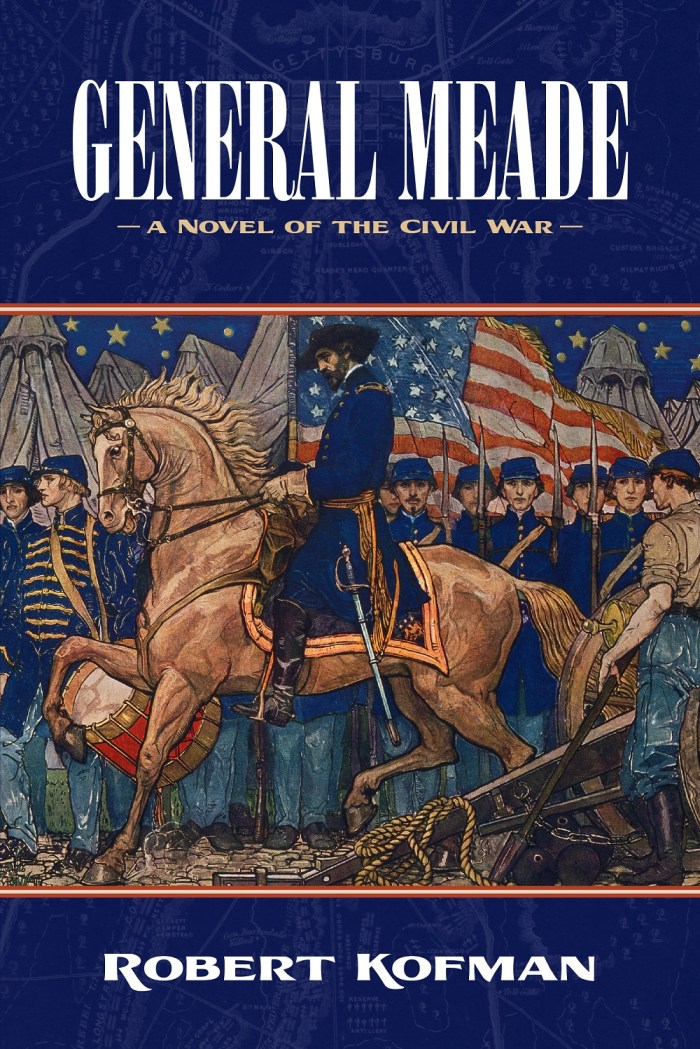
In “General Meade: A Novel of the Civil War” Robert Kofman has written a work of historical fiction detailing a fascinating character, who has been relegated to the margins of history, with credibility and intrigue. It begins with a note by the author where he explains that the novel covers many significant events of the last three years of the American Civil War from the perspective of Major General George Gordon Meade, sometimes in his own words through letters that he wrote to the person he most trusted: his wife Margaret. The Prologue describes what happens in 1860 when Abraham Lincoln becomes President, specifically how the Southern states begin seceding from the Union before he even takes office.
Just three days after taking command, General Meade confronts Lee’s army at Gettysburg, resulting in the bloodiest and most dramatic battle of the war. After that incredible victory, at first he is heralded as a hero who turns the tide of the war, but he then falls victim to a smear campaign that threatens to ruin his reputation and his career. He is forced to muster all of his strength to persevere against an onslaught of political and newspaper attacks, all while leading the Army of the Potomac and serving his superiors: General Ulysses S. Grant and President Lincoln.
Much more than a novel of historical fiction, “General Meade” is also a view of the issues plaguing the nation then and now. Themes include a country divided by social issues, polarized political parties, partisan newspaper attacks, false news stories, war heroes and villains and an unscrupulous Congressional Committee out to destroy the careers of generals who do not share its political ideology. Considering that the main subject is history, the language is easy to understand and the action flows from page to page aided by maps when appropriate. Highlights include the mention of history in the making, like the big story in the paper about Lincoln’s preliminary Emancipation Proclamation and details of vicious hand-to-hand combat: “Blood and brain matter splattered the combatants. A Rebel flag-bearer climbed atop one of the Napoleons and waved his colors. Seconds later, his bullet-ridden, lifeless body fell to the ground.”
Kofman provides sources and a bibliography for anyone interested in reading more on the subject. An interesting section is the Afterward, where he lists what happens to the people in the story: “Robert E. Lee was indicted but never tried for treason,” Ulysses S. Grant “created the Justice Department and used it to prosecute the Ku Klux Klan, which was using violence to deny freed blacks their civil rights” and how Old Baldy, General Meade’s warhorse outlived him by ten years. At Meade’s funeral, “Old Baldy followed the caisson carrying Meade’s casket as the rider-less horse.” “General Meade” is an extraordinary work of historical fiction that spotlights the lesser-known side of history’s legends. It is recommended for readers who enjoy historical fiction at its finest.
*The author received a copy of this book for an honest review. The views and opinions expressed here belong solely to her.

 SA Examiner