
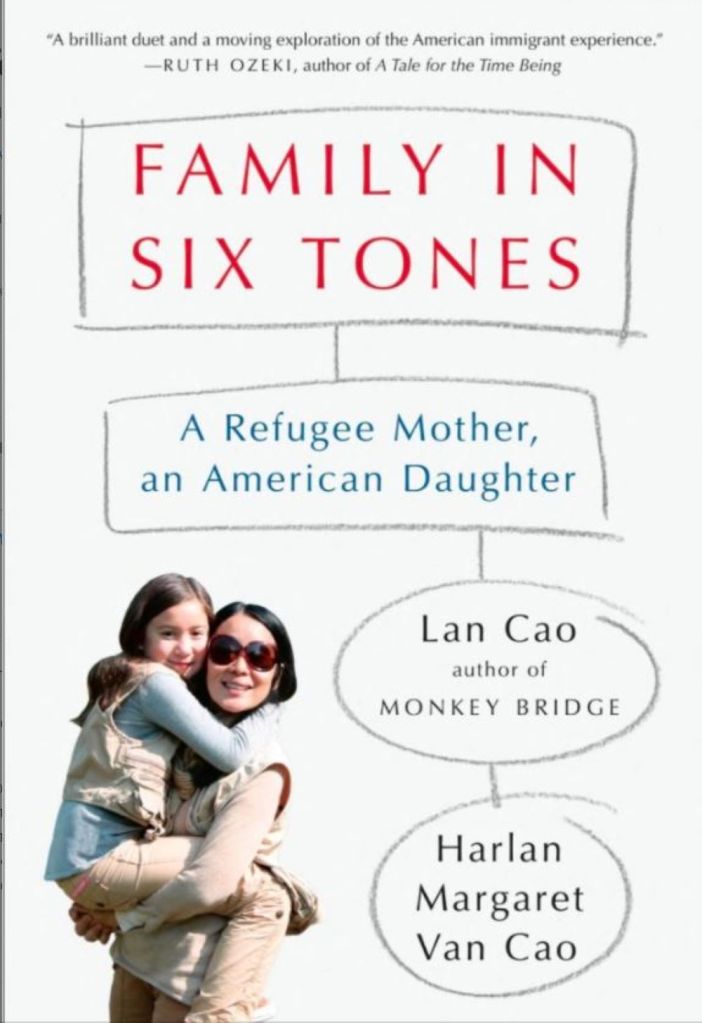
Lan Cao is the author of the novels “Monkey Bridge” and “The Lotus and the Storm” and a professor of law at the Chapman University School of Law, specializing in international business and trade, international law and development. She has taught at Brooklyn Law School, Duke Law School, Michigan Law School and William & Mary Law School. Her latest book “Family in Six Tones: A Refugee Mother, an American Daughter” is the dual first-person memoir by the acclaimed Vietnamese-American novelist and her thoroughly American teenage daughter, Harlan Margaret Van Cao, who just graduated from high school in June 2020 and will be attending UCLA.
In the Introduction, Lan Cao views motherhood and being a refugee with equal trepidation because of how uncertain she still feels about both. Even after forty years of being in the United States and seventeen years of being a parent, she still feels inadequate in both. This is the central theme throughout this memoir as she explores being a refugee and being a mother with the help of Harlan, her teenage daughter, who is half Vietnamese. In short alternating chapters, they show how different and yet how similar they really are. Lan relates her immigrant experience including war, past traumas and tragedies and the struggles and discriminations she faced while getting an education, especially in law school, while Harlan deals with culture clashes, bullying and going through life coping with synesthesia – a condition in which people often see sounds, taste word or feel a sensation on their skin when they smell certain scents – she often relates about having a purple cat following her.
Being an immigrant is never easy and too often the Vietnamese viewpoint is left out of the conversation. This is what makes this memoir unique; not only is it told through the perspective of a mother/daughter relationship, but it is told through the Vietnamese point of view, not a solider or a politician, even though it touches on the sensitive topic of the war. Readers get to witness Lan’s transition from naïve immigrant to law student, especially the moment she decides to study law – when she was working in a video store and the police questioned her regarding missing money. The insight into Vietnamese culture is interesting, especially the system of ranking people, i.e. calling relatives Father Two, Sister Three. Her shared immigrant experiences of discrimination makes her relatable: “We may have Americanness officially documented in birth certificates, passports, or naturalization papers. But despite the seductive panache of the American Dream, the message that we can never really be American has curiously been passed down from generation to generation.” Harlan also has this conflict about being too American versus not being Vietnamese enough and her writing is more poetic: “This life isn’t meant to be a race. It is meant to be a long, slow dream of perfect confusion, loneliness, deep friendships, and ambition. I’m ready.” When she writes “You can be American outside, but not in the house” it speaks to what children of immigrants sometimes deal with at home. They are expected to be Americanized outside the house, but at home they are expected to speak the native language and adhere to that culture’s expectations, leading to an emotional tug of war. Overall, “Family in Six Tones” is an impressive and poignant exploration of the mother/daughter relationship which often has the same struggles and insecurities passed on from generation to generation. It is recommended for readers who appreciate a distinctive perspective on the struggles of refugees and familial bonds.
“ I wanted to bloom wherever I was planted, in this present tense where I had found myself, like a lotus flower that grows in mud and turns to face the sunlight.” – Lan Cao
*The author received a copy of this book for an honest review. The views and opinions expressed here belong solely to her.
 SA Examiner