

As part of National Hispanic Heritage Month (September 15 – October 15), I want to bring attention to how little we know of our history as Mexican-Americans. Even though nowadays more of us are getting an education, little is known about the struggles that those who came before us had to endure. We take for granted how far we have come but are unaware of how difficult it used to be to even finish elementary school. Having Mexican-American studies in school would be a step up but for now, there are two documentaries that I highly recommend: Stolen Education and A Class Apart. Both are a little over an hour long and are available on Amazon. Do yourself and your children a favor and watch these documentaries and learn all you can about our history as Mexican-Americans and the Mexican-American Civil Rights Movement.
Last Thursday I attended a virtual screening of Stolen Education. Hosted by the Mexican American Civil Rights Institute, it documents the untold story of Mexican-American school children who challenged discrimination in Texas schools in the 1950s and changed the face of education in the Southwest. It was amazing how most of those in attendance had never heard of this case or the circumstance surrounding it; mostly because it is a subject seldom discussed. This legal case was after the one featured on A Class Apart, which ended segregation in South Texas. I watched A Class Apart on Amazon last month. What stunned me after watching both documentaries is that this happened in our own backyard and few people are aware of it. See below for a full description of both documentaries.
Stolen Education: As a 9 year-old second grader, Lupe had been forced to remain in the first grade for three years, not because of her academic performance but because she was Mexican American. She was one of eight young students who testified in a federal court case in 1956 to end the discriminatory practice (Hernandez et al. v. Driscoll Consolidated Independent School District), one of the first post-Brown desegregation court cases to be litigated. Degraded for speaking Spanish and dissuaded from achieving academically, Mexican American students were relegated to a “beginner,” “low,” and then “high” first grade – a practice that was common across the Southwest. School officials argued in the case that this practice was necessary because the “retardation of Latin children” would adversely impact the education of White children.
The film portrays the courage of these young people, testifying in an era when fear and intimidation were used to maintain racial hierarchy and control. The students won the case, but for almost sixty years the case was never spoken about in the farming community where they lived despite its significance. Stolen Education presents the full story and impact for the first time, featuring the personal accounts of most of those who were at the center of the court case. The film documents not only an important moment in Mexican American history, but also provides important context to understand our current educational system’s enduring legacy of segregation, discrimination and racism. (Video Project, 2021)
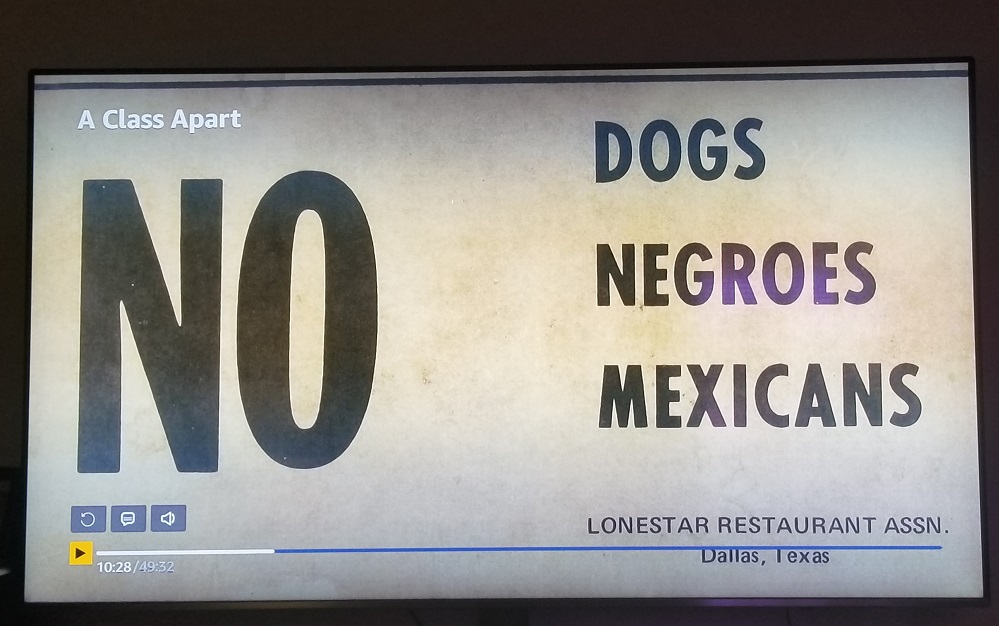
A Class Apart – A Class Apart is a new documentary by award-winning filmmakers Carlos Sandoval (Farmingville) and Peter Miller (Sacco and Vanzetti, Passin’ It On). The first major film to bring to life the heroic post-World War II struggles of Mexican Americans against the Jim Crow-style discrimination targeted against them, A Class Apart is built around the landmark 1951 legal case Hernandez v. Texas, in which an underdog band of Mexican Americans from Texas bring a case all the way to the Supreme Court – and win.
The film begins with a murder in a gritty small-town cantina and follows the legal journey of the Hernandez lawyers through the Texas courts and ultimately to the United States Supreme Court. We see them forge a daring legal strategy that called their own racial identities into question by arguing that Mexican Americans were “a class apart” who did not neatly fit into a legal structure that only recognized blacks and whites.
A grassroots national movement supports the legal efforts, with tiny contributions sent by Latinos from around the country paying for the Hernandez case to go forward. The film dramatically interweaves the story of its central characters – activists and lawyers, returning veterans and ordinary citizens, murderer and victim – within the broader history of Latinos in America during a time of extraordinary change. (Camino Bluff Productions, 2021)


 SA Examiner