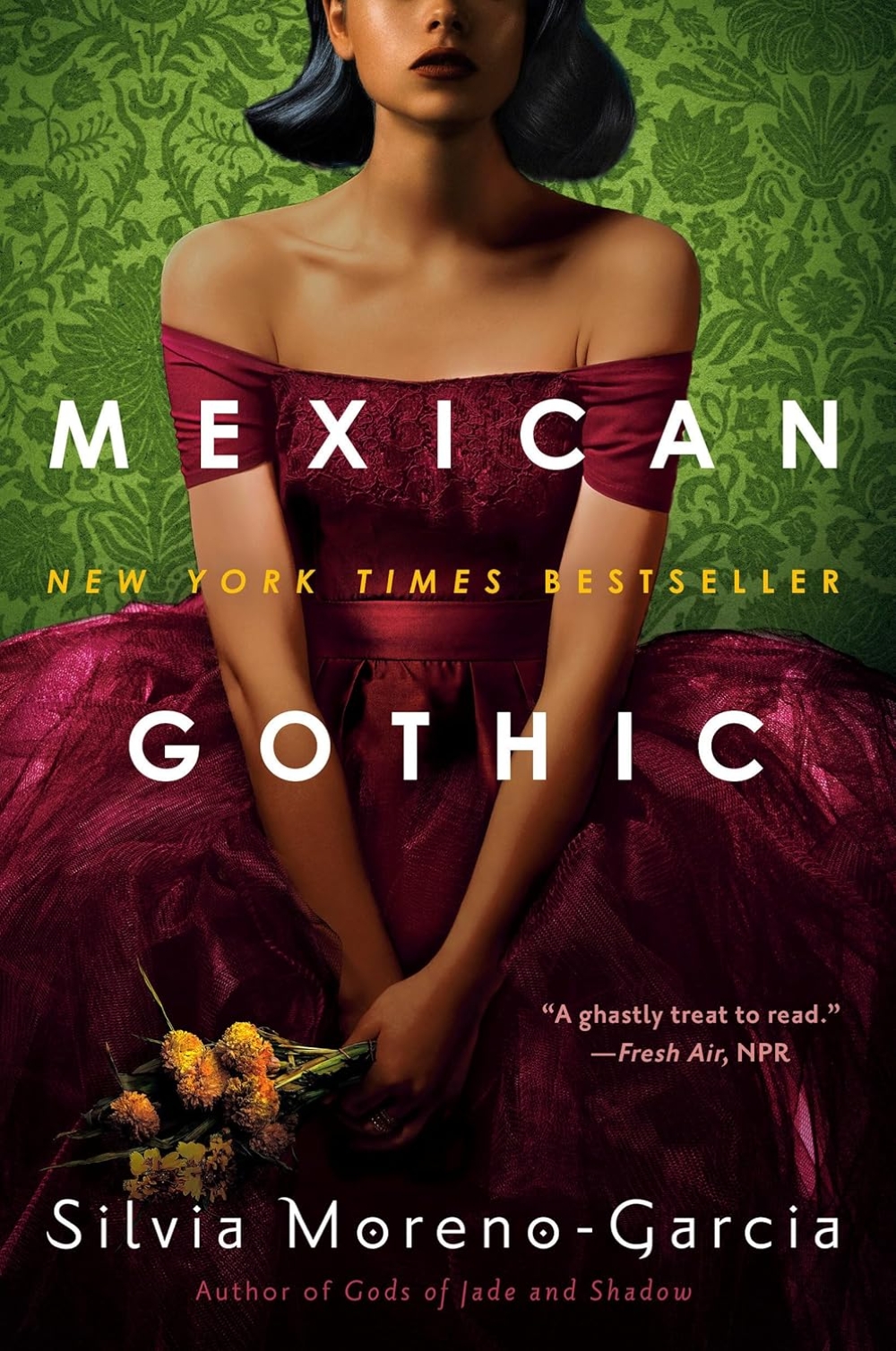
Book Review: Mexican Gothic by Silvia Moreno-Garcia
Synopsis
Set in 1950s Mexico, the novel follows Noemí Taboada, a glamorous socialite whose life mostly consists of high-society parties and leisure. That changes overnight when her father summons her to his office after receiving a frantic, disturbing letter from Noemí’s newly-wed cousin, Catalina. Begging for someone to save her from a “mysterious doom,” Catalina writes about hearing voices in the walls and seems consumed by paranoia. (Barnes & Noble, 2026)
Striking a deal with her father, investigate Catalina’s situation in exchange for his blessing to attend college for anthropology, Noemí strikes out for High Place, a isolated mansion tucked away in the Mexican countryside.
Noemí is an unlikely rescuer. Her chic gowns and perfect red lipstick are better suited for cocktail lounges than amateur sleuthing. However, beneath her polished exterior lies a sharp mind and an indomitable will. She isn’t easily intimidated:
- Not of Virgil: Catalina’s new husband, a handsome Englishman who is as menacing as he is alluring.
- Not of Howard: The family’s ancient patriarch, who harbors a bizarre, unsettling fascination with Noemí.
- Not of High Place itself: Even as the decaying mansion invades her dreams with visions of blood and doom.
Her sole ally in this inhospitable home is Francis, the family’s youngest son. Shy and gentle, Francis wants to help Noemí, but he may also be guarding dark secrets about his family’s past. Behind High Place’s walls lie stories of violence, madness, and a faded silver mining empire built on exploitation. What begins as a family rescue mission quickly devolves into a desperate fight to escape a terrifying, addictive nightmare.
Review
Mexican Gothic brilliantly reinvents classic Gothic horror by fusing familiar tropes, such as dilapidated mansions, tyrannical patriarchs, and psychological dread, with a rich, atmospheric 1950s Mexican backdrop. As Noemí steps into High Place, she enters a living nightmare built on physical isolation and lingering colonial rot.
High Place itself functions as its own character. Its decaying walls and disturbing dreamscapes create an oppressive, suffocating sense of dread. Moreno-Garcia seamlessly weaves traditional horror elements with Mexican history and sharp social commentary.
The narrative unfolds at a steady, deliberate pace, escalating the tension with every chapter and every deeply unsettling secret Noemí unearths. The author balances this high tension with beautifully poetic prose:
“Everything in High Place was gnarled and begrimed, but he’d been able to grow bright and mindful, like an odd plant that is carried onto the wrong flower bed.”
Character Dynamics
- Noemí Taboada: Far from a helpless damsel in distress, Noemí’s party-girl facade conceals a fierce intellect and resilience. Her absolute refusal to break or submit to High Place makes her an incredible protagonist.
- Francis Doyle: Soft-spoken and gentle, Francis offers a stark contrast to his sinister family. His inner conflict between familial loyalty and moral action makes him Noemí’s only true ally.
- Howard Doyle: The ancient patriarch embodies predatory control, obsessively driven by ideas of genetic purity and bodily exploitation.
Core Themes
- Colonialism & Exploitation: The Doyle family’s faded mining empire reveals how foreign powers drain local resources and labor, framing historical exploitation as a literal, invasive threat to the body.
- Autonomy vs. Control: Patriarchal domination and eugenics clash directly with Noemí’s fiercely guarded independence.
A Note on the Audiobook:
While the story itself was deeply entertaining, I found the audiobook narration disappointing. The delivery felt robotic and AI-like, complete with awkward pauses and mispronunciations of Spanish names. I only kept listening because I was so hooked on finding out how the plot ended.
Final Verdict
Mexican Gothic by Silvia Moreno-Garcia is a haunting, visually atmospheric tale where the greatest horrors stem not just from supernatural forces, but from human greed and tyranny. It proves that gothic horror can be both frightening and deeply thought-provoking. Readers who enjoy atmospheric mysteries, strong female leads, and dark family secrets should immediately add this to their reading list.
“She had experience dealing with irritating men. They did not fluster her. She had learned, by navigating cocktail parties and meals at restaurants, that showing any kind of reaction to their crude remarks emboldened them.”
About the Author
Silvia Moreno-Garcia is a Mexican-Canadian novelist, short story writer, editor, and publisher. She is the author of The Bewitching, Mexican Gothic, Gods of Jade and Shadow, and many other acclaimed books. Her work has earned her the Locus, British Fantasy, and World Fantasy awards. She holds an MA in Science and Technology Studies from the University of British Columbia.