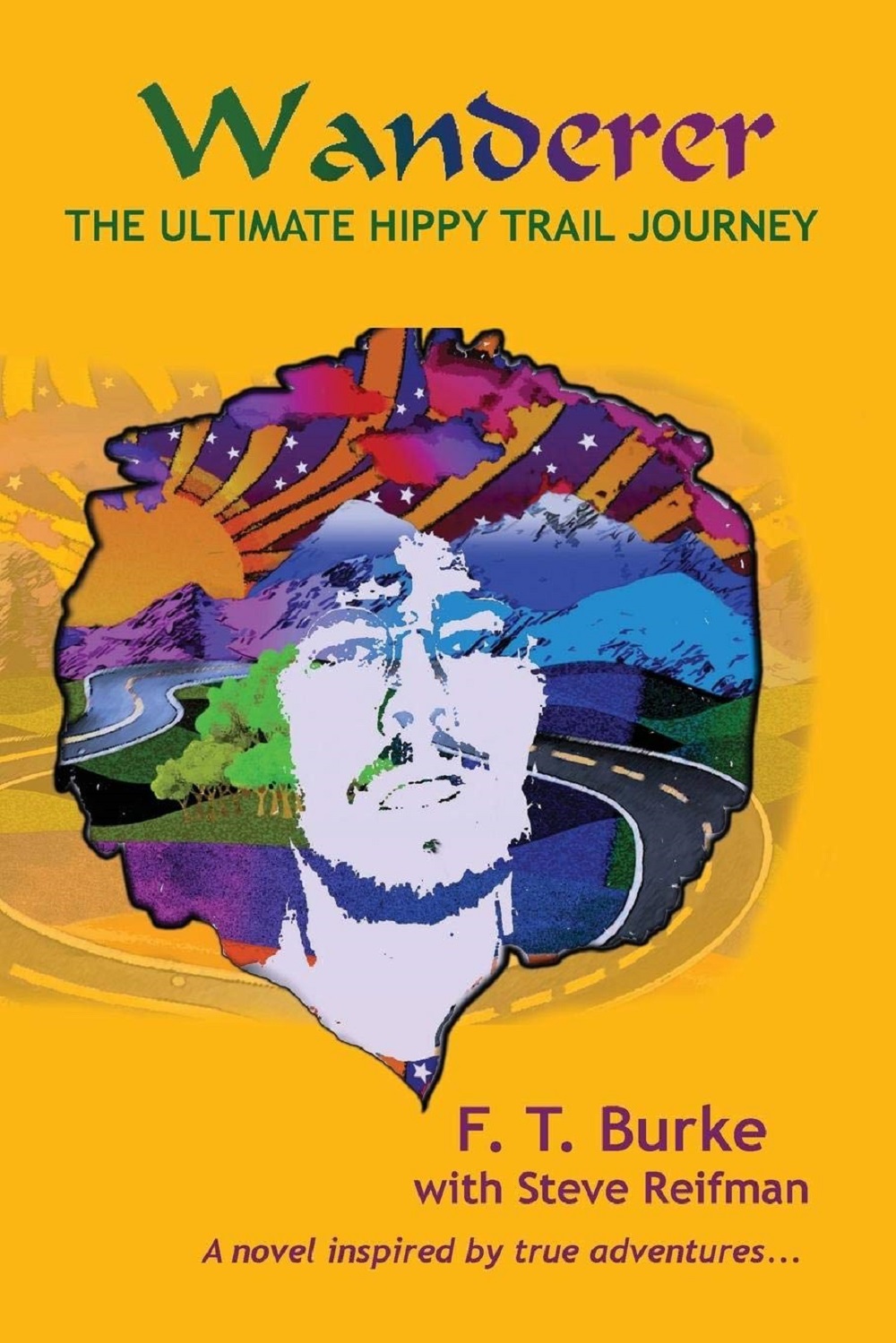
On the golden anniversary of Steve Reifman’s adventure, the authors created a weekly podcast series to commemorate his year-long adventure. Photo: amazon
Author F.T. Burke is a lifelong resident of the state of Michigan. He enjoyed a prior career in the high-tech sector, serving as a systems engineer and project manager. Burke’s debut novel, “The Bohemian Adventure,” traces the journey of one who meets up with devoted “deadheads” who followed the psychedelic rock group, the Grateful Dead. “Wanderer – The Ultimate Hippy Trail Journey” by F.T. Burke and Steve Reifman is a book that tells the remarkable story of a young man’s year-long journey of discovery wandering across the globe in 1970-71. Steven W. Reifman is a practicing lawyer, activist and businessman. He took a journey similar in time and place to that of Wanderer’s main character, Woodstock. (F.T. Burke, 2021)
During the height of the pandemic while in quarantine, Steve Reifman, on whose travel the book is based, recorded the fictional book for posterity in his own home on a podcast type recorder. Then as the 50-year anniversary of the travel approached, Steve was inspired to commemorate his incredible journey of a lifetime by recording and publishing a week-by-week video relying heavily on his handwritten travel journals and readings from the book. Steve and co-author, F.T. Burke, enlisted the services of their media arts specialist, Xavier Vance, and they were “off to the races.” Each week, without fail, the trio have published, all the way to week 42 with the end in sight. As the authors issued their weeklies, the concept of a mini-series or other serial took shape with a chapter based on each week’s adventure.
Steve’s adventures, the inspiration for the book “Wanderer,” co-written with F.T. Burke, took him across four continents through 26 countries in 1970-71. Now on the Golden Anniversary of his own real-life adventure, Attorney Steve Reifman—or “Stevie Wander” as he likes to be called—-tells the true tales behind the story, as the weeks roll by towards his homecoming. The weekly adventures kicked off on September 30, 2020, and now they are in the 42nd week, closing in on the exciting homecoming of this prodigal son on his year-long adventure. The Weekly Wanderer series is available on YouTube.
“Wanderer: The Ultimate Hippy Trail Journey” – During the crazy latter days of the Vietnam War, many young travelers wandered about doing drugs, having sex, sleeping out, and back-packing through Europe, North Africa, and Asia. As a young man coming of age, just out of college, with no clear future and unable to pay rent, the bushy-red-haired Woodstock joins these revelers to wander the world, searching for his soul. Upon beating the Draft, he crosses the Atlantic to the Old World in October 1970 without any particular itinerary, no set time to come “home” and not much money. He finds God everywhere no matter how hard he tries to hide and look away. During his year-long journey, his spontaneous, free-wheeling adventures of raucous, hilarious incidents all weigh heavily against his need to come home and grow up. Come along for this unforgettable adventure of a lifetime. (amazon, 2021)
‘Getaway’ is the new thriller by Zoje Stage. Photo: amazon
Zoje Stage’s debut novel, “Baby Teeth,” was a USA Today and international bestseller. It was nominated for a Bram Stoker Award for Superior Achievement in a First Novel, and was optioned for film by Village Roadshow/Valparaiso Pictures. Her second “mind-bending” (NY Times) novel, “Wonderland,” was one of Book Riot’s Best Horror Books of 2020, and one of Overdrive’s Best Audio Books of 2020. Her third novel, “Getaway,” described as “stunning” in a starred review from Booklist, was released this month. In “Getaway,” three friends set off on a hike into the Grand Canyon—only to discover it is not so easy to leave the world behind. A former filmmaker with a penchant for the dark and suspenseful, Zoje Stage lives in Pittsburgh. (amazon, 2021)
“Getaway” – It was supposed to be the perfect week away. Imogen and Beck, two sisters who could not be more different, have been friends with Tilda since high school. Once inseparable, over two decades the women have grown apart. But after Imogen survives a traumatic attack, Beck suggests they all reunite to hike deep into the Grand Canyon’s backcountry. A week away, secluded in nature. Surely it is just what they need. But as the terrain grows tougher, tensions from their shared past bubble up. And when supplies begin to disappear, it becomes clear secrets are not the only thing they are being stalked by. As friendship and survival collide with an unspeakable evil, Getaway becomes another riveting thriller from a growing master of suspense and a “literary horror writer on the rise.” (BookPage)
‘The Afghanistan Papers’ by Craig Whitlock will be released on Tuesday, August 31, 2021. Photo: amazon
Craig Whitlock is an investigative reporter for The Washington Post. He has covered the global war on terrorism for the Post since 2001 as a foreign correspondent, Pentagon reporter, and national security specialist. In 2019, his coverage of the war in Afghanistan won the George Polk Award for Military Reporting, the Scripps Howard Award for Investigative Reporting, the Investigative Reporters and Editors Freedom of Information Award, and the Robert F. Kennedy Journalism Award for international reporting. He has reported from more than sixty countries and is a three-time finalist for the Pulitzer Prize. His upcoming new book “The Afghanistan Papers: A Secret History of the War” is the groundbreaking investigative story of how three successive presidents and their military commanders deceived the public year after year about America’s longest war, foreshadowing the Taliban’s recapture of Afghanistan. It will be released on Tuesday, August 31, 2021. (amazon, 2021)
“The Afghanistan Papers” – Unlike the wars in Vietnam and Iraq, the US invasion of Afghanistan in 2001 had near-unanimous public support. At first, the goals were straightforward and clear: to defeat al-Qaeda and prevent a repeat of 9/11. Yet soon after the United States and its allies removed the Taliban from power, the mission veered off course and US officials lost sight of their original objectives. Distracted by the war in Iraq, the US military became mired in an unwinnable guerrilla conflict in a country it did not understand. But no president wanted to admit failure, especially in a war that began as a just cause. Instead, the Bush, Obama, and Trump administrations sent more and more troops to Afghanistan and repeatedly said they were making progress, even though they knew there was no realistic prospect for an outright victory.
Just as the Pentagon Papers changed the public’s understanding of Vietnam, The Afghanistan Papers contains startling revelation after revelation from people who played a direct role in the war, from leaders in the White House and the Pentagon to soldiers and aid workers on the front lines. In unvarnished language, they admit that the US government’s strategies were a mess, that the nation-building project was a colossal failure, and that drugs and corruption gained a stranglehold over their allies in the Afghan government. All told, the account is based on interviews with more than 1,000 people who knew that the US government was presenting a distorted, and sometimes entirely fabricated, version of the facts on the ground.
Documents unearthed by The Washington Post reveal that President Bush did not know the name of his Afghanistan war commander—and did not want to make time to meet with him. Secretary of Defense Donald Rumsfeld admitted he had “no visibility into who the bad guys are.” His successor, Robert Gates, said: “We didn’t know jack shit about al-Qaeda.” The Afghanistan Papers is a shocking account that will supercharge a long overdue reckoning over what went wrong and forever change the way the conflict is remembered.
Author Samantha Specks. Courtesy photo, used with permission.
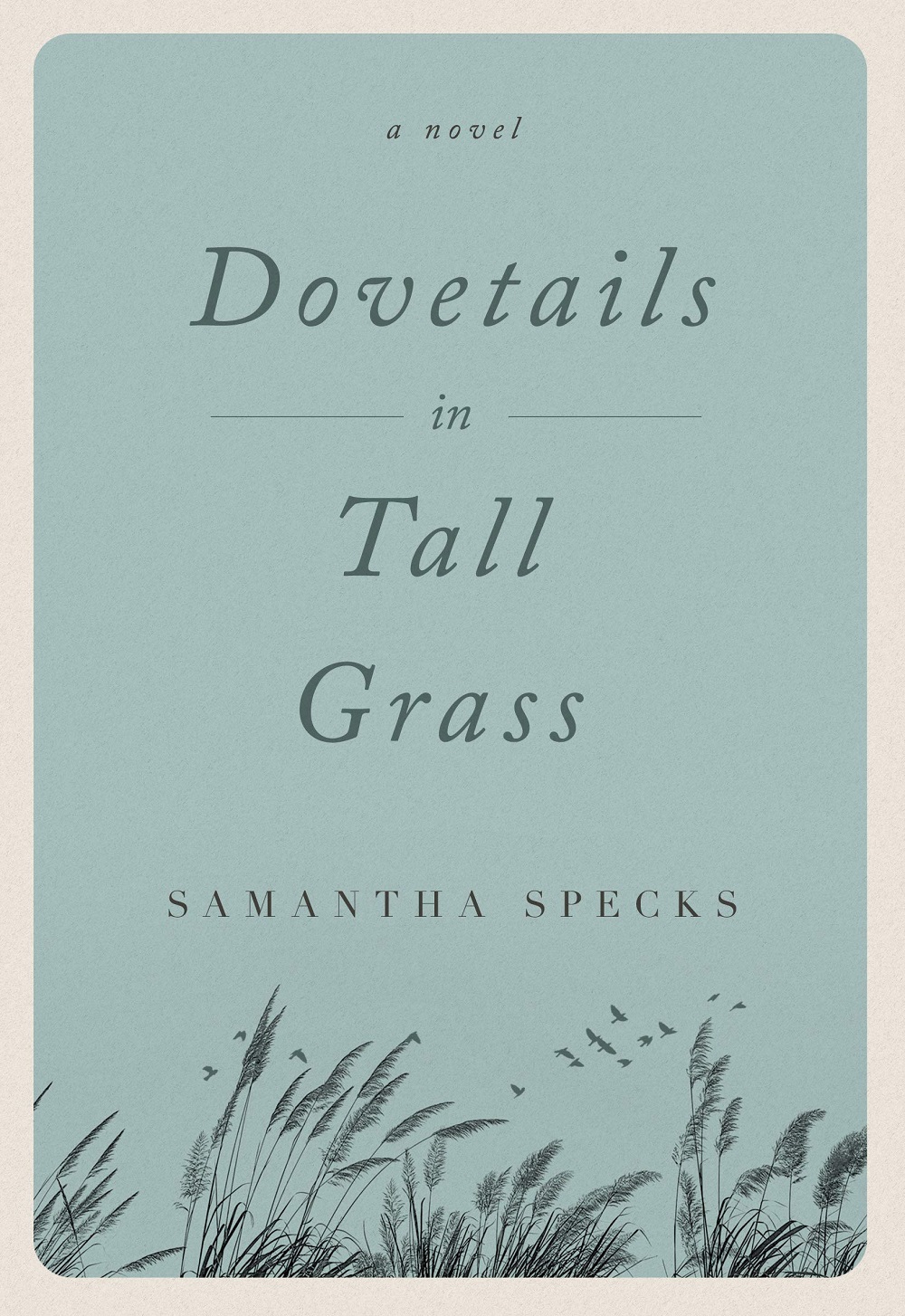
Today’s guest post is from Samantha Specks, author of ‘Dovetails in Tall Grass,’ available everywhere starting today.
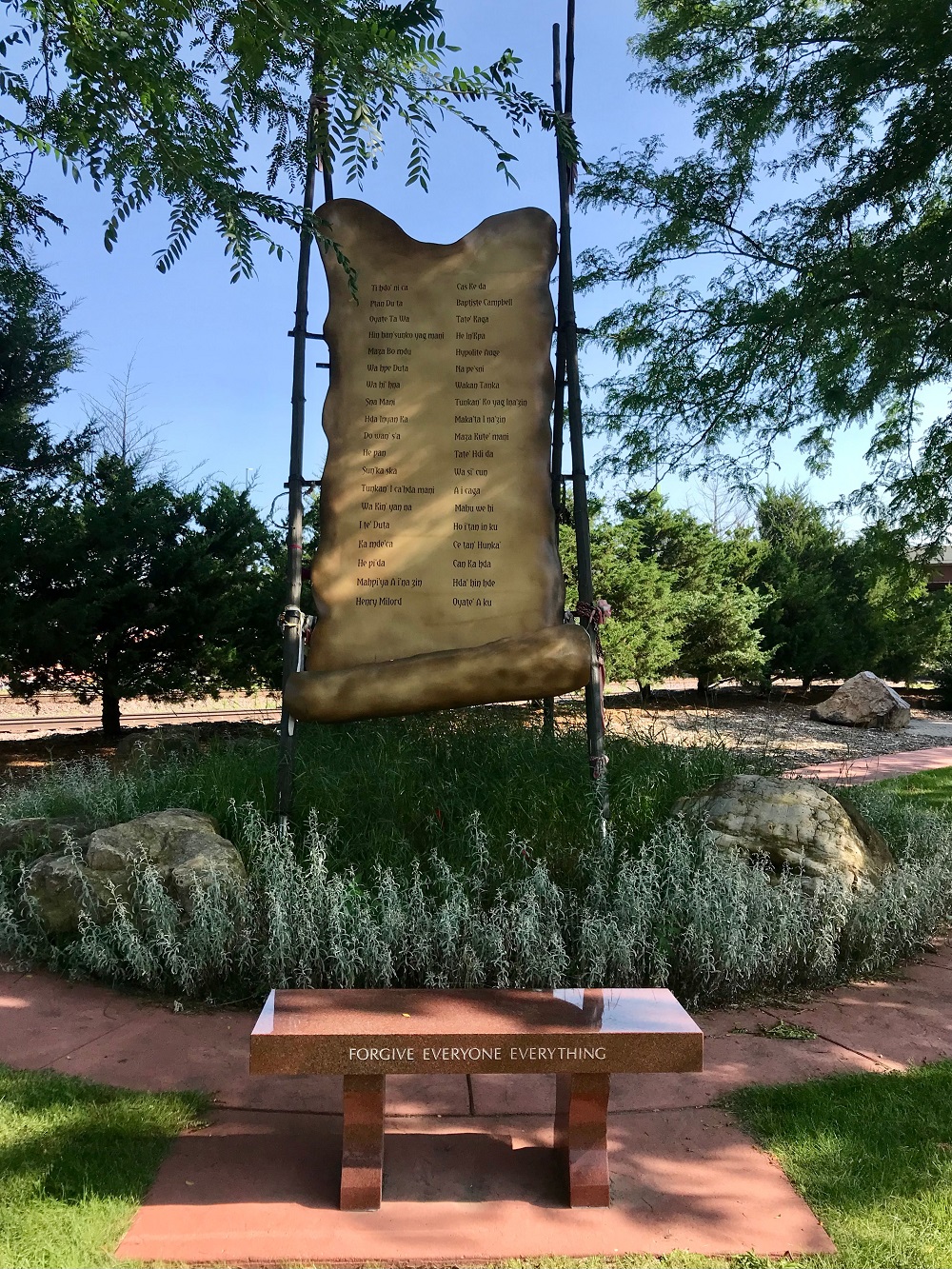
Inspired by the true story of the thirty-eight Dakota-Sioux men hanged in Minnesota in 1862―the largest mass execution in US history―Dovetails in Tall Grass is a tale of two young women connected by the fate of one man.
Writing Historical Fiction with debut novelist Samantha Specks
Though my novel is about events in 1862, for me the story started on Christmas 2005. A bitter wind blew snow over a country road. I was a high-schooler, cozy riding in my parents’ Suburban making the final turn to my grandparents’ home, when my blue eyes spotted something new. Headlights illuminated shapes moving across the darkening horizon. A group of men on horseback. Curious, I asked my parents why people were riding in the cold. My mother explained: “They’re Dakota who are marching to show they haven’t forgotten what happened here long ago.” And I’ve spent the last 15 years of my life learning what they haven’t forgotten.
It was that cold night on the frozen Minnesota prairie when the first seeds of the Dovetails story were planted in my heart. The men who I crossed paths with were the Dakota 38+2 Riders. To commemorate the US-Dakota War anniversary and promote reconciliation, this group still rides every December from Lower Brule, South Dakota to the site of the mass hangings in Mankato, Minnesota. Their journey inspired the girl I was and the woman, and author, I am today.
Writing Dovetails in Tall Grass
Dovetails grew its way through the cracks in my life. In hindsight, I can see how there was space for that, as my career path was meandering; I previously worked in sports broadcast journalism and as a therapist. It was during my graduate studies in 2011 that I began diving deeper into my interest in the US-Dakota War; somewhere amidst the academic research and my personal interest, I began to interpret the history with a lens for story, through the perspective of two women. Still, years and a career passed by. It wasn’t until 2017, once my husband and I had moved from Minnesota to Texas that he encouraged me, “why don’t you finally write that book idea you always talk about?” Story had pushed its way through, grown too big to ignore. A nudge and a new beginning in the Lone Star State were what I needed to give it the time and space it deserved.
Once the moving boxes were unpacked, I had to figure out how to write a book. I didn’t even own a laptop, so a visit to the Apple store was a starting point. My mind was overflowing with ideas. A massive roll of artist’s paper seemed like a good purchase as well. Then I spent six months doing intensive research. There was no information about the US-Dakota War that was too big or too small. My brain wanted it all: scholarly articles, old texts from libraries that hadn’t been checked out for years, or page 7 of comments on Minnesota History message boards. It was time well spent. Once I really knew the history inside and out, I outlined. I unrolled that giant scroll of artists paper and made detailed historical timelines and abstract conceptual character boards. Hours upon hours, I sat on my hardwood floor surrounded by torn sheets of paper, stacks of texts, random pages flagged in open books, and my keyboard home row already worn from the constant clickety-clack of notetaking. After a few months, I sat back and looked at the chaos of a story around me. I let myself feel it. It wasn’t in the past; it overwhelmed my heart now. This war was complex. Ugly. Unresolved. This time in history mattered so much to me.
I knew it, I felt it, I had it. It was time to write.
I took a deep breath, let it out, and started typing. Most mornings, I’d head to a Starbucks with a singular goal of getting the fictional characters of 1862 living in my mind onto a Microsoft Word document. Some days I felt hopeful the writing was taking the shape of a story, but most days I felt like an imposter. I was a first timer, and it was excruciating. To me, my pages were rough, messy, and imperfect. After a morning of writing, I’d stop at Brazos Bookstore to look at the historical fiction section. Beautiful covers, stunning prose. How did writers do this? Mornings at the coffeeshop began to feel dreadful. When I opened my document, those first draft pages felt like I was catching a glimpse of myself midway through a dental procedure. Mouth open bizarrely wide, water and bits of whatnot spraying about, drills zinging and polishers whooshing too loudly in my ears. The world was already full of brilliant authors with dazzling work who smiled perfectly from the shelves. Real, flawless, writing like that was something my messy pages could never be. When I started working with an editor, my insecurity only worsened. I couldn’t look at myself. My stomach flipped with anxiety each time I saw my editor’s name pop up in my inbox. Despite her positivity and encouragement, the comments, deletions, and suggestions throughout my pages flagged my failure. A professional was making it clear that I didn’t have the writing chops. Who was I kidding?
One day, probably while I was avoiding writing and in some rabbit hole of research, I stumbled upon an image of JK Rowling’s edited Harry Potter pages. They were marked top to bottom, Xs over massive blocks of her writing. Wait… what? Rowling’s edits were messy?! My next visit to the bookstore, the shelves looked different to me. The titles were still awe-inspiring. But the authors’ names were superhuman in a new way… they didn’t get here because they wrote a perfect first draft. They got here because they pushed through every comment, suggestion, flag, cut paragraphs, deleted precious words time and time again. The process was ugly. Ugly and necessary.
My therapist brain flipped on. An editor’s feedback would be exposure therapy for me. Bit by bit, I’d face and feel the anxiety of looking at my words. And in that discomfort of exposure, bit by bit, I’d get stronger. I needed to get okay with the ‘ugly and necessary’. Shame dissolved in the light of that truth.
Before long, I was refreshing my inbox, hoping to see my editor’s name pop up. I craved feedback. I didn’t need my writing to be the Harry Potter; I needed it to be Rowling’s marked up pages. And with that shift in my thinking, the words poured out of me.
I got down to it and I wrote a book.
After a handful of years writing, I don’t think of myself as a “writer.” I think of myself as someone who is just lucky enough to tap into compelling ideas when I learn about significant times in history. After I’ve spent time in the trenches of research, the fictional story is something totally outside of myself that I just happen to be able to see. The more I study the fascinating dynamics of our past (cough cough *present*), the more fire lights within me and illuminates just what complexities would play out in a story arc. If I can get my fingers to type fast enough, the actual writing feels like grabbing the ideas/feelings/characters invisibly floating beyond my mind and sticking them onto the physical page. If I write well enough, at the end of my work the fire will spread to a reader turning the pages of a meaningful story playing out on our vibrant and vivid past.
Hopes for a Reader
After finishing Dovetails in Tall Grass, these are my hopes for a reader…
I hope a reader sets the book down and thinks, “Wow, I can’t believe I didn’t know about this time in history before…” and they instantly google “Chief Little Crow” or “Dakota 38+2 Riders” — and maybe even search for “Emma Heard” or “Oenikika” because these fictional characters feel so real, they must be part of the actual history.
I hope this is a novel that makes a reader look forward to her book club meeting – that it brings out lively, engaging, dynamic conversation in a group. And that she chooses to chime in a few more times than she usually does in that discussion.
And finally, at the end of the day, I hope a reader remembers Dovetails in Tall Grass a novel that made her think, feel, and question. When someone asks her, “Have you read any good books lately?” She recommends it; not just because she liked the story but because she wants others to know how much the US-Dakota War of 1862 mattered.
ABOUT THE AUTHOR: Samantha Specksis a licensed independent clinical social worker. She and her husband live in Houston with their baby (Pippa) and fur baby (Charlie). When not in Texas, they enjoy spending time on the lakes of Minnesota and in the mountains of the Roaring Fork Valley in Colorado. Dovetails in Tall Grass is Samantha’s debut novel. Currently, she is writing Dovetails of a River, which is set at the Battle of the Little Bighorn.
‘Dovetails in Tall Grass’ by Samantha Specks. Courtesy photo, used with permission.Memorial. Courtesy photo, used with permission.
Chapelwaite premiered on Epix on Sunday August 22, 2021. Photo: google
Stephen King is the author of more than fifty books, all of them worldwide bestsellers. His first crime thriller featuring Bill Hodges, “Mr. Mercedes,” won the Edgar Award for best novel and was shortlisted for the CWA Gold Dagger Award. Both “Mr. Mercedes” and “End of Watch” received the Goodreads Choice Award for the Best Mystery and Thriller of 2014 and 2016, respectively. King co-wrote the bestselling novel “Sleeping Beauties” with his son Owen King. Several of his books have been adapted into celebrated films and television series including The Shawshank Redemption, Gerald’s Game and It. His short story Jerusalem’s Lot has been adapted into the television series Chapelwaite that premiered on Epix on Sunday August 22 and stars Adrien Brody as Captain Charles Boone. (amazon, 2021)
Jerusalem’s Lot is a short story published in Stephen King’s 1978 collection ‘Night Shift.’ It is an epistolary short story set in the fictional town of Preacher’s Corners, Cumberland County, Maine, in 1850. It is told through a series of letters and diary entries, mainly those of its main character, aristocrat Charles Boone, although his manservant, Calvin McCann occasionally narrates.
Chapelwaite – following his wife’s tragic death at sea, Captain Charles Boone and his children return to the small town of Preacher’s Corners, Maine, where a dark family history haunts them. He is soon forced to confront the darkness that has plagued his family and their ancestral home for centuries.
Jerusalem’s Lot is a short story published in ‘Night Shift.’ Photo: amazon
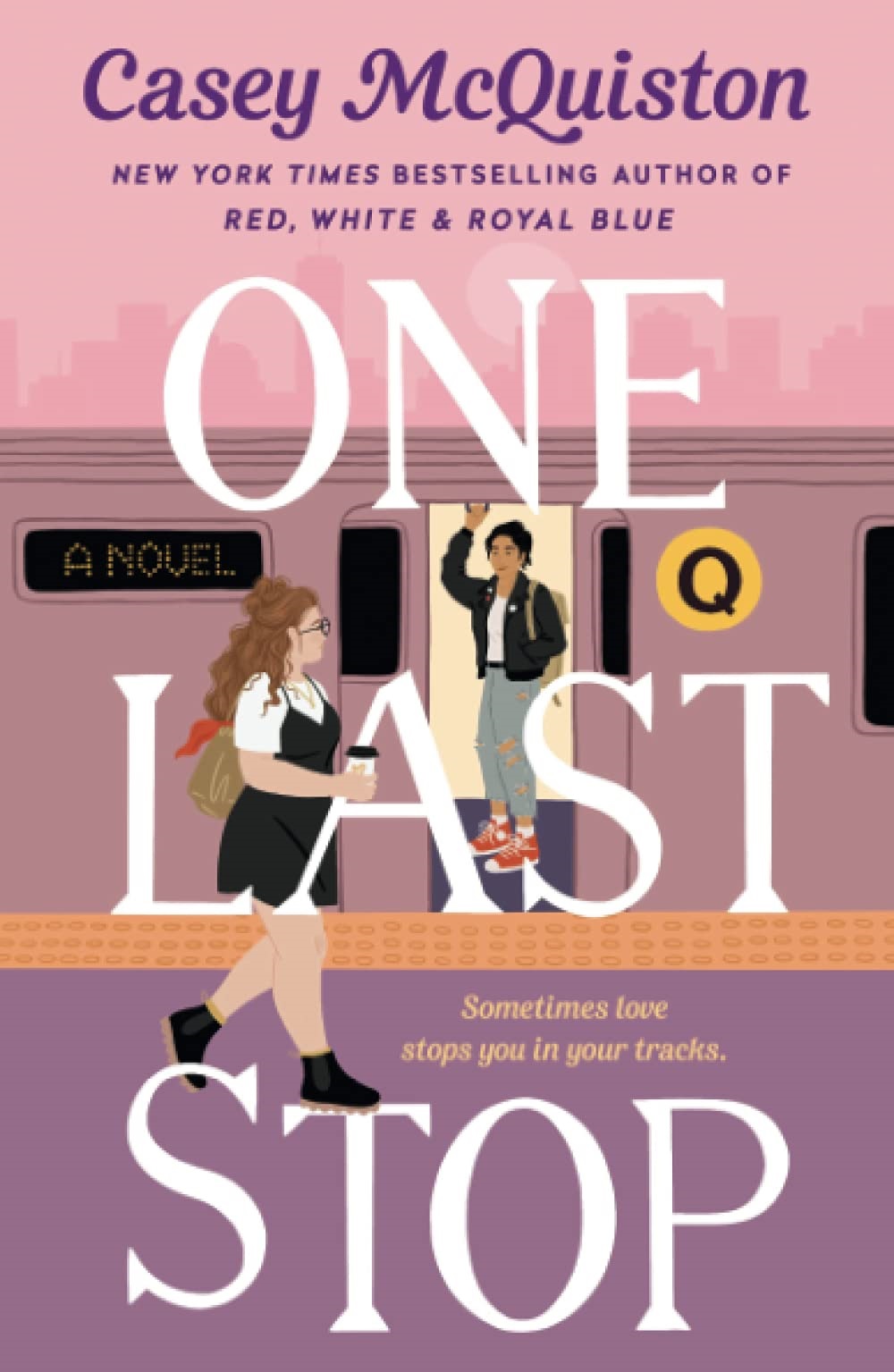
‘One Last Stop’ is the new novel by Casey McQuiston. Photo: amazon
Casey McQuiston is The New York Times bestselling author of “Red, White & Royal Blue,” as well as a pie enthusiast. She writes books about smart people with bad manners falling in love. Born and raised in southern Louisiana, she now lives in New York City with her poodle mix and personal assistant, Pepper. Her new book “One Last Stop” is a romantic comedy that will stop readers in their tracks. (amazon, 2021)
“One Last Stop” – For cynical twenty-three-year-old August, moving to New York City is supposed to prove her right: that things like magic and cinematic love stories do not exist, and the only smart way to go through life is alone. She cannot imagine how waiting tables at a 24-hour pancake diner and moving in with too many weird roommates could possibly change that. And there is certainly no chance of her subway commute being anything more than a daily trudge through boredom and electrical failures.
But then, there is this gorgeous girl on the train. Jane. Dazzling, charming, mysterious, impossible Jane. Jane with her rough edges and swoopy hair and soft smile, showing up in a leather jacket to save August’s day when she needed it most. August’s subway crush becomes the best part of her day, but pretty soon, she discovers there is one big problem: Jane does not just look like an old school punk rocker. She is literally displaced in time from the 1970s, and August is going to have to use everything she tried to leave in her own past to help her. Maybe it is time to start believing in some things, after all.
‘Our African Unconscious’ by Edward Bruce Bynum. Photo: amazon
Edward Bruce Bynum, Ph.D., ABPP, is a clinical psychologist and former director of the behavioral medicine program at the University of Massachusetts Health Services. The 2005 recipient of the Abraham H. Maslow Award from the American Psychological Association and the author of several books, including Dark Light Consciousness, he is currently in private practice in Hadley, Massachusetts. In his new book “Our African Unconscious: The Black Origins of Mysticism and Psychology,” he reveals how spirituality and the collective unconscious of all humanity originated in Africa. It will be released on Tuesday, September 14, 2021. (Black Château, 2021)
The fossil record confirms that humanity originated in Africa. Yet somehow, we have overlooked that Africa is also at the root of all that makes us human—our spirituality, civilization, arts, sciences, philosophy, and our conscious and unconscious minds.
In this extensive look at the unfolding of human history and culture, Edward Bruce Bynum reveals how our collective unconscious is African. Drawing on archaeology, DNA research, history, depth psychology, and the biological and spiritual roots of religion and science, he demonstrates how all modern human beings, regardless of ethnic or racial categorizations, share a common deeper identity, both psychically and genetically, connected with a primordial African unconscious.
Exploring the beginning of early religions, spirituality, and mysticism in Africa, along with philosophy, art, and science, the author looks at the Egyptian Nubian role in the rise of civilization and the emergence of Kemetic Egypt, revealing how and why ancient Egypt was separated from the rest of Africa in the Western mind—despite it being the most sophisticated expression of the Mother Continent. He examines the Oldawan, the Ancient Soul, and its correlation with what modern psychologists have defined as the collective unconscious. Revealing the spiritual and psychological ramifications of our shared African ancestry, the author examines its reflections in the present confrontation in the Americas, in the work of the Founding Fathers, and in modern Black spirituality, which arose from African diaspora religion and philosophy.
By recognizing our shared African unconscious, the matrix that forms the deepest luminous core of human identity, we can learn to see and feel that the differences between one person and another are merely superficial and ultimately there is no real separation between the material and the spiritual.
“Our African Unconscious” by Edward Bruce Bynum, Ph.D., ABPP is available on Amazon
ISBN: 9781644113967 Publisher: Inner Traditions Bear & Company September 2021 Paperback: $22.99 480 pages
Reader’s Digest’s ‘Great American Road Trips: Scenic Drives.’ Courtesy photo, used with permission.
Now that summer is here, most people will be taking vacations, including road trips. Reader’s Digest has put together a new book, the first in the Great American Road Trips series, that covers Scenic Drives. Hoping to inspire readers to travel and explore the wide-opens spaces and breathtaking views of our country, “Great American Road Trips – Scenic Drives: Discover Insider Tips, Must-See Stops, Nearby Attractions and More” is a complete guide to making road trips easier.
Growing up in Arizona, I loved the biodiversity of the state. Minutes from my home, I could hike the best trails in the Sonoran Desert, and after a few hours of driving, I could breathe fresh alpine air and marvel at fall foliage. And there’s one scenic drive in Arizona that has it all: Oak Creek Canyon.
This 15-mile state-designated scenic road along Route 89A begins in Sedona (if you’re coming from Phoenix) and winds its way north to Flagstaff. It curves up the Colorado Plateau from the high desert to a landscape of ponderosa pines.
Getting to the start of the drive is a treat for the senses. Route 89A rolls through Oak Creek Village, passing iconic red rocks that are named for their shapes. The landscape has an unearthly feel, and its singular beauty is unforgettable. Bell Rock, which is just off the road, is a popular spot to pull over for pictures or go on a hike along the lower, easier trail.
My family and I took this drive in the summer to escape the dry desert heat and in the fall to see the foliage, which begins to turn in November. After crossing the Midgley Bridge, our first stop was Slide Rock State Park, a 43-acre historic apple farm that was at one time the Pendley homestead. Growing apples in the high desert sounds far-fetched, but Frank Pendley mastered an innovative irrigation technique in 1912 that allowed his orchards to thrive. In fact, today park officials still use the same technique to water the remaining heirloom trees.
Though the apple orchard is amazing, the main attraction is the park’s namesake natural slide, which is a slippery chute of worn sandstone about 80 feet long and up to 4 feet wide. The waters of Oak Creek, which carved this canyon, are icy cold and refreshing. Children and adults alike squeal in delight as the water carries them down the slide into a pool.
Algae makes the rocks especially slippery, so it’s important to wear water shoes. It’s also important to look up and appreciate the canyon walls and cliffs that surround the park. I’ve never been disappointed by that view.
Back on the highway, you could easily stay in your car to take in the sights, but along the road, a few picnic sites, campgrounds and overlooks, such as Banjo Bill and Halfway, are well worth exploring.
The farther you drive, the higher you climb. The air cools, and by the time you reach the West Fork Trail, ponderosa pines appear alongside oaks and junipers. The trail, one of the most popular in the area, follows the west fork of Oak Creek.
In fall, the trees are ablaze with reds, oranges and yellows. The canyon walls soar, and the sound of the moving water soothes. You’ll step onto a paved trail that leads to a footbridge over the creek and Mayhew’s Lodge, the ruins of an old guesthouse that burned down in 1980. At that point, your West Fork Trail adventure begins. The in-and-out hike is about 6 miles round trip.
The thrilling part of the drive begins at Pumphouse Wash. For the following 2 miles, the road curves into a series of switchbacks, each steeper than the last.
If you’re lucky enough to be the passenger, you’ll see some gorgeous views of the canyon. (My mother always kept her head down during this part of the drive.) If you’re the driver, well, you’re probably looking at your knuckles and the road ahead.
Years ago, my husband-to-be and I went on this curvy drive. Though I knew where we were going, he insisted on using GPS. As the GPS attempted to chart the switchbacks, the fine pink line of the road turned into a blob.
It’s a slow drive to the top, but when you get there, be sure to stop at the Oak Creek Vista. Take a look back at where you’ve been, and marvel at the wonder of it all. The elevation changes and the diverse ecosystems of the drive are laid out before you. It’s a popular stop with visitors. The overlook is also home to a market offering Native American arts and crafts.
At this point, you’re on the Colorado Plateau’s southwestern edge. This is commonly referred to as the Mogollon Rim. The air up here is cooler and the forest is thick with pine trees.
The old lumber town of Flagstaff (home to the San Francisco Peaks, Northern Arizona University and Route 66) lies ahead. But that’s a scenic drive for another day.
POINTS OF INTEREST Length 15 miles
Fun Fact The dramatic reds and oranges in the rocks of Sedona come from iron oxide, left from a post-glacial ocean that filled the Verde Valley.
Words to the Wise A Red Rock Pass is required if you want to stop and park your car along the drive.
Side Trip Thousands of years before Hollywood discovered the red rocks of Sedona and the beauty of Oak Creek Canyon, the Sinagua called this place home. Though they moved on centuries ago, they left behind the Palatki and Honanki cliff dwellings. The sites are open to the public and overseen by Coconino National Forest staff. Call 928-282-3854 to reserve a tour spot.
Nearby Attractions Lowell Observatory, Flagstaff; Tlaquepaque district, Sedona; Fort Verde State Historic Park, Camp Verde; Sharlot Hall Museum, Prescott; Smoki Museum, Prescott
Slide Rock State Park’s natural slide is an oasis of fun. Photo: Pat Canova/Alamy Stock Photo
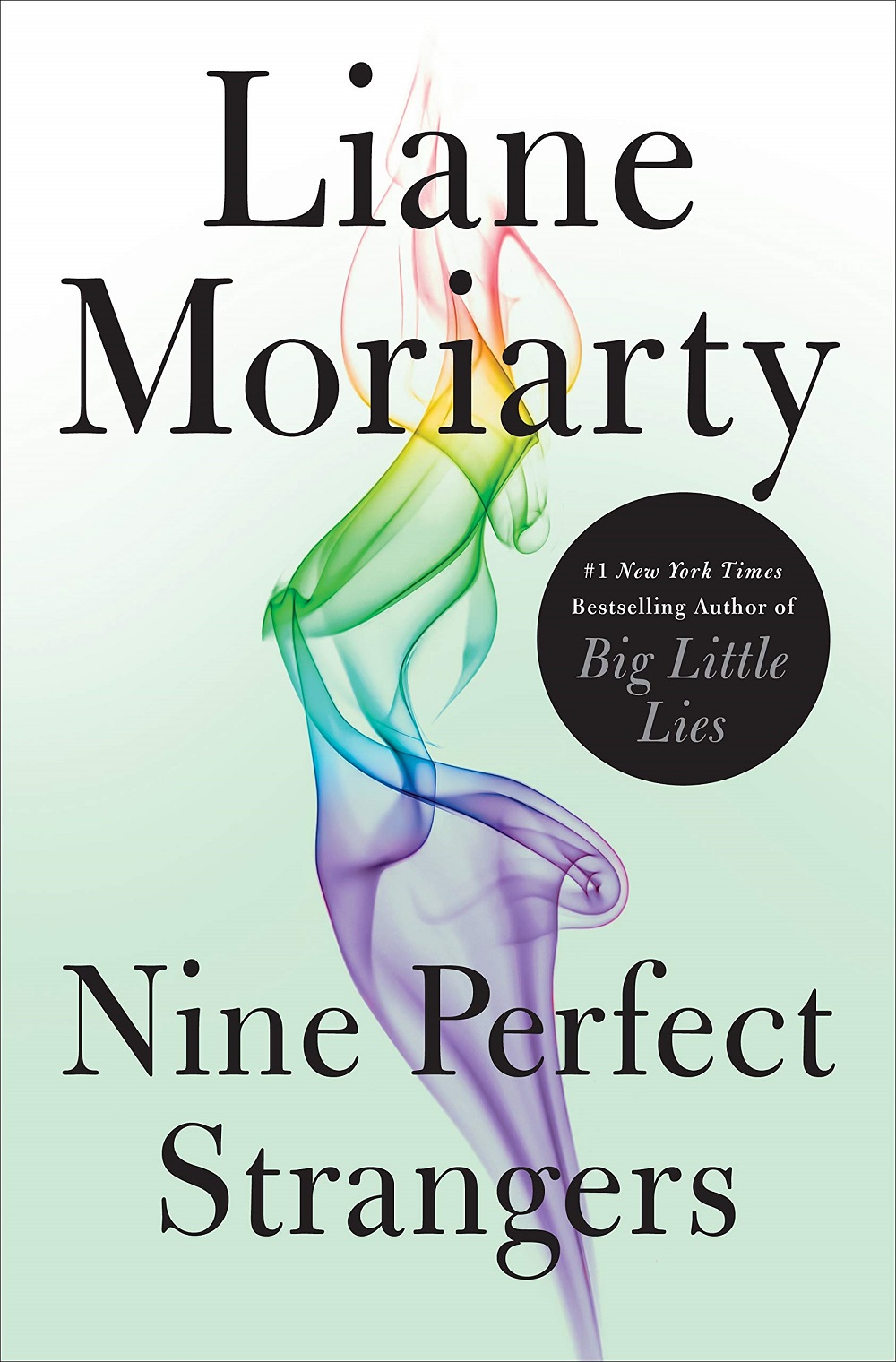
The television adaptation of ‘Nine Perfect Strangers’ is available now on Hulu. Photo: google
Liane Moriarty is the Australian author of eight internationally best-selling novels: “Three Wishes,” “The Last Anniversary,” “What Alice Forgot,” “The Hypnotist’s Love Story,” “Nine Perfect Strangers,” and the number one The New York Times bestsellers: “The Husband’s Secret,” “Big Little Lies,” and “Truly Madly Guilty.” Her books have been translated into over forty languages and sold more than twenty million copies. “Big Little Lies” and “Truly Madly Guilty” both debuted at number one on The New York Times bestseller list – the first time ever by an Australian author. “Big Little Lies” was adapted into a multiple award-winning HBO series with a star-studded cast including Nicole Kidman and Reese Witherspoon. Hulu adapted “Nine Perfect Strangers” into a limited series starring Nicole Kidman and Melissa McCarthy and is available as of August 18, 2021. (amazon, 2021)
“Nine Perfect Strangers” – Nine people gather at a remote health resort. Some are here to lose weight, some are here to get a reboot on life, some are here for reasons they cannot even admit to themselves. Amidst all the luxury and pampering, the mindfulness and meditation, they know these ten days might involve some real work. But none of them could imagine just how challenging the next ten days are going to be. Frances Welty, the formerly best-selling romantic novelist, arrives at Tranquillum House nursing a bad back, a broken heart, and an exquisitely painful paper cut. She is immediately intrigued by her fellow guests. Most of them do not look like they need a health resort at all. But the person that intrigues her most is the strange and charismatic owner/director of Tranquillum House. Could this person really have the answers Frances did not even know she was seeking? Should Frances put aside her doubts and immerse herself in everything Tranquillum House has to offer – or should she run while she still can? It is not long before every guest at Tranquillum House is asking the same question.
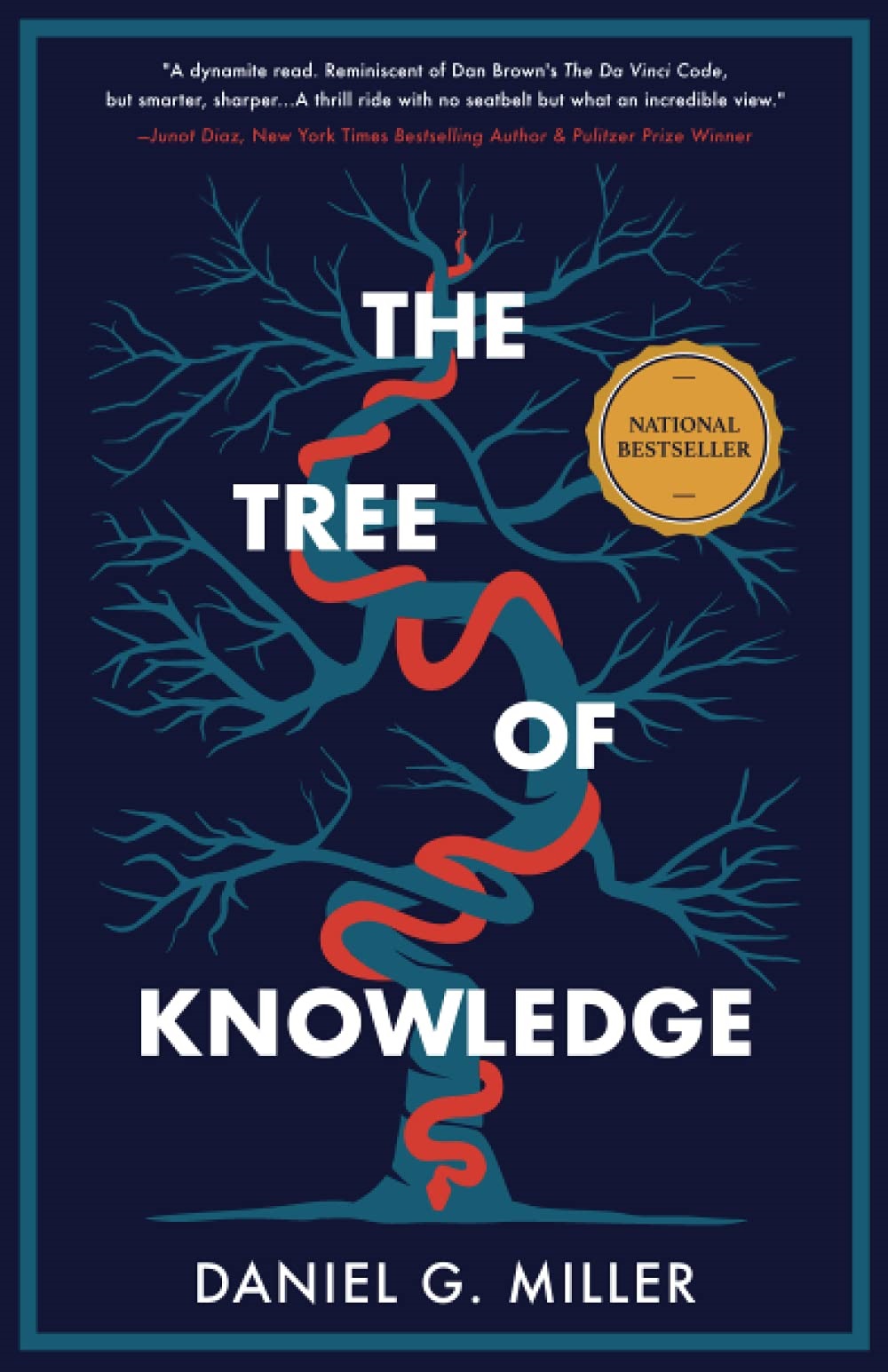
‘The Tree of Knowledge’ is book one in The Tree of Knowledge series. Photo: amazon
Daniel G Miller is a writer and entrepreneur. He currently lives in Dallas with his wife Lexi. “The Tree of Knowledge: A Mystery Thriller” is his debut novel, the first in The Tree of Knowledge series. The second is “Of Good and Evil: A Thriller.” (amazon, 2021)
“The Tree of Knowledge: A Mystery Thriller” – Albert can see the future, he just does not know it yet. It is said that the greatest chess masters can envision a match’s outcome ten moves before it occurs. Imagine a person who can visualize ten steps ahead, not simply in the game of chess, but in every human interaction. Imagine a person who could anticipate what you would say before you said it, who could see a punch before it was thrown. Imagine a person who could see the chess game of politics, economics, and power itself unfold long before it happens. Imagine a secret that could make all of this possible.
Mathematics professor Albert Puddles is such a person, and as he is thrust into a murder and burglary investigation on the Princeton campus, he finds that there is such a secret buried in an obscure cipher. The discovery leads Albert to team up with an aging mentor, a curious graduate assistant, and an unusual “book club” on a frantic chase across the country to recover the secret and clear his name. Through this adventure, Albert rediscovers a woman from his past and is forced to confront his own understanding of love, rationality, power, and the limits of the human mind.
Albert has seen the future…does he have the power to change it? An unstoppable force is sweeping the United States. Powered by a secret ability to predict and manipulate events, Christina Culebra and her Red Army relentlessly accumulate followers with one goal in mind: Absolute Power.
While Christina and her movement captivate the country, the one man who knows their next move– who knows their every move–Mathematics Professor Albert Puddles, hides, grief-stricken from the loss of his one and only mentor. Hoping that Albert holds the key to solving the secrets of the Red Army, his comrades in arms, known as the “Book Club,” recruit friends and foes alike to bring him back from exile. But they may be too late, for a new enemy has risen to challenge Christina and disrupt the Book Club’s plans, a mysterious terrorist known only as “The Cipher.” Faced with twin threats to everything he holds dear, Albert is forced to use his singular power to decode the riddles of a dead man while reckoning with the ghosts of his past.
‘Of Good and Evil: A Thriller’ is book two of The Tree of Knowledge series. Photo: amazon








 SA Examiner