‘White Light’ and the Element of Life and Death: A Luminous Journey Through Phosphorus

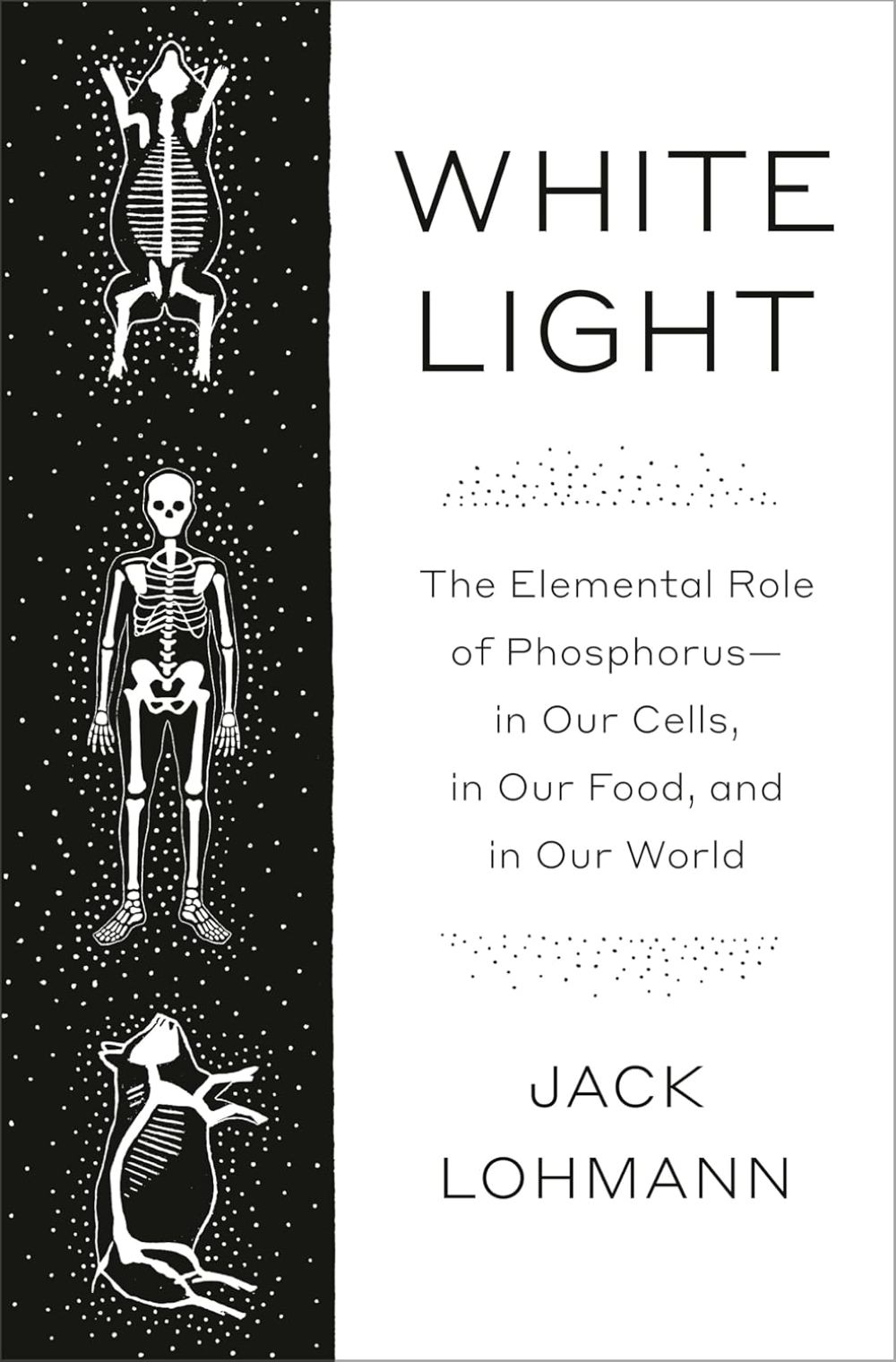
‘White Light’ is a profound and poetic reflection on the cyclical nature of life. Photo: Amazon

White Light: The Elemental Role of Phosphorus—in Our Cells, in Our Food, and In Our World
By Jack Lohmann


Related post: Phosphorus and the Pulse of the Planet: A Look at Jack Lohmann’s ‘White Light’

📖 Review

In White Light, Jack Lohmann delivers a deeply poetic and intellectually rich exploration of phosphorus—the vital yet often overlooked element that both fuels life and marks our decay. Bridging science, history, and philosophy, Lohmann traces phosphorus from the explosive discoveries of alchemy to its indispensable role in DNA, agriculture, and human biology.

White Light is not just about chemistry—it’s a meditation on life, death, and renewal. Lohmann’s lyrical prose elevates the science into something profoundly human.

“Cracked concrete spread out before us, brick ruins, graffiti: the grim equality of destruction by fire.”

He writes not only about phosphates and fertilizers but about our estrangement from the cycles of nature—how we strip-mine the earth and sanitize death, forgetting the ways in which decay feeds rebirth. With urgency and grace, Lohmann calls for a new reverence for the Earth’s resources and a restored relationship with our mortality.

Part science writing, part cultural critique, part spiritual inquiry, readers will walk away with a deeper understanding of phosphorus and more importantly, questioning how we live and die within a closed loop of matter and meaning. He makes the subject easy to understand and accessible to anyone, regardless of their knowledge of science.


✍️Table of Contents

Prologue: Whale Fall

Part I: Life

  1. Sea of Fires
  2. The Acid Test
  3. Lightbringer

Part II: Growth

  1. Stones from Past Times
  2. Rapid Change
  3. The Flood
  4. Peak and Valley

Part III: Rebirth

  1. The End of Everything
  2. Overhaul
  3. Tiny Tracings on a Future World

White Light glows with insight and care, illuminating life’s most fundamental—and fleeting—connections. It is recommended for readers interested in the intersections of science, sustainability, and the soul.

“Cities are composting food scraps. Disenfranchised farmers are fighting for their land. If we listen to those with knowledge—rather than those with money—it is possible to restore the cycles of the earth.”

Rating: 4 out of 5.

* Thank you to Pantheon Books/Penguin Random House for the gifted copy for review consideration. I have not been compensated for this review and all views and opinions expressed are my own.

Phosphorus and the Pulse of the Planet: A Look at Jack Lohmann’s ‘White Light’

‘White Light’ by Jack Lohmann. Photo: Amazon

Phosphorus is a vital mineral that plays a crucial role in everyday life. It is essential for the formation of bones and teeth, working alongside calcium to keep them strong and healthy. Phosphorus also helps the body produce energy by aiding in the conversion of nutrients into ATP, the main energy source for cells. Additionally, it supports kidney function, muscle contractions, and nerve signaling. Found in foods like meat, dairy, nuts, and legumes, phosphorus is a key part of a balanced diet. Without it, many of the body’s essential systems would not function properly, highlighting its importance to overall health.

For readers interested in the subject, the new book “White Light” by Jack Lohmann might be of interest.

Jack Lohmann is a science writer and author of “White Light.” Lohmann has been awarded the John McPhee Award for Interdisciplinary Reporting. He received his undergraduate degree from Princeton University where he majored in English and Environmental Studies. He currently lives in Scotland. (Pantheon Books/Penguin Random House, 2025)

“White Light” A profound and lyrical reflection on the cyclical nature of life, what happens when we break that cycle, and how to repair it—told through the fate of phosphorus: in our bedrock, in our fertilizers, in our food, and in our cells.

“There would be no life without constant death.” So begins Jack Lohmann’s remarkable debut, “White Light,” a mesmerizing swirl of ecology, geology, chemistry, history, agricultural science, investigative reporting, and the poetry of the natural world. Wherever life has roamed, its record is left in the sediment; over centuries, that dead matter is compacted into rock; and in that rock is phosphate—one phosphorus atom bonded to four oxygen atoms—life preserved in death, with all its surging force.

In 1842, when the naturalist John Stevens Henslow, Darwin’s beloved botany professor, discovered the potential of that rock as a fertilizer, little did he know his countrymen would soon be grinding up the bones of dead soldiers and mummified Egyptian cats to exploit their phosphate content. Little did he know he’d spawn a global mining industry that would change our diets, our lifestyle, and the face of the planet.

Lohmann guides us from Henslow’s Suffolk, where the phosphate fertilizer industry took root, to Bone Valley in Central Florida, where it has boomed alongside big ag—leaving wreckage like the Piney Point disaster in its wake—to far-flung Nauru, an island stripped of its life force by the ravenous young industry. We sift through the Earth’s geological layers and eras, speak in depth with experts and locals, and explore our past relationship with cyclical farming—including in seventeenth century Japan, when one could pay their rent with their excrement—before we started wasting just as much phosphate as we mine. Sui generis, filled with passion and rigorous reporting, “White Light” invites us to renew our broken relationship not just with the Earth but with our own death—and the life it brings after us.

PRAISE FOR ‘WHITE LIGHT’
“A surprisingly riveting look at the role of death, in life, as illustrated via a single element.”
—Kirkus Reviews

“In this winding debut history, science writer Lohmann traces how phosphorus has shaped the natural world and human history. […] A stimulating study.”
—Publishers Weekly

“Via lyric, literary prose and journalistic storytelling, Lohmann lays bare a hidden ecological tragedy for scientifically curious readers.”
—Library Journal

“Lohmann robustly reports on the serious health hazards and environmental consequences of phosphate mining and processing.”
—Booklist