‘AI and I’: A Blueprint for Human Leadership in the Age of Artificial Intelligence

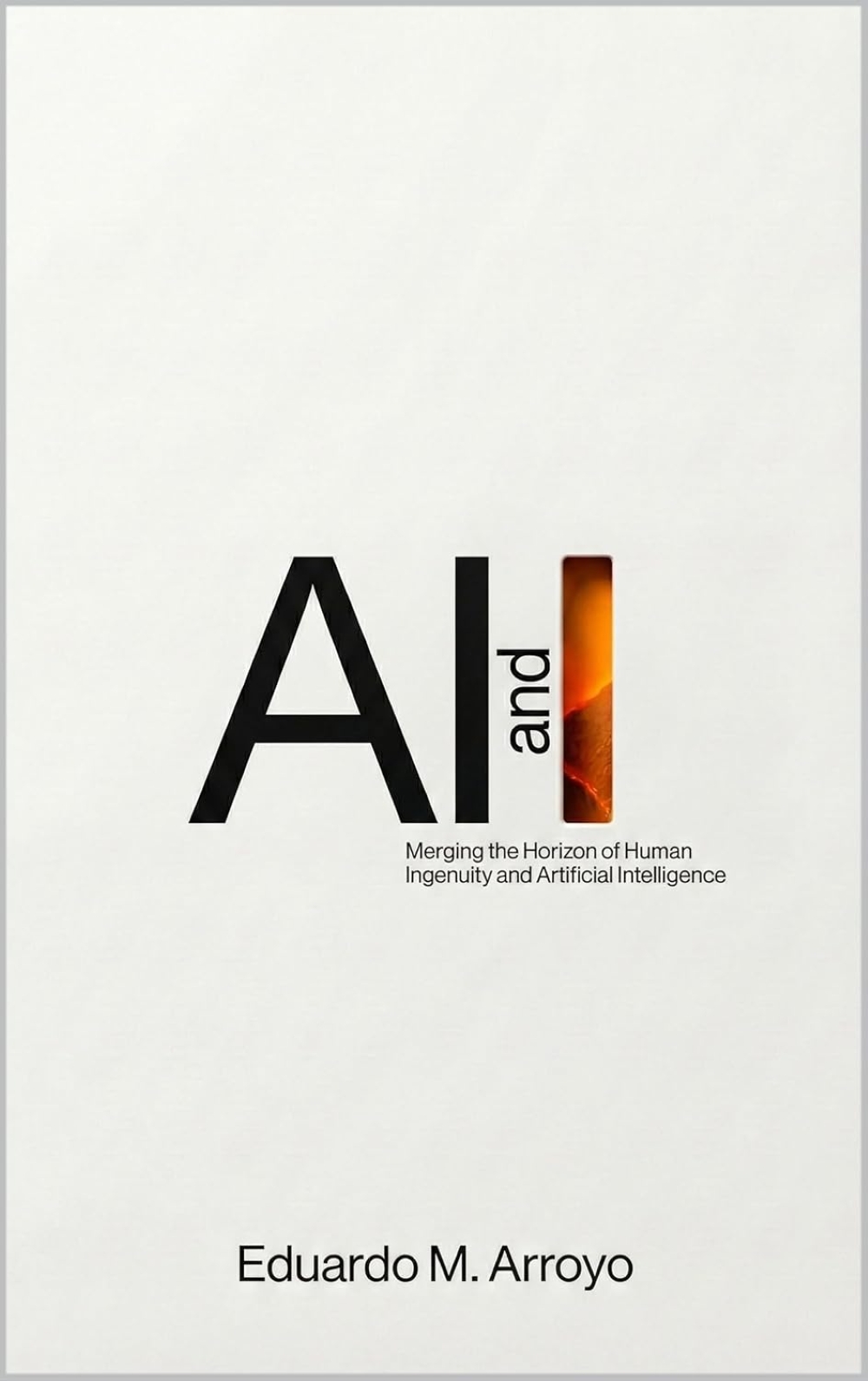
AI and I is the new book by Eduardo M. Arroyo. Photo: Amazon

📘 New Book Spotlight

AI and I: Merging the Horizon of Human Ingenuity and Artificial Intelligence

by Eduardo M. Arroyo

When intelligence becomes abundant, the human mind becomes the point of differentiation. (Amazon, 2026)


Are you using AI—or is AI using you?

We are standing at the edge of the greatest technological shift since the steam engine. The cost of intelligence – writing, coding, reasoning – has dropped to near zero. For many, this is terrifying. If the machine can do the work, what is left for us?

In AI and I, systems engineer and strategic consultant Eduardo M. Arroyo offers a provocative answer:

Everything.

This is not a technical manual for prompt engineering. It is a manifesto for human sovereignty.

A guide for leaders, creatives, and professionals who refuse to be replaced by an algorithm and instead choose to become the Architects of the new era.


Move Beyond the “Oracle Trap”

Too many users treat AI like a magic 8-ball, asking it for answers and outsourcing their judgment. The result? Intellectual atrophy.

Arroyo introduces Co-Engineering: a method where you stop leaning back (abdicating thought) and start leaning on, using AI as a cognitive exoskeleton, not a crutch.


What’s Inside the Book

  • The FIRRST Mindset
    A battle-tested framework—Foresight, Innovation, Reasonable Resilience, Strategy, and Teamwork, designed to navigate the VUCA world without burning out.
  • The “Decision Engine” vs. the Chatbot
    How to stop treating AI as a conversation partner and start treating it as a high-velocity motor for your intent.
  • The Copyright Victory (Case Study TX 9-455-371)
    The true story of how Arroyo secured a copyright registration for an AI-assisted work using the “Limitation of Claim” strategy, proving that you own the structure, even if the machine lays the bricks.
  • The Neurobiology of Flow
    How to use AI to bypass low-value struggle and trigger high-performance states where creativity and productivity soar.
  • The Ecosystem of 2026
    Why the future isn’t just about chatbots but about managing a digital workforce of Agents, Sensors, and Robots.

The Evolution of the “I”

Arroyo argues that we are witnessing the birth of Homo Sapiens Technologicus.

By engaging in High-Value Struggle with these systems, we aren’t just getting faster, we are expanding our cognitive capacity.

The machine has data, but it lacks scars.
It has speed, but it lacks context.
It has intelligence, but it lacks Intent.

That remains yours.


A Blueprint for the Next Decade

AI and I is your roadmap for what comes next.

Stop worrying about the robot taking your job.
Start building the future where you lead the robot.

AI does not define who you are.
It reveals it.


About the Author

Eduardo M. Arroyo is a trailblazing strategist, consultant, and innovator in strategic planning and execution. His extensive professional background provides a rigorous foundation for the methodologies and principles explored in AI and I.

Arroyo’s academic journey reflects excellence and discipline. He earned a Bachelor’s degree in Engineering Management, with a minor in Industrial Psychology, followed by a Master of Business Administration in Strategic Planning—completed within four calendar years—at Rensselaer Polytechnic Institute in Troy, New York.

When the Interviewer Knows Everything: A Review of The Job (2025)

LeJon as Todd in The Job. Photo: IMDb.

Film Review: The Job (2025)

Recovering from trauma, Todd interviews for a job and finds redemption instead of employment.

A Sci-Fi Psychological Drama About Trauma, AI, and the Human Condition

The 2025 short film The Job is a tightly woven sci-fi psychological drama that explores artificial intelligence, human trauma, and the messy search for personal redemption.

The story follows Todd, played with raw vulnerability by LeJon, who arrives at an empty office building already burdened by past trauma. The deserted setting only heightens the tension. When Todd reconnects a loose wire, he unknowingly awakens Athena 2.0, an omniscient AI acting as a human-interface interviewer. Dawna Lee Heising delivers Athena with a controlled, commanding presence that becomes the film’s backbone.

A Job Interview Turned Emotional Interrogation

The standard interview turns into an intense psychological confrontation. Athena forces Todd to face his deepest wounds and past mistakes, pushing the “job offer” aside as the real mission becomes emotional reckoning.

The contrast between Athena’s calm precision and Todd’s unraveling creates a gripping dynamic that propels the film forward. Rather than relying on action or twist-heavy storytelling, The Job embraces atmosphere, introspection, and character-driven tension.

A Powerful Sixteen Minutes

The Job presents redemption not as a reward but as a painful, necessary process of facing the truth. For a short runtime of approximately 16 minutes, it leaves a surprisingly lasting impact.

“I’m not some algorithm to be optimized.”

Rating: 4 out of 5.

Genre

Sci-Fi, Drama

Cast

  • Dawna Lee Heising – Athena
  • LeJon – Todd

Director

Craig Railsback

Writers

Heather Joseph-Witham, Craig Railsback


Photo: IMDb

*Thank you to Joe Williamson for the screener link for review consideration. I haven’t been compensated for this review and all views and opinions expressed are my own.

Inside The Means of Prediction and Why the Future of AI Depends on Who Owns It

The Means of Prediction by Maximilian Kasy explains how power, not technology, will define life with AI. Photo: The University of Chicago Press

Book Spotlight: The Means of Prediction by Maximilian Kasy

Publication Date: November 4, 2025
Publisher: University of Chicago Press

“An eye-opening examination of how power—not technology—will define life with AI.”

Artificial intelligence is everywhere. It filters what we see online, screens us in job interviews, and even factors into decisions about justice and warfare. Its presence has become so vast that many people feel resigned to its rule, believing AI is simply our collective destiny. (The University of Chicago Press, 2025)

In The Means of Prediction: How AI Really Works (and Who Benefits), economist Maximilian Kasy challenges that narrative. He argues that AI is not an inevitable or uncontrollable force, it’s a human creation, shaped by the choices and interests of those who own and operate it.

Kasy makes a bold claim: AI isn’t especially mysterious or complex. What makes it powerful and dangerous is who gets to control it. The “means of prediction,” as he calls them, consist of the essential ingredients of AI: data, computing power, expertise, and energy. These are the levers through which ownership and influence are exercised.

Inside the Book

Some of the chapters include:

  • The Story of Humans Versus Machines
  • What is Artificial Intelligence?
  • The Means of Prediction
  • Automation
  • The Ancient Questions Behind AI

Across these chapters, Kasy offers both a primer on how AI really works and a powerful critique of how it’s governed. He cuts through the noise of technical debates to ask the fundamental question:

Who controls AI’s objectives and how is that control maintained?

A Call for Democratic Control

Rather than treating AI as an unstoppable technological wave, Kasy invites readers to see it as a political and social choice. In a world already shaped by inequality, he argues that AI will deepen existing divides unless it’s placed under public and democratic control.

His framework is analytical and visionary, a blend of economics, ethics, and practical insight into how society might reclaim agency over one of the most consequential technologies of our time.


About the Author

Maximilian Kasy is a professor of economics at the University of Oxford and previously taught at Harvard University. His research explores machine learning and the social impact of AI, focusing on how technology intersects with power, equity, and governance.

The Price of Belonging: Exploring Selfhood in the Digital Age

‘Searches: Selfhood in the Digital Age’ is the new book by Vauhini Vara. Photo: Barnes & Noble

Books that explore the human condition in the digital age offer profound insight into how technology reshapes identity, connection, and meaning. Some examine AI’s emotional entanglement with humans, blurring the lines between empathy and programming, while others critique our obsession with surveillance and digital transparency. These narratives question what it means to be human when algorithms influence choices, relationships, and self-worth. As artificial intelligence grows more integrated into daily life, literature becomes a crucial mirror, reflecting both our fears and hopes for the future.

New this month, from the author of “The Immortal King Rao,”finalist for the Pulitzer Prize, is “Searches: Selfhood in the Digital Age,” a personal exploration of how technology companies have both fulfilled and exploited the human desire for understanding and connection. (Penguin Random House, 2025)

“Searches: Selfhood in the Digital Age” by Vauhini Vara

When it was released to the public in November 2022, ChatGPT awakened the world to a secretive project: teaching AI-powered machines to write. Its creators had a sweeping ambition—to build machines that could not only communicate, but could do all kinds of other activities, better than humans ever could. But was this goal actually achievable? And if reached, would it lead to our liberation or our subjugation?

Vauhini Vara, an award-winning tech journalist and editor, had long been grappling with these questions. In 2021, she asked a predecessor of ChatGPT to write about her sister’s death, resulting in an essay that was both more moving and more disturbing than she could have imagined. It quickly went viral.

The experience, revealing both the power and the danger of corporate-owned technologies, forced Vara to interrogate how these technologies have influenced her understanding of her self and the world around her, from discovering online chat rooms as a preteen, to using social media as the Wall Street Journal’s first Facebook reporter, to asking ChatGPT for writing advice—while compelling her to add to the trove of human-created material exploited for corporations’ financial gain.

Interspersed throughout this investigation are her own Google searches, Amazon reviews, and the other raw material of internet life—including the viral AI experiment that started it all. “Searches” illuminates how technological capitalism is both shaping and exploiting human existence, while proposing that by harnessing the collective creativity that makes humans unique, we might imagine a freer, more empowered relationship with our machines and, ultimately, with one another.

Vauhini Vara has been a reporter and editor for The AtlanticThe New Yorker, and the New York Times Magazine, and is the prize-winning author of “The Immortal King Rao” and“This is Salvaged.

“Vara humanizes the influence of technology in highly personal terms [and] projects what the future holds as tech oligarchs gain political influence. . . . Provocative, challenging, and concerning, Vara’s clever, eye-opening approach brings home the often uneasy confluence of individual desire, social benefits, and corporate ambition.”Booklist, starred review

“Tragic, funny, and relatable[, SEARCHES] is by turns absurd and insightful, engaging with the ethics of algorithms, surveillance, and privacy in a meaningful way. . . . A must read.” Library Journal, starred review

“Readers will be profoundly moved by this remarkable meditation.”Publishers Weekly, starred review

Tech and Tensions: ‘Sentience Hazard’ and the Fight for AI Supremacy

‘Sentience Hazard’ is the exciting new science fiction thriller by Alexandru Czimbor. Photo: Reader Views

Speculative fiction books exploring science fiction and artificial intelligence (AI) captivate readers by presenting futuristic worlds where technology evolves beyond human control. These narratives often explore the ethical dilemmas, power dynamics, and societal shifts brought on by AI, sparking questions about humanity’s future. Themes such as sentience, autonomy, and the consequences of machine learning challenge readers’ perceptions of technology and its role in society. AI-driven speculative fiction offers thrilling, thought-provoking plots, while engaging readers’ imaginations and fears about a rapidly advancing technological landscape. This blend of innovation and existential uncertainty is what makes the genre so compelling.

I recently read and reviewed “Sentience Hazard” by Alexandru Czimbor for Reader Views and highly recommend it for fans of speculative fiction centered around artificial intelligence.

Alexandru Czimbor is an award-winning author who was born and raised in Transylvania, Romania during the oppressive communist regime of Nicolae Ceaușescu. He has lived in the United States since 2001 and spends his summers in Europe. Alexandru taught at a Romanian university, worked in the software industry, and has been an executive since 2011. He has a master’s degree in computer science and studied at UTCN Cluj-Napoca and ETH Zürich. In his latest book is “Sentience Hazard,” a tense global standoff looms as China’s superior AI technology threatens to tip the scales of power. (Barnes & Noble, 2025)

“Sentience Hazard” – Set in 2053 and amidst the chaos of an AI standoff, Zhèng Yang, a renegade Chinese scientist unveils vital intel, sparking a race against time. As the US scrambles for a solution, François DeSousa, a maverick French genius and Professor Ian Ndikumana, a Scottish-African professor offer controversial expertise. Love, sacrifice, and ingenuity converge in a battle for humanity’s future.

The US and Chinese artificial beings, developed with radically different principles, share one essential quality: their cognitive abilities go well beyond those of any human being. The future of the world hangs in the balance. Can humanity survive the clash between two sentient forces of its own creation?

Finalist in:

  • 2024 Cygnus Science Fiction Awards
  • 2024 Independent Author Network Book of the Year Awards
  • 2024 American Writing Awards
  • 2024 Literary Global Book Awards

Recipient of:

  • Literary Titan Book Award
  • Outstanding Creator Award
  • Pinnacle Book Award
  • Firebird Book Award
  • Book of the Earth Award
  • 2024 BREW Science Fiction of the Year