
New Documentary Spotlight: TO USE A MOUNTAIN
Facet, Narrow Vision Endeavors, and Correspondent Productions Present:
TO USE A MOUNTAIN
- Director, Cinematographer, Editor: Casey Carter
- Producers: Colleen Cassingham, Jonna McKone
- Executive Producers: Brett Story, Maida Lynn, Ryan Krivoshey
- Format: Feature Documentary | USA, 2025 | 99 Minutes
Release & Screening Information
- Theatrical Release: Opens theatrically at DCTV in New York on Friday, August 21, with a regional theatrical expansion to follow.
- VOD Release: Coming in 2027 via Grasshopper Film.
- Community Screenings: TO USE A MOUNTAIN is currently screening with frontline communities across the country confronting issues of nuclear waste, nuclear weapons production, and next-generation nuclear projects initiated in response to the energy demands of the AI data center boom.
Festival Accolades
- Visions du Réel (Switzerland) — World Premiere | Special Jury Award, International Competition
- Dallas IFF (Dallas, Texas) — Documentary Feature Competition
- DOXA (Vancouver) — Best Feature Honorable Mention, ParaDOXA Forum
- IDFA (Amsterdam) — Best of Fest
- Big Sky (Missoula, Montana) — Official Selection
- And many more…
Synopsis
In 1982, six rural communities across the United States were notified that all of the nation’s nuclear waste might be buried beneath them forever. (EG PR, 2026)
Faced with a mandate to isolate the waste for 10,000 years, the Department of Energy mapped, analyzed, and assembled its assessments, while the unsuspecting stewards of sacrificial territory found themselves fighting for their homes, health, history, and dignity.
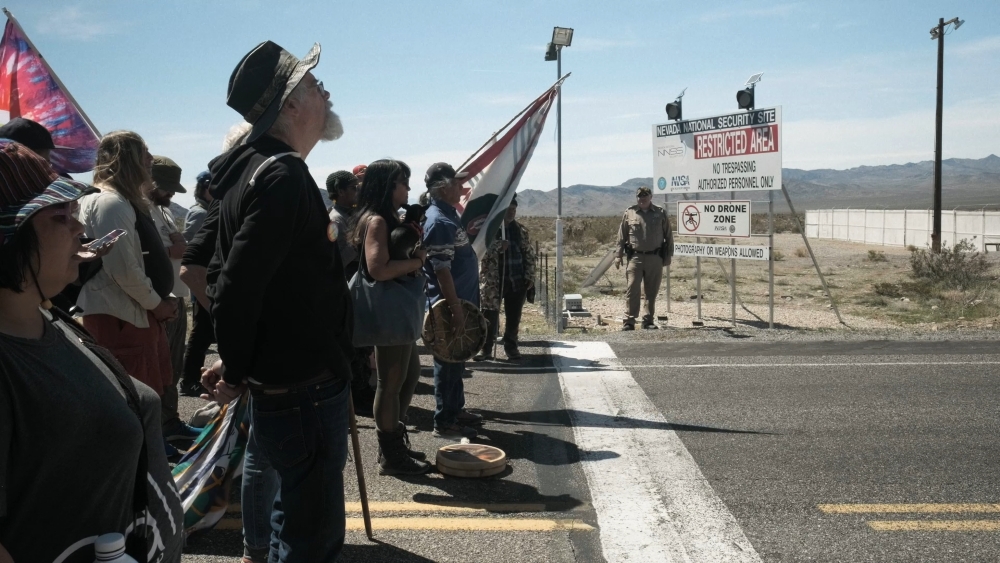
In the end, one site was chosen: a desert ridge in Nevada called Yucca Mountain, on the unceded lands of the Western Shoshone. After decades of controversy, construction at Yucca Mountain was halted, and to this day, no permanent solution has been devised for America’s 90,000 tons of high-level nuclear waste.
Against the impassive logic of government analysis and archives, TO USE A MOUNTAIN assembles a people’s history of resistance and stewardship through a visceral journey across the landscapes, ecologies, and personal histories of the candidate sites. Farmers, miners, citizen scientists, Native American leaders, and activists—each with a story bound to this enduring threat—stand in stark contrast to the cold, silent machinery of bureaucracy, in a meditation on resistance, memory, and the timeless struggle between power and place.
About the Filmmaker: Casey Carter
Casey Carter is a filmmaker and interdisciplinary designer whose work engages nonfiction storytelling in film and video, photography, data visualization, and cartography. His work centers around themes of governmentality, geography, environmentalism, and personal subjectivities.
Prior Work & Background
His short films—TWO BOYS AND A DREAM (2023), TWO PRISONS (2020), and THE RIGHTS OF NATURE (2019)—have screened at festivals including Revolutions Per Minute, SF Shorts, Salem, Ashland Independent, and Hong Kong Film Art.
He holds a B.S. in Physics and a B.S. in Photography from Middle Tennessee State University, as well as a Master of Architecture from the University of Michigan.
Grants & Recognition
His work has been supported through grants and fellowships from institutions including:
- Sundance Documentary Film Program
- International Documentary Association (IDA)
- UnionDocs Center for Documentary Art
- New York Foundation for the Arts
- The Marble House Project
- Monson Arts
- The Redford Center
- SFFILM
- Flies Collective


