
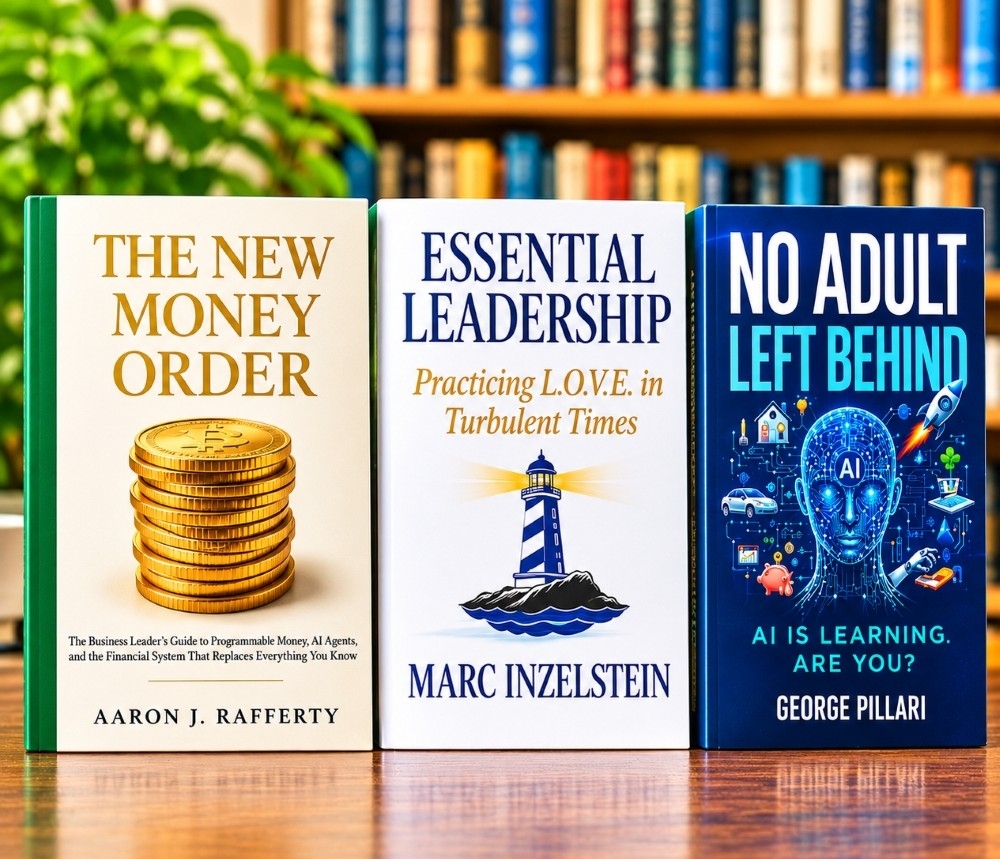
Books of the Week: Navigating the Future of Money, Leadership, and AI
Welcome to this week’s book spotlight! Whether you are looking to decode the emerging digital economy, revolutionize how you lead under pressure, or finally demystify artificial intelligence for your day-to-day life, these three essential reads offer practical playbooks from seasoned experts. (Barnes & Noble, 2026)
By Aaron J. Rafferty
About the Book
Money is becoming software and software follows instructions.
In The New Money Order, entrepreneur and researcher Aaron J. Rafferty maps the collision of two technological revolutions: programmable money and artificial intelligence. He shows business leaders exactly how this convergence is already reshaping real estate, financial services, philanthropy, the creator economy, and every industry that moves value from one place to another.
This isn’t just theory; Rafferty built the systems he writes about:
- Co-founded a media company reaching over 1 million subscribers.
- Launched an AI venture studio generating real revenue.
- Created the EAT token (a “cause coin”) that has funded nearly 10,000 meals through everyday trading activity rather than traditional donations.
From watching a Filipino contractor wait three days for a wire transfer to launching a token on a WeWork whiteboard in Irvine, Rafferty grounds complex technological shifts in real lived experience. Drawing on Ray Dalio’s 150-year geopolitical cycles and Carlotta Perez’s frameworks for technological revolutions, he traces the arc from the 1910 Jekyll Island meeting to today’s open-source protocols.
BlackRock tokenizing treasury bonds, JPMorgan issuing programmable deposits, Wyoming granting legal standing to decentralized organizations, and AI agents operating digital wallets, the signals are everywhere. The New Money Order provides the framework to read them and the playbook to act on Monday morning.
About the Author
Aaron J. Rafferty is a behavioral scientist turned serial technology entrepreneur who builds companies at the intersection of technology and social impact. As an NIH-funded behavioral scientist, he published one of the earliest peer-reviewed studies on AI-powered health interventions in the Journal of Medical Internet Research before leaving his PhD program to build businesses. Through his parent company, Standard, Rafferty manages a portfolio spanning AI data products, programmable impact infrastructure, and media.
2. Essential Leadership: Practicing L.O.V.E. in Turbulent Times
By Marc Inzelstein
About the Book
What if the way you’ve learned to lead is exactly what’s holding you back?
You’re performing, delivering, and solving problems. By every external measure, you’re doing everything right. So why does it feel like you’re carrying more while creating less of what truly matters?
Many high-achieving leaders fall into a quiet pattern: under pressure, they push harder, exert more control, and take on extra burden. It works, until it doesn’t. Over time, this leads to strain, disconnection, and a persistent sense that something is missing.
In Essential Leadership, executive advisor Marc Inzelstein offers a fundamentally different path based on a simple truth: you don’t control what happens, but you always have a choice in how you respond.
Key insights from the book include:
- The Space Between Stimulus and Response: How to access awareness, presence, and deliberate action in high-stakes moments.
- The Leadership Heartset: Moving beyond control-and-performance models to integrate both mindset and heartset.
- Leading Through Complexity: Sustainable strategies for leaders who are succeeding on paper but feeling the physical and emotional weight of how they lead.
If you’re ready to lead with greater clarity, steadiness, and impact under pressure, Essential Leadership provides the roadmap.
About the Author
Marc Inzelstein is an executive advisor and leadership strategist to senior leaders of global organizations. With over 25 years of experience, he works closely with executive teams to navigate complexity, align around core priorities, and translate strategy into meaningful action. His work focuses on how leaders show up under pressure and shape the culture around them.
3. No Adult Left Behind: AI is Learning. Are You?
By George Pillari
About the Book
If you have been watching the AI conversation from a distance wondering if the window to get on board is closing, this book was written for you.
George Pillari spent his career in crisis management, where reading dense contracts and presenting to corporate boards were standard routines. When consumer AI arrived, he approached it like any working adult: using it to solve immediate, everyday problems—from a confusing stereo receiver and prescription labels to reviewing candidate resumes.
What he learned along the way became No Adult Left Behind. Pillari writes like a knowledgeable friend who has done the homework and wants to save you months of trial and error:
- Honest & Practical: Written in plain, conversational language with zero coding required.
- Real-World Focus: Teaches you how to integrate AI directly into your work and daily life.
- Skeptical & Grounded: Cuts through tech hype to focus strictly on what works.
If you have been waiting for an approachable, non-technical guide to embrace artificial intelligence, this is the book to get you started.
About the Author
George Pillari holds a B.S. in Mathematical Sciences from the Whiting School of Engineering at The Johns Hopkins University. He has served as a crisis manager for more than 100 companies, acting as a source of truth for boards, investors, and lenders in high-leverage situations. Through analyzing failing businesses, he identified recurring errors in executive judgment, organizing them into a framework known as The Seven Deadly Stupidities. His insights have been featured on CNN and quoted in The Wall Street Journal, The New York Times, and The Washington Post.

