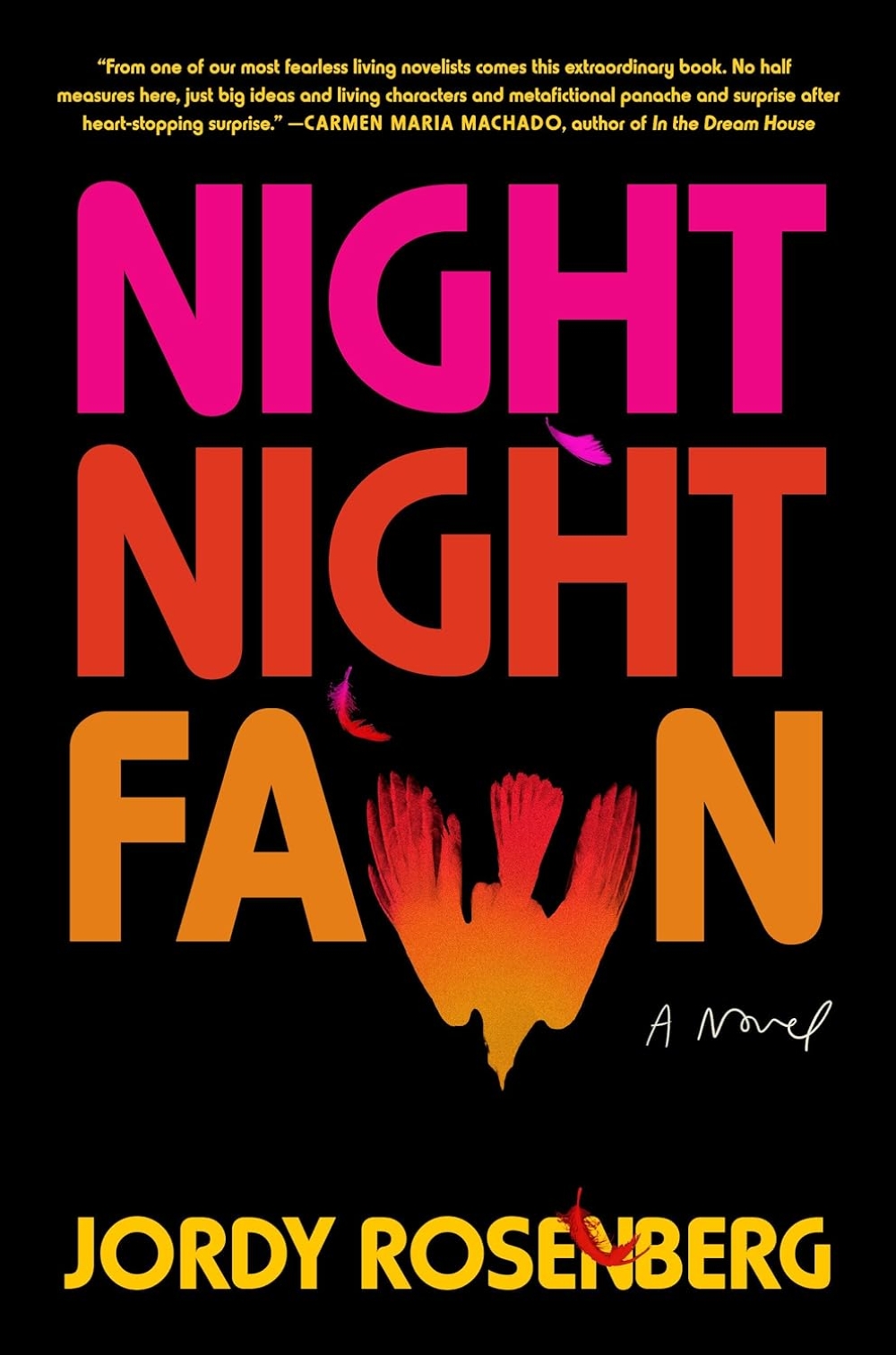
‘Night Night Fawn’ is a Bold and Unfiltered Novel About Family and Reckoning

‘Night Night Fawn’ is the new novel by Jordy Rosenberg. Photo: Barnes & Noble

Book Review: Night Night Fawn by Jordy Rosenberg

Overview

From the acclaimed author of Confessions of the Fox comes a novel that feels like an unauthorized memoir dictated in a fever dream. Set in a cluttered, rent-controlled Manhattan apartment, Barbara Rosenberg is terminally ill, high on opioids, and utterly unrepentant. Night Night Fawn will be released on Tuesday March 3, 2026 and available for pre-order. (Broadside PR, 2026)

As she writes the story of her life, she spares no one, least of all herself. Her narrative skips between memories of a smutty late husband, a career with a disreputable plastic surgeon, and her “glory days” of jazzercise, all while she grapples with unhinged thoughts on gender, Karl Marx, and Zionism.

At the heart of her delirium are two haunting disappointments:

  • An estranged trans son.
  • A long-lost best friend whose betrayal still lingers.

Review: A Reckoning in Real-Time

Written in a sharp first-person POV, Night Night Fawn forces readers to confront the jagged edges of intergenerational conflict. Barbara’s voice pivots effortlessly between gutter humor and piercing self-awareness. Rosenberg provides an unfiltered portrait of a mother who cannot love cleanly, apologize easily, or die quietly. Themes explored include identity, colonialism, sexuality, and gender.

The prose is vivid and descriptive, turning even the mundane into something cinematic:

“In my daughter’s bedroom the traffic along Second Avenue cast stripes of light through the blinds; they floated across the ceiling like empty frames of film reel ticking off after a show.”

The narrative structure is nonlinear, mirroring Barbara’s descent into illness. It’s a bold exploration of the stories we tell ourselves when time is running out. While the novel is provocative and often uncomfortable, it remains a fiercely intelligent reminder of our shared, messy humanity.

Recommended for: Fans of family life fiction and unconventional memoirs who appreciate raw, “unfiltered” storytelling.


Key Quotes

“As I started down the ramp of sleep, I could feel my mind begin to unravel, like a piece of knitting being pulled out to correct a slipped stitch.”

Rating: 4 out of 5.

About the Author

Jordy Rosenberg is the author of Confessions of the Fox, a New York Times Editors’ Choice selection and finalist for numerous prestigious awards, including the Center for Fiction First Novel Prize and the Lambda Literary Award.

A recipient of support from the MacDowell and Lannan Foundations, Rosenberg currently serves as a professor in the Department of English and MFA Faculty at UMass-Amherst.


*Thank you to Broadspire PR/NetGalley for the gifted ARC for review consideration. I haven’t been compensated for this review and all views and opinions expressed are my own.

1772572242

  days

  hours  minutes  seconds

until

Night Night Fawn release date

Book to series adaptation: ‘The Tattooist of Auschwitz’ by Heather Morris

‘The Tattooist of Auschwitz’ has been adapted into a Peacock original series. Photo: Amazon

Historical fiction transports readers to bygone eras, blending fact with imaginative narrative. They resurrect ancient civilizations and wartime landscapes with meticulous research and vivid storytelling. Through the eyes of fictional characters, readers explore crucial events, from epic battles to intimate moments of daily life, offering insights into the human condition across time. These stories often combine real historical figures with invented protagonists, creating a rich tapestry of emotion, intrigue, and adventure. These books not only entertain but also educate, inviting readers to ponder the echoes of the past in our present and future. One such historical novel is The New York Times and International bestseller “The Tattooist of Auschwitz” by Heather Morris.

Heather Morris is a native of New Zealand, now living in Australia. For several years, while working in a large public hospital in Melbourne, she studied and wrote screenplays, one of which was optioned by an Academy Award-winning screenwriter in the US. In 2003, Heather was introduced to an elderly gentleman who ‘might just have a story worth telling.’ The day she met Lale Sokolov changed both their lives. Their friendship grew and Lale embarked on a journey of self-scrutiny, entrusting the innermost details of his life during the Holocaust to her. Heather originally wrote Lale’s story as a screenplay – which ranked high in international competitions – before reshaping it into her debut novel, “The Tattooist of Auschwitz.” It is a tale of hope and courage based on interviews that were conducted with Holocaust survivor and Auschwitz-Birkenau tattooist Ludwig (Lale) Sokolov—an unforgettable love story in the midst of atrocity. It has now been adapted into a Peacock original series (6 episodes) and will be available for streaming starting May 2, 2024. (Amazon, 2024)

“The Tattooist of Auschwitz” – In April 1942, Lale Sokolov, a Slovakian Jew, is forcibly transported to the concentration camps at Auschwitz-Birkenau. When his captors discover that he speaks several languages, he is put to work as a Tätowierer (the German word for tattooist), tasked with permanently marking his fellow prisoners.

Imprisoned for over two and a half years, Lale witnesses horrific atrocities and barbarism—but also incredible acts of bravery and compassion. Risking his own life, he uses his privileged position to exchange jewels and money from murdered Jews for food to keep his fellow prisoners alive.

One day in July 1942, Lale, prisoner 32407, comforts a trembling young woman waiting in line to have the number 34902 tattooed onto her arm. Her name is Gita, and in that first encounter, Lale vows to somehow survive the camp and marry her.

A vivid, harrowing, and ultimately hopeful re-creation of Lale Sokolov’s experiences as the man who tattooed the arms of thousands of prisoners with what would become one of the most potent symbols of the Holocaust, “The Tattooist of Auschwitz” is also a testament to the endurance of love and humanity under the darkest possible conditions.