‘The Middleman’ is Mike Papantonio’s new thought-provoking legal thriller. Photo: Barnes & Noble
“The Middleman” by Mike Papantonio is a gripping legal thriller that explores the high-stakes world of whistleblowers, corruption, and corporate greed. Drawing heavily from real-world headlines, the novel weaves a fast-paced narrative that’s as timely as it is thrilling. Papantonio, a renowned trial lawyer, uses his insider knowledge of the justice system to craft a story that feels disturbingly authentic.
The plot centers around Amy Redmond, the president of EirePharma, the Redmond family business and a powerful Pharmacy Benefit Manager (PBM). EirePharma was recently taken over by the charismatic CEO Connor Devlin who she suspects of using racketeering practices—and perhaps murder—to raise the prices of insulin for his own profit that ultimately harms consumers.
Amy is engaged to Connor but she tentatively decides to become a whistleblower as she tries to gather evidence to make sure Connor pays for his crimes. Nicholas “Deke” Deketomis and his law firm have a reputation for taking on America’s Big Pharma, so when Deke’s college friend and Amy’s cousin Matt Redmond presents him with a case of possible fraud, he agrees to investigate the matter. Amy is caught in the middle of a deadly game of wills between a formidable gangster, who in the eyes of the public is a respected businessman, and a law firm that is determined to investigate and uncover Connor’s crimes.
As the stakes rise, the characters are drawn into a deadly game of cat-and-mouse, where truth comes at a steep price. Murder, manipulation, and lies blur the lines between right and wrong, keeping readers on edge until the final page. The narration is non-linear, providing the necessary character development to make them relatable. There is not much court drama and the language doesn’t include too much legal terminology; instead, it focuses on the intense relationship between Amy and Connor, as Amy tries to gather the necessary evidence to convict him and Connor’s use of mobster-like tactics to preserve his way of life. Papantonio doesn’t just tell a story—he delivers a wake-up call about the consequences of unchecked power and the courage it takes to stand against it.
Overall, “The Middleman” is a suspenseful blend of mystery and moral urgency. By exploring the themes of family, friendship, justice, and good vs. evil, it creates a compelling and thought-provoking story. With sharp dialogue and a plot full of twists, this book is recommended for fans of John Grisham or anyone intrigued by the dark intersections of law, politics, and corporate influence.
*The author of this blog received a copy for an honest review. The views and opinions expressed here belong solely to her.
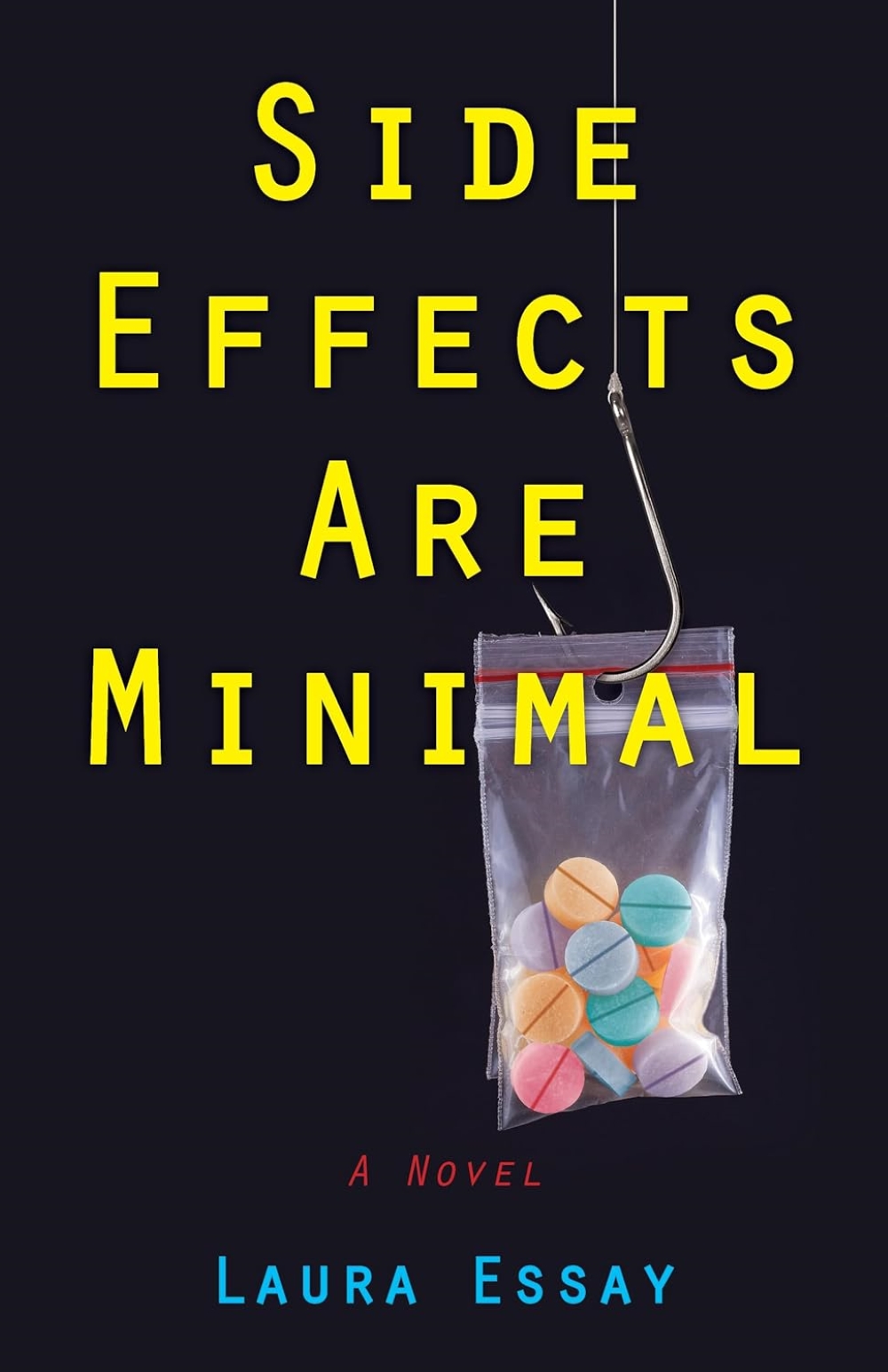
‘Side Effects Are Minimal’ is the new legal thriller by Laura Essay. Photo: Amazon
Laura Essay attended the University of Nebraska and obtained a law degree from Creighton University School of Law. When her three grown children moved on to graduate programs in other cities, writing became her passion. “Side Effects Are Minimal,” her debut novel, is about a corrupt pharmaceutical industry, the guilt of physicians prescribing the opioids that kill, and the pain experienced by families who have lost loved ones to a widespread epidemic. Her knowledge of the opioid crisis stems from her passion for research and countless hours spent searching for the truth about opioids in America.
Synopsis:
“Side Effects Are Minimal” – ambitious attorney Claire Hewitt is asked to represent the Satoris, one of Philadelphia’s most prominent families in a lawsuit over the death of their daughter Emma. She is thrust into an opioid nightmare with deadly impact—and not for the first time. Even after twenty years after her sister Molly’s death from what she believes to be an opioid-related death, Claire still feels guilty for not being able to help her. Now, with this new assignment, her guilt comes full circle. Who was really at fault in Molly’s death? And who is at fault now?
Claire struggles to balance her desire for justice with the Satoris’ thirst for revenge. She knows she needs to expose the greed that transforms legal opioid production into illicit fabrications and the neglect that is the breaking point between physicians and their patients. There are powerful people who will seemingly stop at nothing to prevent these truths from seeing the light of day, and she is sabotaged at every turn. Can she push past the obstacles in her way to build a winning case?
Review:
The opioid epidemic in America has devastated communities nationwide, claiming countless lives and leaving a trail of shattered families. Laura Essay expertly combines real events with a compelling narrative. The story begins as Claire is excited at being assigned the Sartoris case even though in the long run it might be a class action suit. She is nervous but looking forward to the challenge partially because the opioid crisis affected her family as well when her sister Molly passed away and she sees this case as a way to get justice for her as well. Her character is confident and qualified but right from the beginning when she is assaulted and her briefcase is stolen, it becomes evident that there will be strong forces out to stop her at all costs.
I was drawn to this novel because of its exploration of the human experience within the medical and legal systems. The fictional court case brings to light the heartache faced by families touched by this crisis and how it transcends demographics, but at least the parents in this story are lucky to be wealthy enough to be able to sue the pharmaceutical supplier. The courtroom drama and the hard work by the lawyers and everyone working behind the scenes to bring these cases to court is gripping and eye-opening.
Essay’s writing style makes it easy to follow the medical and legal terms because she doesn’t use overly complicated jargon. Her use of descriptive language immerses the reader in the action: “Beads of sweat glistened on his upper lip and beside the veins spider-webbing his nostrils.” The characters she creates are vivid and relatable, each struggling with their own challenges and triumphs. This story explores the themes of family, courage, and power/corruption and the challenges that come in times of crisis. Highlights include the in-depth research on the case and Chapter 24 No Friend of Mine when Claire is given the spotlight when the trial begins.
Overall, “Side Effects Are Minimal” is a compelling novel that reminds us of the power of the court system and the resilience of the human spirit in the face of medical challenges. It is recommended for readers interested in learning more about the opioid epidemic and enjoy medical thrillers by Robin Cook, legal thrillers by Mike Papantonio and John Grisham, and strong female characters.
“Claire’s movements revealed the sorrow she felt. Her fingers glided along each line as she read. She whispered their names. She grimaced and smiled and often looked to the ceiling for a break. She squeezed her eyes shut when a break wasn’t enough.”
*The author received a copy of this book for an honest review. The views and opinions expressed here belong solely to her.
‘No Truth Left to Tell’ is the exciting debut novel by attorney Michael McAuliffe. Courtesy photo, used with permission.
Michael McAuliffe has practiced law for over 30 years, including as a federal prosecutor, a trial attorney for the civil rights division of the Department of Justice and an elected state attorney in Florida. In his debut novel, “No Truth Left to Tell,” federal civil rights prosecutor Adrien Rush travels to small town Lynwood Louisiana to investigate an incident of four flaming crosses by the Ku Klux Klan meant to terrorize the southern town and start a new race war. He joins forces with Lee Mercer, a seasoned local FBI special agent and their partnership is tested as they clash over how far to go to catch the racists before the violence escalates.
“No Truth Left to Tell” begins with a Prologue set in Lynwood, Louisiana in July 1920 where a young black girl, Nettie Wynn, witnesses the horror of a lynching. In present day Lynwood, 1994, the quiet little town is about to be shattered by the resurgence of the Ku Klux Klan. They want to start a new race war and proceed to carry out a series of cross burnings at the local NAACP office, the courthouse, a home in the black neighborhood of Mooretown, a synagogue and an Islamic center. An elderly Nettie Wynn is the unfortunate victim in Mooretown and as a lifelong resident, these hate crimes bring back dreadful memories of her youth and unfortunately she suffers a heart attack. Her granddaughter Nicole DuBose, a successful journalist in New York City, returns to Lynwood to take care of her grandmother. Federal prosecutor Adrien Rush and Lee Mercer, a local FBI agent lead the investigation into the cross burnings without much luck until a local detective, Jimmy Batiste, arrests the Klan’s new grand dragon Frank Daniels and coerces a confession out of him. Frank is convicted but years later the truth surfaces about how Batiste got the confession and now the town is faced with an ethical dilemma: seeking justice for victims of hate crimes versus who truly deserves a “fair” trial.
Some of the best legal thrillers revolve around ethical dilemmas that make an easy conviction hard to obtain. Such is the case with “No Truth Left to Tell,” Michael McAuliffe’s excellent debut novel about a civil rights case in the Deep South. The courtroom drama is interesting and written without any complicated legal terms so it is easy to follow. Being himself a climber, the author uses plenty of climbing metaphors throughout: “A climber who’s given an extra bottle of oxygen in the death zone on Everest gratefully makes use of it” and regular metaphors as well “The Klansman’s strained breaths dissipated through the car’s interior like the smoky remains of a cheap cigar” both of which make the story really come alive. Foreshadowing is rarely used in modern novels but here it successfully builds the climax “Gill and Mercer both laughed, oblivious to the land mine that awaited.” The characters are relatable and well developed, especially Adrien Rush. This is a fascinating page-turner recommended for John Grisham fans. Hopefully this will turn into a series of novels featuring federal civil rights prosecutor Adrien Rush; he is an intriguing character and readers deserve more of his stories.
“It can’t be some truth you’re selling; it has to be the only truth with nothing left to tell.”
*The author received a copy of this book for an honest review. The views and opinions expressed here belong solely to her.
Nettie glided along the sidewalk in her best dress, her mother’s creation that would soon be too small. That Saturday, however, the colorful outfit still fit and perfectly complemented her wide smile and earnest stride. The dress was spring blue with flower patterns bursting open into full blossoms, quite like Nettie herself.
She stayed out of the way of the white pedestrians inspecting her with what appeared to be a mixture of curiosity and irritation. “What’s that one doin’ here?” one woman asked as she passed by. So Nettie hugged the buildings as she moved, trying to disappear against the facades. There was something big going on in the square, but Nettie couldn’t see over or through the gathering, since she was just seven years old.
She had pleaded with her parents to go with her father from their home in Mooretown, Lynwood’s section for blacks, to a nearby town while he delivered a meal to a close friend who was gravely ill. At the last minute, Nettie’s mother had wanted one more item added to the delivery from a store on Lynwood’s downtown square—an establishment that served them only from the back door off an alley. Nettie was supposed to wait in the car, but despite her father’s admonishments, the strange and festive noises drew her out into the nearby crowd where she was protected only by her look of youthful wonder.
Lynwood’s civic core was comprised of an expanse of lawn with a massive oak reigning over the surroundings. Four perpendicular streets framed the lawn, and they had been closed for several hours so people could mingle without regard to sputtering cars. The attendees had obliged the gesture by swarming the entire area by midmorning. The day’s activities appeared to originate across the street nearer the tree, allowing the spectators along the periphery to wander about with more freedom. From where Nettie was she could see the crown of the tree, and she moved in that direction as if pulled by some invisible force.
The day was hot and humid. High clouds had gathered through the morning and darkened the midday sky, but the music played on and people chatted in small groups as if they were at an annual parish fair.
After several minutes of distant rumbling a sprinkle started, and it soon developed into cascading water pouring from invisible pots in the sky. The drenching dispersed the crowd into stores and under awnings. Deserted chairs and soda bottles lay across the lawn.
The scattering of the masses created large openings around the square. What was an impenetrable wall of people became a flat, open field of vision. The oak, of course, remained right where it had begun decades before as a sapling.
Nettie couldn’t run into any of the stores like the others caught out in the street during the rainstorm. So, like the oak, she remained standing, although now she had a clear view of the square. Her dress—dripping and heavy with water—would have distracted her in any other setting, but unanswered curiosity kept her searching the square for clues about the day’s festivities.
The oak tree had long, thick branches, like the heavy arms of a giant. A braided rope was slung over one of these arms, out about ten feet from the trunk. The rope was wrapped once about the branch and secured to a large stake in the ground. The other end of the rope was fashioned into a noose, and suspended from it was the still body of a black man. The man’s neck was grotesquely angled, and the feet were bare. His hands were bound behind his back.
Nettie leaned forward like she was about to rush toward the oak. But she neither ran away nor went to it. She stared up at what had been until moments before a living, breathing person. She was frozen in place and time—alone in the moment when her world changed forever.
Her father came running from behind and snatched her up with such force that the dress ripped along a side seam. He covered her with his protective embrace and spirited her away to the car that waited in the alley. They headed straight home using back streets and little-known shortcuts, the car not speeding despite the urgency of the situation. The trip to deliver the meal basket was abandoned as her father kept swearing that he’d never go to the square again.
Nettie didn’t look outside the car. She kept her head down and stared at one of the dress’s printed blossoms, the flower part of the pattern ending at the hemline to reveal her trembling knees.
**************************************************************************** Michael McAuliffe is the author of ‘No Truth Left to Tell’ and has been a practicing lawyer for thirty years. He was a federal prosecutor serving both as a supervisory assistant US attorney in the Southern District of Florida and a trial attorney in the Criminal Section of the Civil Rights Division at the Department of Justice in Washington, DC. In 2008, Michael was elected and served as the state attorney for Palm Beach County, leading an office of approximately 125 prosecutors. He was known for leading the ethics reform movement in county that resulted in the creation of a permanent inspector general, an ethics commission and new ethics code. Michael and his wife Robin Rosenberg, a US district judge, have three children and live in Florida and Massachusetts.
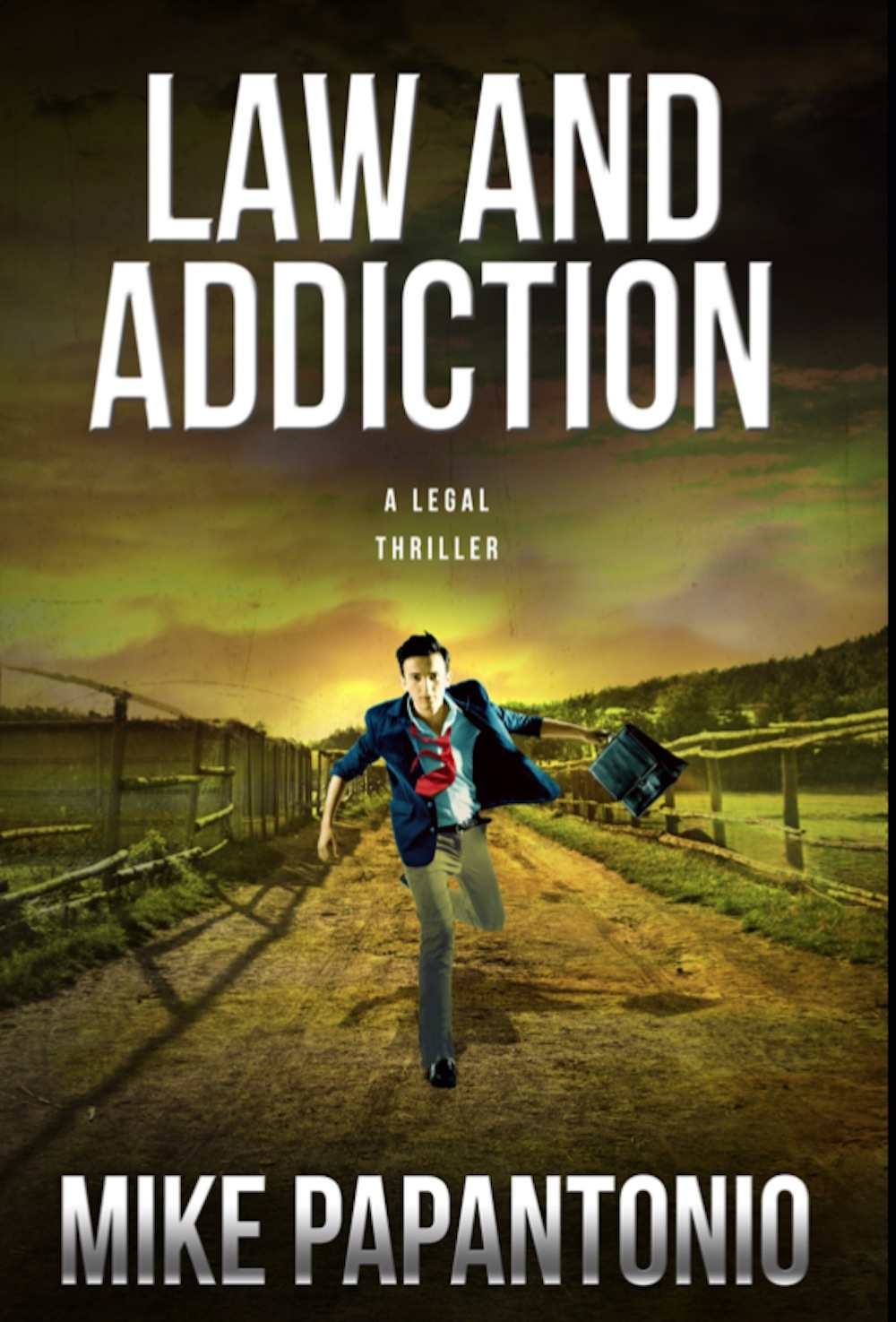
‘Law and Addiction’ is the new legal thriller by Mike Papantonio. Photo: google
Mike Papantonio is a writer, prominent trial attorney and co-host of Ring of Fire, a nationally syndicated weekly radio talk show, along with Robert F Kennedy, Jr and Sam Seder where he is known as ‘America’s lawyer.’ He has written several books including “In Search of Atticus Finch, A Motivational Book for Lawyers,” “Resurrecting Aesop: Fables Lawyers Should Remember” and the Nicholas “Deke” Deketomis’ legal thrillers “Law and Disorder” and “Law and Vengeance.” In his newest novel, “Law and Addiction,” Mike Papantonio pulls back the curtain on America’s deadly opioid epidemic with a legal thriller about greed, corruption and the power of personal conviction.
“Law and Addiction” begins with a Prologue that has Blake Rutledge, in the middle of a drug-induced paranoia attack, becoming another victim of the opioid crisis: “Blake’s lungs slowed to a stop, but his mind didn’t know it.” This was one week before his twin brother Jake’s law school graduation. Upon hearing of Blake’s death, Jake returns to his hometown of Oakley, West Virginia, who many now refer to as “Zombieland” because most of the city has been ravaged by the opioid epidemic. Seeking justice for Blake, he plans to take on Big Pharma but realizing that he is way out of his league, he seeks out famed lawyer Nicholas “Deke” Deketomis for help. Together they join forces but soon death threats, bribes and unlawful property seizures threaten to derail their legal efforts. To discredit Jake, he is kidnapped and unwillingly turned into an addict. He escapes, but not unscathed because now he is faced with his own battle to become clean.
With his latest novel, Mike Papantonio successfully translates the opioid epidemic into a suspenseful legal thriller. The research Deke’s team does to prepare the case develops into a narrative into how the pharmaceutical companies fueled the epidemic and eventually profited from it and it is nothing short of eye opening. As with his other novels, the story has a strong beginning with the Prologue where readers have a front row seat to witness Jake’s suffering and death. The author re-introduces Deke’s legal team, so readers who may be unfamiliar with them are not lost. Regarding the legal jargon and courtroom drama, they are both easy to understand and the fast-paced action flows easily from page to page. The characters are well-developed and relatable and the poetic prose brings a fresh perspective to the storytelling: “skeletal branches from trees reached for him, snagging his clothing.” “Law and Addiction” is a must-read and recommended for fans of smart legal thrillers, but it also has elements of suspense and mystery with some politics mixed in to appeal to most readers. Since Mr. Papantonio uses his real life cases as springboards for his novels, readers can surely look forward to more in this exciting series.
“As I write these words, somewhere in America an individual is dying of a drug overdose. During the next twenty-four hours, there will be at least 115 deaths from the same cause.” – Mike Papantonio (Author’s Note)
*The author received a copy of this book for an honest review. The views and opinions expressed here belong solely to her.



 SA Examiner