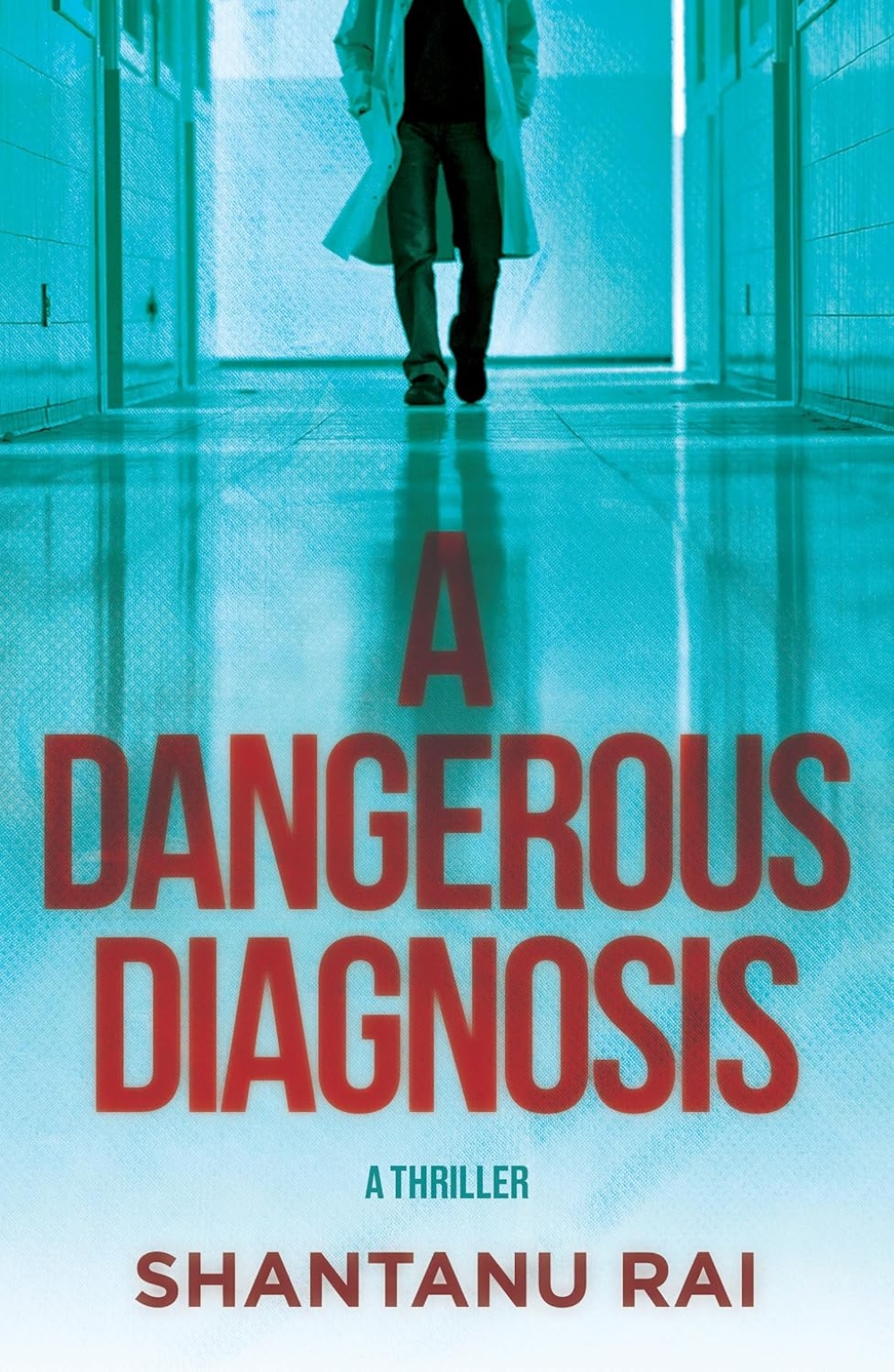
‘A Dangerous Diagnosis’ is the new thriller novel by Shantanu Rai. Photo: Barnes & Noble
New Book Spotlight: A Dangerous Diagnosis
Get ready for a gripping addition to your thriller shelf! This Tuesday, February 24, marks the release of A Dangerous Diagnosis, the timely debut medical thriller by practicing physician Shantanu Rai.(Sharkpoint Studio, 2026)
Whether you’re a fan of high-stakes medical dramas or legal thrillers with a heart, this is one release you won’t want to miss. It is currently available for pre-order.
The Story: Luxury Medicine Meets a Deadly Conspiracy
Brilliant diagnostician Dr. Sanjay Patel has come a long way from his dreams of serving the needy. These days, he treats the global elite, traveling by private jet and receiving payments in cash-stuffed designer totes.
But his high-flying life is grounded when his estranged mentor, Dr. Tom Carpenter, collapses from a fatal stroke. His final act? A cryptic message scribbled on a prescription pad: “Page Dr. Sanjay.”
The mystery pulls Sanjay back to Boston’s Mount Beacon Hospital, the very place that nearly destroyed his career. There, he must face his past in more ways than one, reuniting with cancer researcher Emma Carpenter-Flores, Tom’s daughter and the woman Sanjay left behind a decade ago.
Together, they uncover a trail of disturbing cases that put them directly in the crosshairs of a powerful medical-industrial complex. In a race against time, Sanjay and Emma must risk their lives to expose a truth that could shatter the foundations of modern medicine.
Perfect for fans of: Robin Cook, The Lincoln Lawyer, House, and HBO’s The Pitt.
Core Themes
A Dangerous Diagnosis dives deep into the complexities of the modern healthcare world, exploring:
Moral Injury: The psychological toll on providers within a broken system.
Ethics vs. Profit: The tension between patient care and corporate greed.
Redemption: A second chance at a lost legacy and a lost love.
Systemic Injustice: Uncovering the hidden flaws within the healthcare machine.
Meet the Author: Shantanu Rai
Shantanu Rai is a physician and writer who uses fiction to illuminate the hidden struggles of the American healthcare system. Drawing from years of frontline patient care, Rai blends his medical expertise with a lifelong love for Bollywood films and classic whodunits.
When he isn’t at the hospital or at his desk, you can find him hiking, enjoying a family movie night, or refueling with a strong cup of chai. A Dangerous Diagnosis is his first novel.
‘Night Shift’ is the thrilling medical thriller by the master of the genre Robin Cook. Photo: Barnes & Noble.
Doctor and author Robin Cook is widely credited with introducing the word ‘medical’ to the thriller genre, and decades after the publication of his 1977 breakthrough novel, “Coma,” he continues to dominate the category he created. Cook has successfully combined medical fact with fiction to produce thirty-nine international bestsellers, including “Outbreak,” “Terminal,” “Contagion,” and “Chromosome 6.” “Night Shift” is the 13th book in the Jack Stapleton and Laurie Montgomery series. (Barnes & Noble, 2025)
“Night Shift” – In this exhilarating new medical thriller, fan favorites Jack and Laurie are lured into the dark underbelly of hospital dangers when an internist dies mysteriously.
Colleagues-turned-spouses Dr. Laurie Montgomery and Dr. Jack Stapleton already have their hands full due to demanding forensic pathology work and family pressures. The last thing they need is the sudden death of a colleague. When Laurie’s apparently vital and healthy longtime friend Dr. Sue Passero dies mysteriously in the hospital parking garage, an autopsy is required. It falls uncomfortably under Laurie’s purview as the chief medical examiner and when Laurie asks Jack to take special care with the case, he can hardly refuse.
With his curiosity sparked by an inconclusive autopsy, Jack is compelled to resolve the case at hand, and sets out to investigate on-site at Manhattan Memorial Hospital, even though it means defying the Office of Chief Medical Examiner’s rules. What started out as an inquiry into Sue’s tragic passing soon turns into a deadly and dangerous chess game between Jack and the clever and deranged killer, who might just administer another lethal blow if Jack isn’t careful.
Review:
Robin Cook’s “Night Shift” is a gripping return to the adrenaline-charged world of medical suspense, where danger is around every corner. In this latest installment, Cook reunites readers with beloved characters Dr. Jack Stapleton and Dr. Laurie Montgomery, a dynamic duo whose chemistry and sharp instincts have made them staples of the genre.
When Dr. Sue Passero dies of an apparent heart attack in her car after a late-night shift, Jack and Laurie are drawn into a murky investigation that reveals alarming vulnerabilities surrounding the the people entrusted to save lives. As Jack digs deeper, he uncovers a chilling conspiracy that blurs the lines between healthcare and crime.
Cook masterfully blends cutting-edge medical details with the fast-paced narrative of a crime thriller, delivering a story that feels urgent and unsettlingly plausible because these cases have occurred in real life. “Night Shift” pulses with tension, balancing scenes of clinical precision with emotional stakes that hit close to home. Longtime fans will appreciate the return of familiar characters, while new readers will find an accessible entry point into Cook’s world.
One way to get readers inside the killer’s mind is by revealing his/her identity halfway through the book. Some readers are put off by this, but I find it fascinating because we get a peek into the killer’s reasonings and plannings and in this case, when the killer goes after Jack, it adds layers to the suspense.For this book, I checked out the audiobook on the Libby app, so that made the action even more exciting.
Overall, “Night Shift” is a gripping page-turner and confirms Robin Cook’s place as a master of the medical thriller. It explores the themes of good vs evil, human nature, death, and justice. Recommended for fans of medical thrillers, it’s a compelling reminder that in medicine, not all dangers are biological.
Cristina LePort’s new medical thriller ‘Change of Heart’ will be released in February. Photo: Barnes & Noble
Medical thrillers blend the high-stakes tension of thrillers with the intrigue of medical science. These novels often involve intense situations, such as dangerous viruses, unethical experiments, or life-and-death medical dilemmas, creating a gripping sense of urgency. The appeal lies in the combination of suspense, intellectual challenge, and emotional investment. Readers are drawn to the complex characters—doctors, patients, and scientists—navigating moral gray areas, and the fast-paced plots keep them on the edge of their seat. Additionally, the real-world connections to medical advancements or crises make the stories feel both thrilling and plausibly terrifying, heightening their impact.
These are some of my favorite novels to read and Robin Cook’s were some of the first ones I picked up. Since then, there’s been Michael Palmer, Patricia Cornwell, Kathy Reichs, and Tess Gerritsen. A couple of years ago, I read Cristina LePort’s debut novel “Dissection” and was thrilled to have another such author on my must-read list. Her next one, “Change of Heart,” comes out in February and takes readers into the shadowy underbelly of organ trafficking, revealing the lengths to which people will go to secure life-saving transplants. So if you’re a fan of gripping medical thrillers, I wholeheartedly recommend her novels. “Change of Heart” will be released on February 4 and is available now for pre-order on Barnes & Noble.
Cristina LePort, MD is a renowned cardiologist and a respected author, known for her compelling medical thrillers that explore the high stakes of medical crises and moral conflicts. Born in Bologna, Italy, she new resides in Southern California and combines her medical expertise with her narrative prowess to create stories that are informative and engaging. (Meryl Moss Media Group, 2024)
“Change of Heart” – In the bustling heart of New York City, a young medical student’s life is tragically cut short, though her heart continues to beat, holding the promise of life for another. Detective Kirk Miner is called to the scene and quickly uncovers a chilling conspiracy involving organ donations and high-stakes crime. As the investigation unfolds, Miner realizes the case is far more complex and dangerous than it initially seemed.
Enter FBI Agent Jack Mulville, who steps in to supervise Special Agent Charlotte Bloom as they join forces with Miner. Together, they unravel a web of corruption, revealing that Amy Winter’s death is connected to a ruthless organ trafficking ring. Amy Winter, a promising pre-med student, is found dead under mysterious circumstances. Her death triggers an investigation that pulls Miner, Mulville, and Bloom into a labyrinth of deceit and desperation. As they dig deeper, they discover that Amy’s heart is not just a donor’s gift but a coveted prize in a deadly game controlled by criminals willing to kill to keep their secrets hidden. Amidst the danger, they face moral dilemmas and personal risks, pushing them to their limits as they strive to protect innocent lives and dismantle a powerful criminal network.
“Change of Heart” is a gripping medical thriller that intertwines the intricacies of modern medicine with the relentless pursuit of justice. Cristina LePort, M.D., masterfully combines her medical expertise with edge-of-your-seat storytelling, delivering a novel that will keep you turning pages long into the night. Dr. LePort is an accomplished physician with a passion for weaving medical knowledge into thrilling narratives. Her extensive background in medicine lends authenticity and depth to her stories, making the Miner & Mulville series a unique blend of fact and fiction.
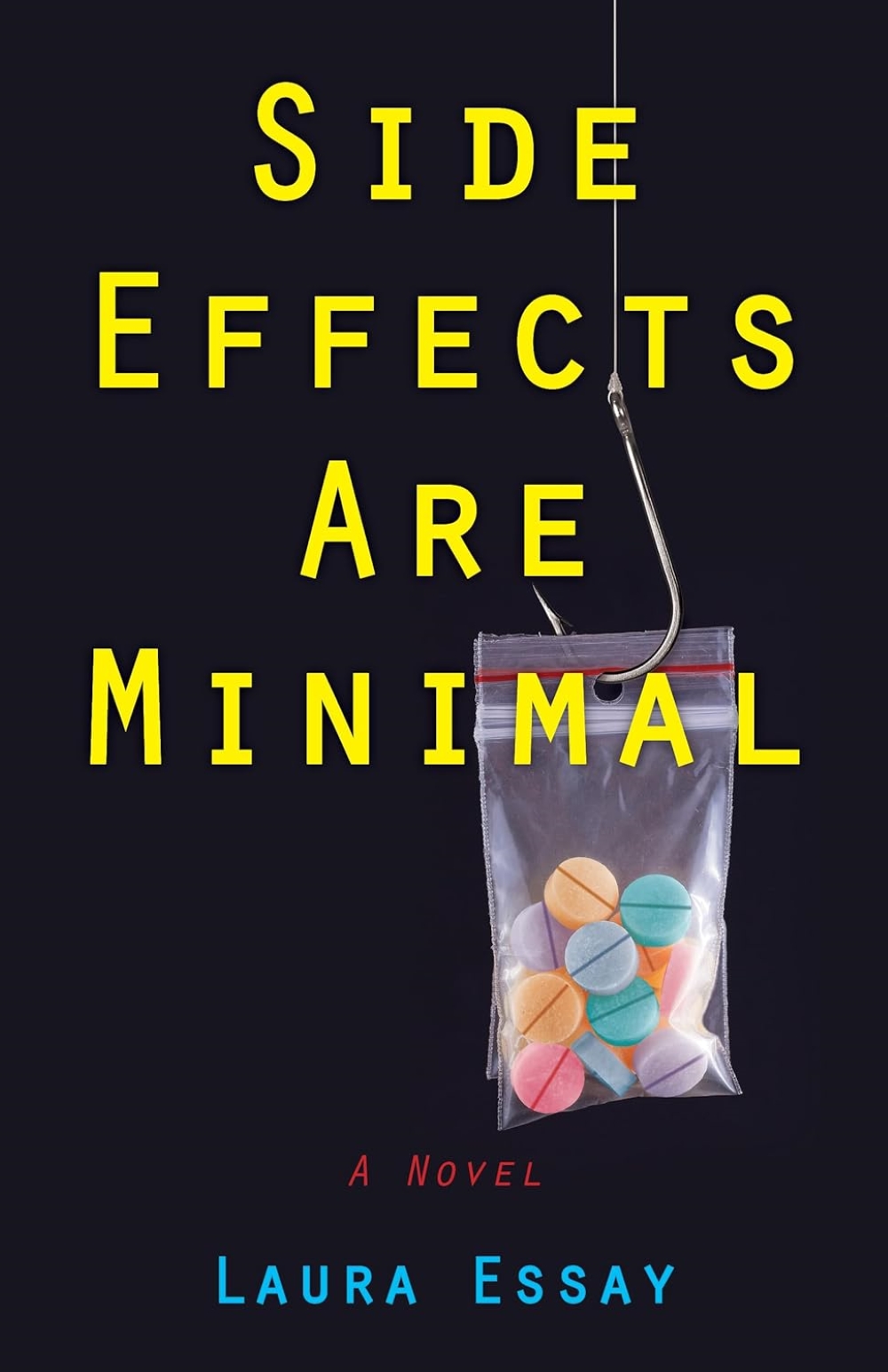
‘Side Effects Are Minimal’ is the new legal thriller by Laura Essay. Photo: Amazon
Laura Essay attended the University of Nebraska and obtained a law degree from Creighton University School of Law. When her three grown children moved on to graduate programs in other cities, writing became her passion. “Side Effects Are Minimal,” her debut novel, is about a corrupt pharmaceutical industry, the guilt of physicians prescribing the opioids that kill, and the pain experienced by families who have lost loved ones to a widespread epidemic. Her knowledge of the opioid crisis stems from her passion for research and countless hours spent searching for the truth about opioids in America.
Synopsis:
“Side Effects Are Minimal” – ambitious attorney Claire Hewitt is asked to represent the Satoris, one of Philadelphia’s most prominent families in a lawsuit over the death of their daughter Emma. She is thrust into an opioid nightmare with deadly impact—and not for the first time. Even after twenty years after her sister Molly’s death from what she believes to be an opioid-related death, Claire still feels guilty for not being able to help her. Now, with this new assignment, her guilt comes full circle. Who was really at fault in Molly’s death? And who is at fault now?
Claire struggles to balance her desire for justice with the Satoris’ thirst for revenge. She knows she needs to expose the greed that transforms legal opioid production into illicit fabrications and the neglect that is the breaking point between physicians and their patients. There are powerful people who will seemingly stop at nothing to prevent these truths from seeing the light of day, and she is sabotaged at every turn. Can she push past the obstacles in her way to build a winning case?
Review:
The opioid epidemic in America has devastated communities nationwide, claiming countless lives and leaving a trail of shattered families. Laura Essay expertly combines real events with a compelling narrative. The story begins as Claire is excited at being assigned the Sartoris case even though in the long run it might be a class action suit. She is nervous but looking forward to the challenge partially because the opioid crisis affected her family as well when her sister Molly passed away and she sees this case as a way to get justice for her as well. Her character is confident and qualified but right from the beginning when she is assaulted and her briefcase is stolen, it becomes evident that there will be strong forces out to stop her at all costs.
I was drawn to this novel because of its exploration of the human experience within the medical and legal systems. The fictional court case brings to light the heartache faced by families touched by this crisis and how it transcends demographics, but at least the parents in this story are lucky to be wealthy enough to be able to sue the pharmaceutical supplier. The courtroom drama and the hard work by the lawyers and everyone working behind the scenes to bring these cases to court is gripping and eye-opening.
Essay’s writing style makes it easy to follow the medical and legal terms because she doesn’t use overly complicated jargon. Her use of descriptive language immerses the reader in the action: “Beads of sweat glistened on his upper lip and beside the veins spider-webbing his nostrils.” The characters she creates are vivid and relatable, each struggling with their own challenges and triumphs. This story explores the themes of family, courage, and power/corruption and the challenges that come in times of crisis. Highlights include the in-depth research on the case and Chapter 24 No Friend of Mine when Claire is given the spotlight when the trial begins.
Overall, “Side Effects Are Minimal” is a compelling novel that reminds us of the power of the court system and the resilience of the human spirit in the face of medical challenges. It is recommended for readers interested in learning more about the opioid epidemic and enjoy medical thrillers by Robin Cook, legal thrillers by Mike Papantonio and John Grisham, and strong female characters.
“Claire’s movements revealed the sorrow she felt. Her fingers glided along each line as she read. She whispered their names. She grimaced and smiled and often looked to the ceiling for a break. She squeezed her eyes shut when a break wasn’t enough.”
*The author received a copy of this book for an honest review. The views and opinions expressed here belong solely to her.
‘Unnatural Death’ is the new Scarpetta novel by Patricia Cornwell. Photo: Amazon
Medical thrillers are some of my favorite novels to read, specifically Michael Palmer, Robin Cook, and Patricia Cornwell. I have read almost all of Patricia Cornwell’s Scarpetta novels, so I am excited for her new release: “Unnatural Death.”
Patricia Cornwell sold her first novel, “Postmortem,” while working at the Office of the Chief Medical Examiner in Richmond, Virginia. An auspicious debut, it went on to win the Edgar, Creasey, Anthony, and Macavity Awards, as well as the French Prix du Roman d’Aventures—the first book ever to claim all these distinctions in a single year. Growing into an international phenomenon, the Scarpetta series won Cornwell the Sherlock Award for best detective created by an American author, the Gold Dagger Award, the RBA Thriller Award, and the Medal of Chevalier of the Order of Arts and Letters for her contributions to literary and artistic development. Today, Cornwell’s novels and iconic characters are known around the world. Her interests range from the morgue to artificial intelligence and include visits to Interpol, the Pentagon, the U.S. Secret Service and NASA. Her new book “Unnatural Death” is the 27th book in the Scarpetta series and involves two mauled bodies in the woods, top secret autopsies, and the most chilling cases of Scarpetta’s career. It will be released November 28, 2023. (Amazon, 2023)
“Unnatural Death” – In this thrilling new installment of Patricia Cornwell’s #1 bestselling Scarpetta series, chief medical examiner Dr. Kay Scarpetta finds herself in a Northern Virginia wilderness examining the remains of two campers wanted by federal law enforcement. The victims have been savaged beyond recognition, and other evidence is terrifying and baffling, including a larger-than-life footprint. After one of the most frightening body retrievals of her career, Scarpetta must discover who would commit murders this savage, and why.
‘R/N/A: Deadly Sequence’ is the new fast-paced medical thriller by Mikael Lundt. Photo: Mikael Lundt, used with permission.
When it comes to thrillers, my all time favorite are medical thrillers and it is no wonder: they often explore the deadly consequences of medical science when it falls into the wrong hands, all in the name of greed or in the quest for ultimate power and control. One of the first authors I read in this genre was Robin Cook, then I discovered Michael Palmer, Tess Gerritsen, Patricia Cornwell, and most recently, Dr. Cristina LePort. After reading a sample, this new book release reminds me so much of the best of Robin Cook, whose antagonists are often pharmaceutical companies. If like me, you love getting lost in a gripping medical thriller, check out Mikael Lundt’s “R/N/A: Deadly Sequence” and find out what happens when a Pandora’s Box of chaos is unleashed. It is available on Amazon.
Mikael Lundt is an author who stands for gripping thrillers, dark science fiction, and thought-provoking fantasy. In his books, technology, philosophy, the supernatural, and the extraterrestrial often blend into a stirring combination. Unveil the terrifying underbelly of modern medicine in “R/N/A: Deadly Sequence,” his riveting new pharmaceutical thriller. (Mikael Lundt, 2023)
“R/N/A: Deadly Sequence” – A dramatic increase in unexplained side effects calls WHO expert Dr. Laura Delille to the scene. Infertility, miscarriages and deaths are on the rise. Initial evidence points to a new mRNA-based vaccine. As the symptoms worsen and people who have never received the vaccine begin to fall ill, it becomes clear that there is more at stake than just the obvious side effects.
As Laura investigates the mysterious causes on the African continent, reporter Hugh Stevens follows her lead. His research shows: this is neither a tragic coincidence nor a natural phenomenon, but the ruthless plan of a pharmaceutical company. Most puzzling of all, there is no trace of a clear pathogen. Laura’s superiors at the WHO, on the other hand, seem to keep putting obstacles in her way.
Soon, Laura and Hugh find themselves in the middle of a sinister conspiracy – and in grave danger. With time running out for them, the phenomenon spreads worldwide, soon threatening millions. Is the world at the beginning of a planned pandemic that could threaten the very existence of the human species?
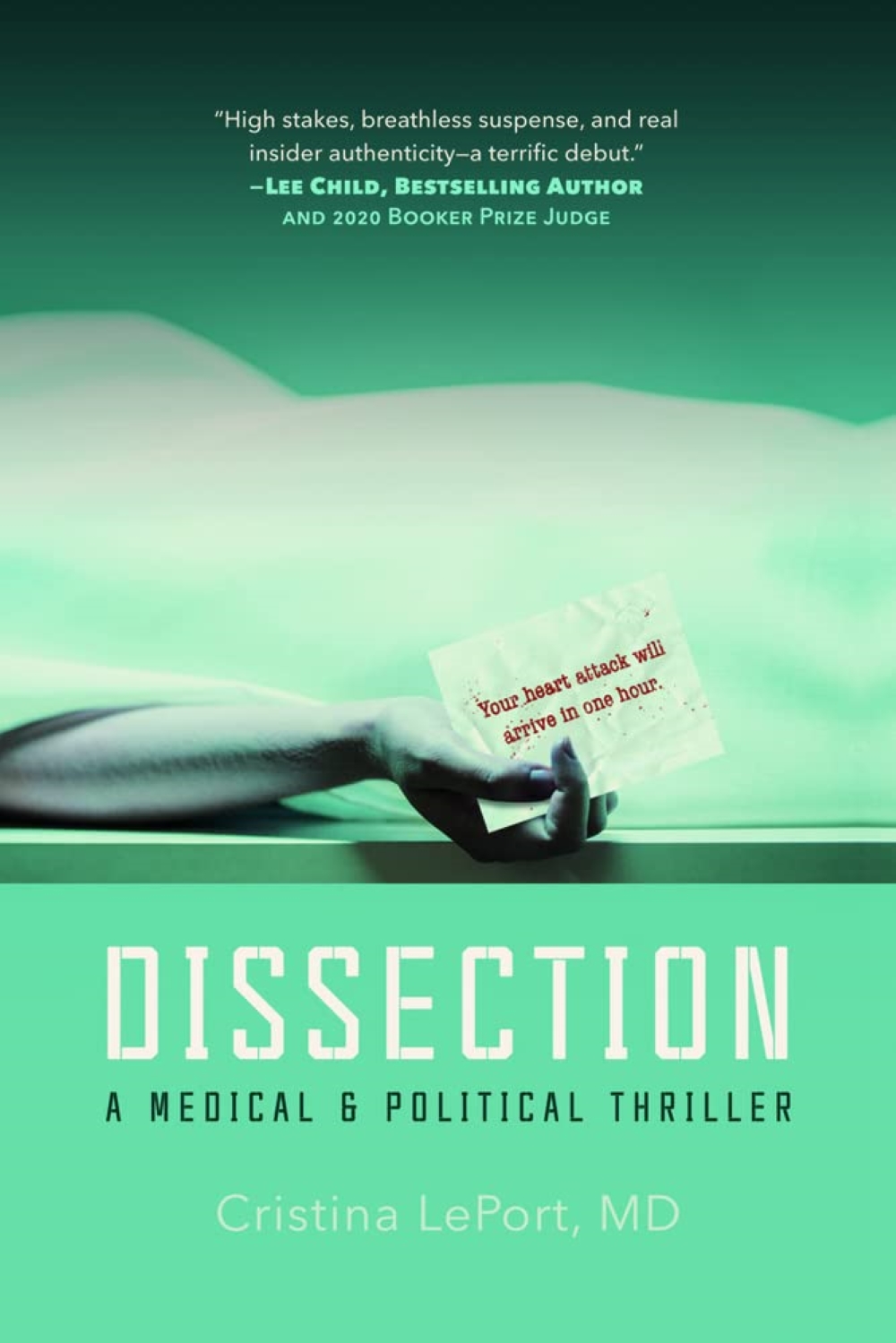
‘Dissection’ is the debut suspense thriller by Cristina LePort, MD. Photo: Amazon
Dr. Cristina LePort was born in Bologna, Italy, where she attended medical school before emigrating to the USA to complete her Internal Medicine residency at Long Island College Hospital in Brooklyn and her Cardiology fellowship at West Los Angeles VA/UCLA. She has been practicing medicine for more than 30 years as Dr. Cristina Rizza. “Dissection: A Medical and Political Thriller” is her first published novel and a tense thriller with complex characters that combines cutting-edge medical technology with horrific yet still believable terrorist plots.
“Dissection”– DC heart surgeon Dr. Steven Leeds is suddenly overwhelmed by a handful of extremely complicated heart attack and stroke cases, all caused by a rare arterial injury―a dissection. The victims all have one thing in common: they receive harmless-looking cards announcing, “Your heart attack/stroke will arrive within one hour!” It all starts with Dr. Nirula receiving a card warning him of an impending fatal heart attack. At first he dismisses it because he knows his personal odds of such an episode are slim, but then he remembers that 25% of people who have heart attacks have no known risks. His heart starts pounding as his life flashes through his mind, but eventually he moves on. He is the first of many such cases but unfortunately some do not make it. When private detective Kirk Miner and FBI agent Jack Mulville start investigating, they immediately suspect Leeds’ former lover, Dr. Silvana Moretti, a brilliant research scientist who harbors a grudge against all the victims. When important people in the U.S. government begin to receive these same threatening cards and experience similar cardiac emergencies, it falls to the unlikely team of three―the headstrong FBI agent, the gifted private investigator, and the brilliant but conflicted heart surgeon―to find the actual perpetrators and to snuff out a catastrophic plot that only the medically astute can divine.
Dr. Cristina LePort has written an impressive debut novel. Her experience as a medical professional gives it an authentic voice, for example, when she describes a heart attack: “a heavy sickening pressure rose from the center of his chest and spread like an oil spill to reach his jaw.” When doctors themselves get sick, the experience tends to give them a reality check, such as when Dr. Nirula admits that it is not fun being on the other side, being the patient instead of the doctor. The thorough character development makes them relatable, flawed, but overall courageous. With her descriptive language, the author makes the story come alive: “Fear receded like a wave from the shore and crashed into anger.” The political thriller subplot gives it an extra thrill ride during the rush to find the designated survivor to avoid a catastrophe and in case the president does not make it. The chapters are short and the action is mostly dialogue driven. Highlights include Chapter 3: Dissection where Dr. LePort describes Dr. Steven Leeds preparing to perform surgery: he “slid a cap over his thinning black hair, reached for a sponge, and stepped on the pedal to switch on the water” and Chapter 31: Choices when all hell breaks loose and Kirk Miner and Jack Mulville relentlessly pursue the terrorists even though they have both been injured. “Dissection” is a must read suspenseful page turner that combines a fast paced medical thriller with white knuckle political action. It is recommended for readers who appreciate the best of Tom Clancy and Robin Cook.
“She stared at her husband for a long moment as if deciding how to best handle the possible emergency. The man flapped his hand, hurrying her to get ready. A few minutes later, man and wife sat buckled up in their car on their way to Capitol Hospital. The man’s headache and neck pain escalated with the car’s bouncing and swerving. To him, the city street lights appeared blurred. Panic set in.”
*The author received a copy of this book for an honest review. The views and opinions expressed here belong solely to her.
Christina LePort’s debut novel ‘Dissection’ will be out October 18, 2022. Photo: Amazon
Dr. Cristina LePort was born in Bologna, Italy, where she attended medical school before emigrating to the USA to complete her Internal Medicine residency at Long Island College Hospital in Brooklyn and her Cardiology fellowship at West Los Angeles VA/UCLA. She has been practicing medicine for more than 30 years as Dr. Cristina Rizza. “Dissection: A Medical and Political Thriller,” her first published novel, will be released October 18, 2022. It is a taut thriller with complex characters that combines cutting-edge medical technology with horrific yet still believable terrorist plots. (Amazon, 2022)
“Dissection”– DC heart surgeon Dr. Steven Leeds is suddenly besieged by a handful of complicated heart attack and stroke cases, all caused by a rare arterial injury―a dissection. Before that, all the victims receive innocuous-looking cards announcing: “Your heart attack/stroke will arrive within one hour!” When private detective Kirk Miner and FBI agent Jack Mulville investigate, they immediately suspect Leeds’ former lover, Dr. Silvana Moretti, a brilliant research scientist who harbors a grudge against all the victims. When prominent people in the U.S. government begin to receive these same threatening cards and almost immediately experience these same deadly cardiac emergencies, it falls to the unlikely team of three―the headstrong FBI agent, the gifted private investigator, and the brilliant but conflicted heart surgeon―to find the actual perpetrators and to snuff out a catastrophic plot that only the medically astute can divine.
Dr. Cristina LePort’s story combines the artfully nightmarish scenarios in Vince Flynn’s Mitch Rapp novels with the fast-paced tempo of Robin Cook’s medical thrillers. It features page-turning suspense, action-packed climaxes, and thoughtful character development, set against a believable backdrop of medical science informed by her long career as a cardiologist. Her style, though accessible, is more sophisticated than superficial, and, with strong protagonists on both sides of the gender divide, appeals to both male and female readers.
I awoke that Friday morning in a serious sweat, the kind that is not immediately relieved by rising and washing one’s face with cold water. I noted that the clock in the bathroom read 4:38, twenty-two minutes before my designated alarm setting. After staring at the clock for a minute, maybe two, I felt my right radial pulse. The accelerated throbbing confirmed that tachycardia was still my predominant rhythm. I decided to attend to ritualistic morning bathroom chores, make coffee, read the paper, and at least try to pretend that it was a normal Friday morning.
Upon completion of the bathroom routine, as quietly as possible, I punched in the five-digit alarm code and started to leave the bedroom to go downstairs. Unfortunately, even the sound of punching in the numbers was unduly shrill, and it caused Mary Louise, my bride of twenty-four years, to stir.
“Jim Bob?”
“Yes?”
“It’s not even five yet. Why are you up?”
“Couldn’t sleep. Woke up with the sweats again. Sorry to wake you. I thought I’d go downstairs, make some coffee, and sit outside and think for a while. Okay?”
“Want some company?”
Normally, I would never turn down such an offer. I loved my wife dearly. She was, in fact, my best friend. That particular morning, however, I responded in the negative.
“I don’t want to hurt your feelings, sweetie, but this is just one of those times I need to collect my thoughts. Know what I mean?”
“I do. I’m sorry you’re having to go through all this. It isn’t fair. After all you’ve done for everybody else. I know in my heart it will be all right, just maybe not today. Try not to get too upset. Promise?”
“I’ll do my best.” I leaned down and kissed her warm cheek. She smelled so good, I considered taking off my robe and getting back into bed. I finally chose not to. “Go back to sleep. I’m not leaving until about eight o’clock.”
I left her reluctantly and plodded downstairs barefooted, in my cotton robe, with lights still off, toward coffee heaven. I selected Twin Peaks Blend coffee beans, which we kept in the freezer to avoid staleness, ground them, and began the ten-minute process to achieve as perfect a cup of coffee as I could make. I waited on the back porch in my “spot,” a large white cane rocker. The month of August was a stifling time of year in Houston, even at that hour of the morning. The heat and humidity were almost unbearable during July, August, and early September. I turned on the outdoor ceiling fan that hovered above my chair and hoped it would make the weather more pleasant. It didn’t.
I considered my life that morning. I, Dr. James Robert Brady, who had done my best to be a compassionate and dedicated orthopedic surgeon for the past seventeen years, was being sued for medical malpractice. I was not a neophyte when it came to lawsuits. I had been sued twice before, not an unusual occurrence in a city of four million people, with far too many law school graduates sitting in their quiet offices with nothing to do. The other two suits were quite minor and did not linger but were dismissed rather quickly, meaning over a year-or-two period. The current lawsuit, the cause of my awakening before five with the sweats and intense gastrointestinal distress, had not been dismissed.
I stepped back inside to the relatively cool air, although during August even the air-conditioning system labored heavily. I poured my coffee into a large black mug with a removable top that allowed intermittent filling of the cup but twisted on securely so as not to spill during the drive to work. While I wasn’t yet ready to leave, I used the “to go” cup anyway, being a creature of habit, a trait inherited from my dear departed father, and one which drove even me to distraction on occasion.
I returned to the French door to head back to the humidity and spotted Cat perched on the back doorstep, peering through the lowest windowpane, awaiting her breakfast. I sipped my coffee and prepared her Prime Feast in a disposable dish, probably not recyclable because I am sure it isn’t possible to remove the smell of mixed seafood, no matter what treatment is available at the nearest recycling plant.
Strolling to the door, feast in hand, I greeted the discriminating feline.
“Morning, Cat. I have your breakfast.”
No response. Just a simple twitch of the sensitive nose. There was no tail-wagging or jumping on my bare leg to greet me, sure signs that man’s best friend loved you and missed you. Rather, Cat simply did what she did best. She remained aloof and distinctly noncommittal. I bent down, sat her dish on the patterned concrete deck, and stroked her damp fur as she sampled my selection. She did give me a brief look of gratitude, then resumed her nibbling. I returned to my chair and continued to assess my life and its worth.
I was most critical of self that morning, pondering the effects of aging on a once-athletic physique. While Mary Louise considered me to be a handsome specimen, I lamented my shrinkage from six feet plus one inch to slightly less than the “manly” six feet. I continued to disguise my shortening by wearing Western boots, and only on weekends did I allow myself the comfort of high-topped athletic shoes—not that I used them for athletics.
I remembered my previously full head of hair that had slowly thinned, especially at the front, to allow for enlargement of my forehead while a balding spot was created on the crown of my head. My sideburns were a little long and gray and transitioned to brown at an always-increasing distance from the top of my ears. I criticized the extra minute I spent every morning to carefully position my combed-straight-back locks over that bare spot I had grown to hate.
I had begun to study myself each morning before showering to confirm that I indeed resembled Alfalfa of Little Rascals fame, with thin wisps of hair sticking straight up toward the heavens. I then reminded myself of my need to wear bifocals and of my need to start a workout program to slim my waist from its size 38—although I had noticed lately that the cleaners had been shrinking my best jeans.
I tried to take comfort in Mary Louise’s love of what she called my “charming cleft chin” and “captivating smile” but was unsuccessful. I felt old that morning, which, along with words like useless, worthless, out-of-shape, and four-eyed, drove me to an even fouler mood than when I awoke to cold sweats and the dreaded digestive-tract blues.
By six o’clock I was sweating again, that time from drinking an entire pot of coffee and from the oppressive heat that had already risen to a sultry 80 degrees with the humidity at drip level. I threw off my robe and dove into the pool, taking care to avoid a cervical spine injury in the four-foot-deep water. It did cool me off temporarily, so after two laps I simply stood in the healing waters, naturally, in the buff. As I reminisced over the treatment of the patient that had decided to sue me, the back door of the house opened and the Tipster bounded outside. He saw me in the pool and almost dove in with me. Fortunately, I was able to hold him back while I ruffled his shaggy mane and scratched his ears. At least he was glad to see me and acted as though we had been apart for years, not just the six hours since we had bid him good night.
His official title was “Tippecanoe and Tyler Too,” a typical name given by a particular breeder who prized his full-blooded intelligent golden retrievers. But “Tip,” “Tipper,” or “the Tipster,” as Mary Louise intermittently called him, had failed the IQ test for well-bred dogs and was lovingly given to me by that grateful patient, who had many more golden retrievers than insurance dollars.
Tip had been presented to me in the office five months previously at the end of the day as a surprise. The man didn’t ask me if I wanted a dog, but simply showed up at my office with a large, overly friendly seven-month-old golden retriever puppy. I still suspected that Fran and Rae, my faithful office staff, had somehow conspired with my darling wife to bring some new joy into my life. At the time, I was highly skeptical and hoped to rid myself of the constantly-shedding beast who had disrupted our lives. Over the next few months, however, I had grown to love, without restraint, this large, adorable dog, whose only faults were that he was too much a friend to strangers and a poor fetcher of dead birds. Neither flaw bothered me. I didn’t hunt much anymore, and we rarely had anyone to the house that I despised. Besides, considering we had yet to be burglarized, the Tipster’s camaraderie with those stealers of one’s things was an untested character defect.
My mood improved significantly after seeing Tip, and I watched with interest as he bounded over to greet Cat with a friendly good morning. He had attempted to make Cat his new best friend every day since his arrival at our abode but had been miserably unsuccessful. Cat’s reaction to his energetic playfulness was to leap gracefully into the rocking chair next to mine, back herself up as far as possible to the rear of the chair, and wait. When Tip happily padded over to see her and put his whole head onto the seat of the chair, she would strike out at his sensitive nose with one of her front paws, prompting an episode of howling. For five months, this scenario had occurred each and every time the two animals had a backyard encounter. I believed that Cat had become bored with the whole routine and had actually become embarrassed at what seemed to be the retriever’s inability to learn.
“Tip? Be careful over there. She scratches your nose every day! It’s so raw, you almost need stitches.”
I obviously had lost my mind. I was talking to the dog as though he understood my every word. Just before pushing his fat head into the seat of the chair to smell the gray bundle of fur, though, he turned his head toward me and perked up his ears. I didn’t know if he had actually understood what I had said or simply had forgotten that I was in the pool, since he had wandered into the bushes to relieve himself before approaching Cat. He stared at me for a moment, seemed to consider what I had said, then pushed his tender, scarred nose toward the she-beast, and . . . I couldn’t believe it! She didn’t hurt him! He licked her fur, and Cat just stood there. I guessed she finally decided that Tip was harmless and just wanted to play. She might have also figured out that a large dog like that could be an impressive ally when trying to ward off neighborhood cats who strayed into her domain looking for a free meal.
And so it was that on that hot, steamy morning in August, my cat and dog became friends. I thought that maybe Mary Louise was right, having told me repeatedly that everything would be okay. Alas, that small, backyard miracle was the only one I witnessed for a while.
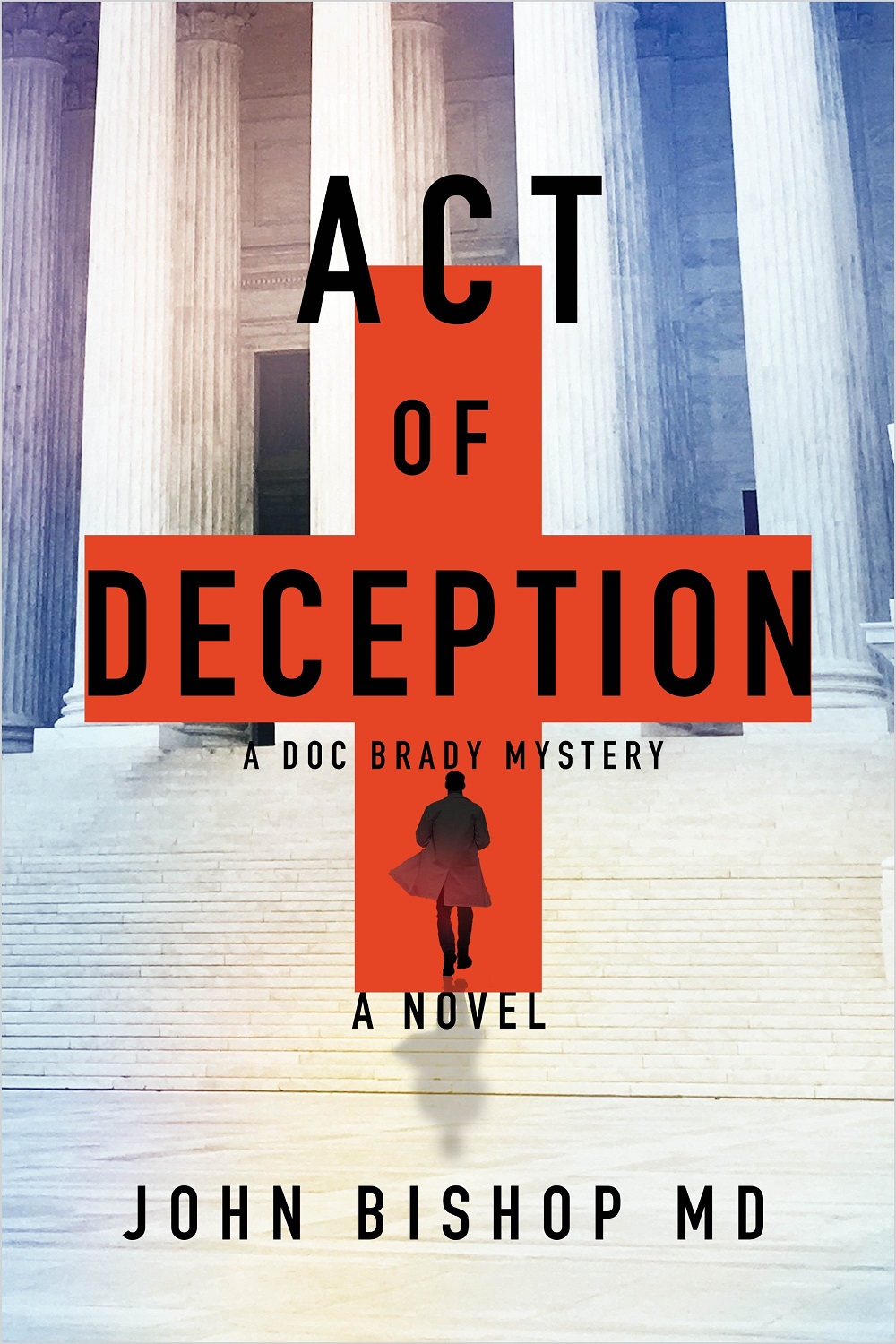
John Bishop MD is the author of “Act of Deception: A Doc Brady Mystery.” Dr. Bishop has practiced orthopedic surgery in Houston, Texas, for 30 years. His Doc Brady medical thriller series is set in the changing environment of medicine in the 1990s. Drawing on his years of experience as a practicing surgeon, Bishop entertains readers using his unique insights into the medical world with all its challenges, intricacies, and complexities, while at the same time revealing the compassion and dedication of health care professionals.
What I remember first about that day was the sound of a sickening thud. It was blended almost imperceptibly with the screeching of tires, both before and after the thud. I had been in the backyard, watering our cherished potted plants and flowering shrubs. As soon as I heard the screech, I dropped the plastic watering bucket and tore down the driveway toward the front yard, thanking God that the electric wrought-iron gate was open, and praying that Mary Louise was not the source of the street sounds.
Although it wasn’t but 150 feet or so from the backyard to the street, it seemed that I was moving in slow motion through a much longer distance. Our neighbor to the right as we faced the street was kneeling down over a small blue lump. I remember initially thinking it was a neighborhood cat or dog with a sweater but as I neared the scene, I saw that the blue lump was Bobbie’s son, Stevie.
Bobbie was screaming, “OH, GOD! Oh, God! Jim Bob, is he all right? OH, GOD, JIM BOB, PLEASE LET HIM BE ALL RIGHT!”
Stevie was not all right. I felt his little ten-year-old wrist for a pulse. Nothing. I felt his left carotid artery. Nothing. I considered rolling him over on his back but was afraid that if he were in shock and not dead, I could paralyze him if his spine were fractured. Some of the other neighbors had arrived by then. I yelled for someone to call 911.
“Can’t you give him mouth-to-mouth or something?” Bobbie had yelled. “You’re a doctor, for God’s sake! DO something! Oh, please, do SOMETHING!” I felt helpless and wished I could do something. Anything. A mother was losing her child, and all my years of medical training were, at that particular moment, useless. I waited with her and tried to keep her from moving Stevie. But how can you keep a mother from trying to shelter, protect, hide, and heal her child? Mostly, I waited with her and Stevie, feeling for his carotid pulse repeatedly, though my touch would not restore it.
It seemed like an eternity before the Houston Fire Department arrived, although later my neighbors would tell me it was only four or five minutes. The paramedics were affected as much as I was by the slight, crushed bundle. Although there was, thankfully, little external bleeding, they must have sensed the lifelessness when they stabilized his neck before gently moving him onto the stretcher and into the ambulance. He seemed so tiny to me as the paramedics deftly intubated Stevie and started an IV running. It appeared they injected his heart, probably with epinephrine, before they electroshocked him. A heartbeat did not register on the monitor.
As I rode in the ambulance with Bobbie and the paramedics, I thanked God that Mary Louise was not the one being resuscitated. I vaguely remembered her running outside during the commotion. Knowing her and her composure and intelligence, she probably had called 911 before I had time to give those instructions. Her gentle hand had rested briefly on my shoulder as little Stevie was loaded into the ambulance. A great woman, my wife. I was glad our only son, J. J., was away at college. At least he couldn’t get run over in front of our house.
“You’re a doc?” asked the least-busy paramedic in the ambulance. I nodded. “Jim Bob Brady.”
All three continued to work on Stevie, attaching monitors, pushing IV drugs, and occasionally using the paddles to try to stimulate his heart into beating.
“What kind?” one of the other paramedics asked.
I thought that was a helluva time to be making small talk. Dead child, or presumably dead child. Mother, semi-hysterical, clinging to me. Ambulance speeding down Kirby, sirens blaring. Who cared what kind of doctor I was! Obviously, not a very good one. I had done nothing to help save that child. At that moment, I felt I should be anything but a doctor.
“Orthopedic surgeon, although this doesn’t seem the time to discuss my career,” I snapped. The comment ensured a silent journey the remaining five or six minutes to Children’s Hospital.
Poor guys. We all become too calloused in the medical and surgical business, seeing murder, mayhem, and tragedy the way we do. But this was my neighbor’s child, and I felt for her. And him. And me.
Fortunately, the traffic was light that Saturday afternoon. Normally, Fannin Street was stop-and-go in the several blocks known as the Texas Medical Center. As the ambulance pulled into the emergency center, people seemed to be everywhere. An injured child draws considerable attention—not that adults don’t, but the Children’s Hospital staff was impressively organized, showing efficiency, compassion, and skill. Within the next thirty minutes or so, they had examined little Stevie and pronounced him dead. Apparently, the trauma team was composed of not only medical personnel but of social workers, ministers, and counselors. Bobbie was shattered, requiring sedation. She was attended to, and I was left to give details of the accident. I fended questions regarding arrangements for the body and all the usual accompanying inquiries in such a situation.
I begged off from the full-frontal assault, explaining that I was a neighbor and had come along for the ride because I was a doctor, in case I could help. No, I didn’t know anything, but if I could make a few calls, I could find some people to answer their questions.
I left the holding area in the back of the emergency room and returned to the lobby through the electric double doors. I assumed the personnel on duty had allowed me to remain in the NO VISITORS area because they had heard from the paramedics that I was a physician. I was surprised, dressed as I was in baggy shorts and a not-so-clean T-shirt. I had been dressed for gardening, not doctoring and death.
The lobby was fairly empty except for a few sick children and their overwrought parents. Not wanting to search for a physician’s lounge and the privacy it would afford, and having left my cell phone at home in the rush, I used a pay phone to call home. I had to borrow a quarter from a phone neighbor.
“Hello?”
“It’s me.”
“How are you holding up?” Mary Louise asked.
“I’m all right, other than feeling useless. Stevie’s dead. Seems he was killed instantly. The chief pediatric surgeon thinks his chest was crushed. Ruptured heart. They’ll have to do an autopsy to know for sure. Bobbie collapsed. They have her on a gurney in one of the exam rooms, sedated. They’ve been incredibly kind and attentive.”
“I feel so sorry for her. Is anyone else there yet?”
“Well, that’s one reason I called. The hospital staff is asking all kinds of questions. The police will want to talk to witnesses. Someone needs to be here who knows more about their personal lives and preferences than I do. Do you know where Pete is?”
“He’s on his way from his office. He’s involved in some big trial that starts Monday. At least that’s what the Mullens told me. I called a few of the neighbors, and they called a few more people, and so on. You know how the network is around here. Bobbie’s sister should be there soon, and Pete, God help him, should be there any minute.” She paused. “Do you want me to come and get you?”
Great, Brady, I thought, you even forgot you have no car.
“No, that’s all right. I’m going to hang out here until I see Pete, or someone else I recognize, and see if I can help out with anything. I’ll see you as soon as I can. Oh, one more thing. I love you. For a long five seconds or so, I thought it might have been you out in the street.”
“I’m still here, sweetie. I love you, too.”
As Stevie’s dad Pete and the others arrived, I basically directed traffic and answered their questions as best I could. When I felt that I had done enough, I walked outside. The paramedics were still hanging around the emergency entrance. I apologized for my rudeness in the ambulance, but they seemed to understand. They kindly offered me a ride home.
On the way, two of the men sat in the back with me and made small talk about the medical world. I asked if either of them smoked. They looked at each other, laughed, then individually brought out their own packs of carcinogens. As we all lit up, I hoped that the oxygen had been turned off.
John Bishop MD is the author of “Act of Murder: A Doc Brady Mystery.” Dr. Bishop has practiced orthopedic surgery in Houston, Texas for 30 years. His Doc Brady medical thriller series is set in the changing environment of medicine in the 1990s. Drawing on his years of experience as a practicing surgeon, Bishop entertains readers using his unique insights into the medical world with all its challenges, intricacies, and complexities, while at the same time revealing the compassion and dedication of health care professionals.







 SA Examiner