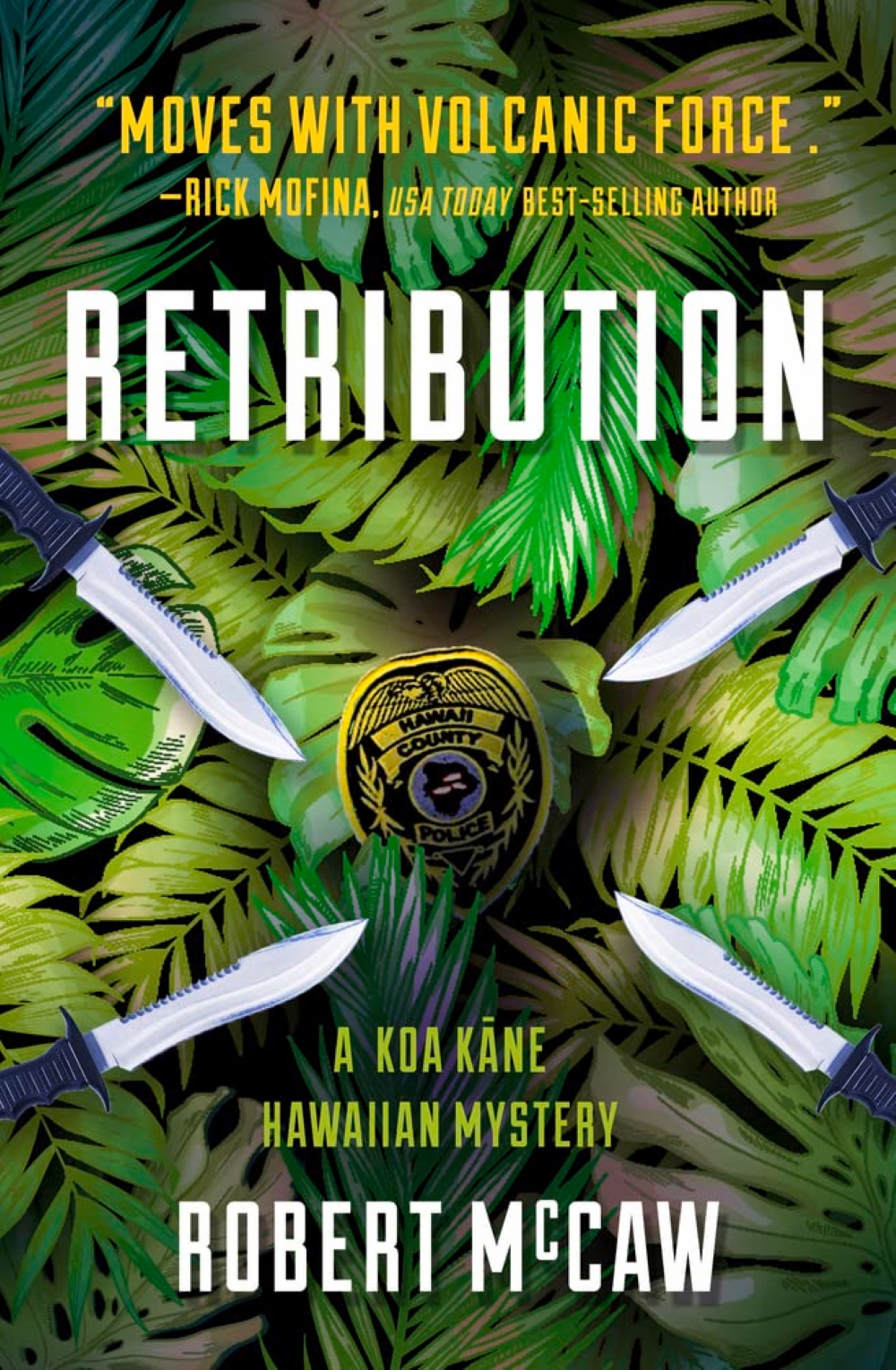
‘Retribution’ is the new novel by Robert McCaw and the fifth in the Koa Kāne Hawaiian Mystery Series. Photo: Amazon.
Robert McCaw grew up in a military family, traveling the world. He is a graduate of Georgetown University, served as a U.S. Army lieutenant, and earned a law degree from the University of Virginia. Having lived on the Big Island of Hawaii, McCaw’ s writing is imbued by his more than 20-year love affair with this Pacific paradise. In his new novel “Retribution,” the fifth in his Koa Kāne Hawaiian Mystery Series, Chief Detective Koa Kāne wonders if he might be the real target as people around him come under attack. Other books in the series include “Death of a Messenger,” “Off the Grid,” “Fire and Vengeance,” and “Treachery Times Two.” (Amazon, 2023)
“Retribution” – the story begins as an unknown Muslim man climbs off a Philippine freighter unto a speed boat with one goal in mind: to avenge his brother’s killing. Meanwhile, in the back alley of a bar on the Hawaii Island, a young man is found stabbed to death. When Hilo Chief Detective Koa Kāne begins investigating the crime, the murder weapon is conveniently recovered only a few feet away from the body. Crime scene technicians find fingerprints on the knife and they are a perfect match for Kāne’s younger brother, Ikaika. Even though his brother has a history of getting in trouble with the law, he has turned his life around, so Kāne is certain he is being framed for this crime. He is warned to stay out of the investigation, but of course he is determined to clear his brother’s name. During the investigation, another crime sends shockwaves through the Hilo police force. A sniper tries to take out Makanui, Kāne’s closest colleague. As Kāne tries to figure out whether these crimes are connected, the sinister force continues the killing spree, threatening him and his loved ones at every turn. Could Kāne be the real target? If so, who is behind this trail of retribution? With his own secret criminal past, he confronts an all-out offensive against those closest to him and his police force to which he has devoted his life. As the bodies pile up, Kāne finds himself the ultimate target of a ruthless adversary and must risk it all to survive.
Someone out there is determined to get to Detective Koa Kāne and is killing everyone connected to him. Not only is he still haunted by a secret he has kept all these years, he is constantly worrying about the safety of those around him but determined to catch a killer who seems to be one step ahead of him. On top of it all, he also needs to clear his brother’s name, and that further increases the conflict he feels between his police responsibilities and family loyalty. Since there are a couple of storylines, it can become challenging to follow along from time to time. The action is non-stop but perfectly balanced by the beauty of the Hawaiian location, which ironically enough, sometimes makes the investigation harder because some of the locations are remote and hard to access. With deeply developed and relatable characters, the story is mostly dialogue driven and flows from page to page until the suspenseful climatic ending. The highlight is Chapter 59 where the killer’s identity is revealed. As with his previous books, the author uses relevant Hawaiian terms and language, and even though he explains them as he goes along, it occasionally slows down the pacing, but it is worth it and readers are rewarded with a thrilling murder mystery filled with one plot twist after another. “Retribution” is another remarkable murder mystery by Robert McCaw and is recommended for fans of Michael Connelly who enjoy action thrillers revolving around terrorists and terrorist organizations. The good thing about this excellent mystery series is that each novel stands on its own and can be read in any order.
“The cave exploded with the roar of the gunshot, and the sound reverberated off the cave walls. Makanui’s bullet hit its mark and exited through the back of Cruz’s skull, leaving a golf-ball-sized hole and splattering Cruz’s brains into the lava tube behind him. His gun and hard hat went flying, plunging the cave into blackness.”
*The author received a copy of this book for an honest review. The views and opinions expressed here belong solely to her.
I awoke that Friday morning in a serious sweat, the kind that is not immediately relieved by rising and washing one’s face with cold water. I noted that the clock in the bathroom read 4:38, twenty-two minutes before my designated alarm setting. After staring at the clock for a minute, maybe two, I felt my right radial pulse. The accelerated throbbing confirmed that tachycardia was still my predominant rhythm. I decided to attend to ritualistic morning bathroom chores, make coffee, read the paper, and at least try to pretend that it was a normal Friday morning.
Upon completion of the bathroom routine, as quietly as possible, I punched in the five-digit alarm code and started to leave the bedroom to go downstairs. Unfortunately, even the sound of punching in the numbers was unduly shrill, and it caused Mary Louise, my bride of twenty-four years, to stir.
“Jim Bob?”
“Yes?”
“It’s not even five yet. Why are you up?”
“Couldn’t sleep. Woke up with the sweats again. Sorry to wake you. I thought I’d go downstairs, make some coffee, and sit outside and think for a while. Okay?”
“Want some company?”
Normally, I would never turn down such an offer. I loved my wife dearly. She was, in fact, my best friend. That particular morning, however, I responded in the negative.
“I don’t want to hurt your feelings, sweetie, but this is just one of those times I need to collect my thoughts. Know what I mean?”
“I do. I’m sorry you’re having to go through all this. It isn’t fair. After all you’ve done for everybody else. I know in my heart it will be all right, just maybe not today. Try not to get too upset. Promise?”
“I’ll do my best.” I leaned down and kissed her warm cheek. She smelled so good, I considered taking off my robe and getting back into bed. I finally chose not to. “Go back to sleep. I’m not leaving until about eight o’clock.”
I left her reluctantly and plodded downstairs barefooted, in my cotton robe, with lights still off, toward coffee heaven. I selected Twin Peaks Blend coffee beans, which we kept in the freezer to avoid staleness, ground them, and began the ten-minute process to achieve as perfect a cup of coffee as I could make. I waited on the back porch in my “spot,” a large white cane rocker. The month of August was a stifling time of year in Houston, even at that hour of the morning. The heat and humidity were almost unbearable during July, August, and early September. I turned on the outdoor ceiling fan that hovered above my chair and hoped it would make the weather more pleasant. It didn’t.
I considered my life that morning. I, Dr. James Robert Brady, who had done my best to be a compassionate and dedicated orthopedic surgeon for the past seventeen years, was being sued for medical malpractice. I was not a neophyte when it came to lawsuits. I had been sued twice before, not an unusual occurrence in a city of four million people, with far too many law school graduates sitting in their quiet offices with nothing to do. The other two suits were quite minor and did not linger but were dismissed rather quickly, meaning over a year-or-two period. The current lawsuit, the cause of my awakening before five with the sweats and intense gastrointestinal distress, had not been dismissed.
I stepped back inside to the relatively cool air, although during August even the air-conditioning system labored heavily. I poured my coffee into a large black mug with a removable top that allowed intermittent filling of the cup but twisted on securely so as not to spill during the drive to work. While I wasn’t yet ready to leave, I used the “to go” cup anyway, being a creature of habit, a trait inherited from my dear departed father, and one which drove even me to distraction on occasion.
I returned to the French door to head back to the humidity and spotted Cat perched on the back doorstep, peering through the lowest windowpane, awaiting her breakfast. I sipped my coffee and prepared her Prime Feast in a disposable dish, probably not recyclable because I am sure it isn’t possible to remove the smell of mixed seafood, no matter what treatment is available at the nearest recycling plant.
Strolling to the door, feast in hand, I greeted the discriminating feline.
“Morning, Cat. I have your breakfast.”
No response. Just a simple twitch of the sensitive nose. There was no tail-wagging or jumping on my bare leg to greet me, sure signs that man’s best friend loved you and missed you. Rather, Cat simply did what she did best. She remained aloof and distinctly noncommittal. I bent down, sat her dish on the patterned concrete deck, and stroked her damp fur as she sampled my selection. She did give me a brief look of gratitude, then resumed her nibbling. I returned to my chair and continued to assess my life and its worth.
I was most critical of self that morning, pondering the effects of aging on a once-athletic physique. While Mary Louise considered me to be a handsome specimen, I lamented my shrinkage from six feet plus one inch to slightly less than the “manly” six feet. I continued to disguise my shortening by wearing Western boots, and only on weekends did I allow myself the comfort of high-topped athletic shoes—not that I used them for athletics.
I remembered my previously full head of hair that had slowly thinned, especially at the front, to allow for enlargement of my forehead while a balding spot was created on the crown of my head. My sideburns were a little long and gray and transitioned to brown at an always-increasing distance from the top of my ears. I criticized the extra minute I spent every morning to carefully position my combed-straight-back locks over that bare spot I had grown to hate.
I had begun to study myself each morning before showering to confirm that I indeed resembled Alfalfa of Little Rascals fame, with thin wisps of hair sticking straight up toward the heavens. I then reminded myself of my need to wear bifocals and of my need to start a workout program to slim my waist from its size 38—although I had noticed lately that the cleaners had been shrinking my best jeans.
I tried to take comfort in Mary Louise’s love of what she called my “charming cleft chin” and “captivating smile” but was unsuccessful. I felt old that morning, which, along with words like useless, worthless, out-of-shape, and four-eyed, drove me to an even fouler mood than when I awoke to cold sweats and the dreaded digestive-tract blues.
By six o’clock I was sweating again, that time from drinking an entire pot of coffee and from the oppressive heat that had already risen to a sultry 80 degrees with the humidity at drip level. I threw off my robe and dove into the pool, taking care to avoid a cervical spine injury in the four-foot-deep water. It did cool me off temporarily, so after two laps I simply stood in the healing waters, naturally, in the buff. As I reminisced over the treatment of the patient that had decided to sue me, the back door of the house opened and the Tipster bounded outside. He saw me in the pool and almost dove in with me. Fortunately, I was able to hold him back while I ruffled his shaggy mane and scratched his ears. At least he was glad to see me and acted as though we had been apart for years, not just the six hours since we had bid him good night.
His official title was “Tippecanoe and Tyler Too,” a typical name given by a particular breeder who prized his full-blooded intelligent golden retrievers. But “Tip,” “Tipper,” or “the Tipster,” as Mary Louise intermittently called him, had failed the IQ test for well-bred dogs and was lovingly given to me by that grateful patient, who had many more golden retrievers than insurance dollars.
Tip had been presented to me in the office five months previously at the end of the day as a surprise. The man didn’t ask me if I wanted a dog, but simply showed up at my office with a large, overly friendly seven-month-old golden retriever puppy. I still suspected that Fran and Rae, my faithful office staff, had somehow conspired with my darling wife to bring some new joy into my life. At the time, I was highly skeptical and hoped to rid myself of the constantly-shedding beast who had disrupted our lives. Over the next few months, however, I had grown to love, without restraint, this large, adorable dog, whose only faults were that he was too much a friend to strangers and a poor fetcher of dead birds. Neither flaw bothered me. I didn’t hunt much anymore, and we rarely had anyone to the house that I despised. Besides, considering we had yet to be burglarized, the Tipster’s camaraderie with those stealers of one’s things was an untested character defect.
My mood improved significantly after seeing Tip, and I watched with interest as he bounded over to greet Cat with a friendly good morning. He had attempted to make Cat his new best friend every day since his arrival at our abode but had been miserably unsuccessful. Cat’s reaction to his energetic playfulness was to leap gracefully into the rocking chair next to mine, back herself up as far as possible to the rear of the chair, and wait. When Tip happily padded over to see her and put his whole head onto the seat of the chair, she would strike out at his sensitive nose with one of her front paws, prompting an episode of howling. For five months, this scenario had occurred each and every time the two animals had a backyard encounter. I believed that Cat had become bored with the whole routine and had actually become embarrassed at what seemed to be the retriever’s inability to learn.
“Tip? Be careful over there. She scratches your nose every day! It’s so raw, you almost need stitches.”
I obviously had lost my mind. I was talking to the dog as though he understood my every word. Just before pushing his fat head into the seat of the chair to smell the gray bundle of fur, though, he turned his head toward me and perked up his ears. I didn’t know if he had actually understood what I had said or simply had forgotten that I was in the pool, since he had wandered into the bushes to relieve himself before approaching Cat. He stared at me for a moment, seemed to consider what I had said, then pushed his tender, scarred nose toward the she-beast, and . . . I couldn’t believe it! She didn’t hurt him! He licked her fur, and Cat just stood there. I guessed she finally decided that Tip was harmless and just wanted to play. She might have also figured out that a large dog like that could be an impressive ally when trying to ward off neighborhood cats who strayed into her domain looking for a free meal.
And so it was that on that hot, steamy morning in August, my cat and dog became friends. I thought that maybe Mary Louise was right, having told me repeatedly that everything would be okay. Alas, that small, backyard miracle was the only one I witnessed for a while.
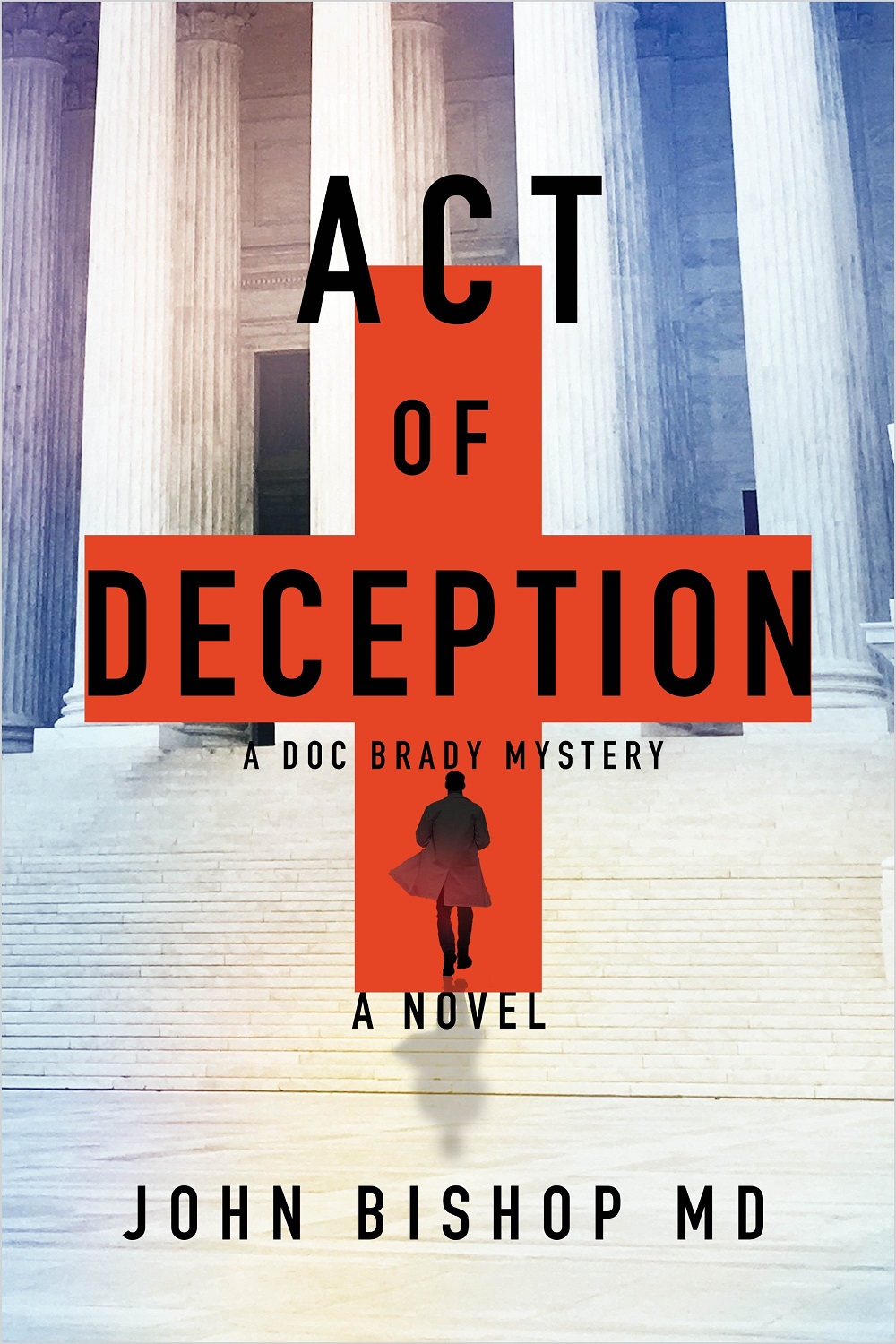
John Bishop MD is the author of “Act of Deception: A Doc Brady Mystery.” Dr. Bishop has practiced orthopedic surgery in Houston, Texas, for 30 years. His Doc Brady medical thriller series is set in the changing environment of medicine in the 1990s. Drawing on his years of experience as a practicing surgeon, Bishop entertains readers using his unique insights into the medical world with all its challenges, intricacies, and complexities, while at the same time revealing the compassion and dedication of health care professionals.

 SA Examiner