
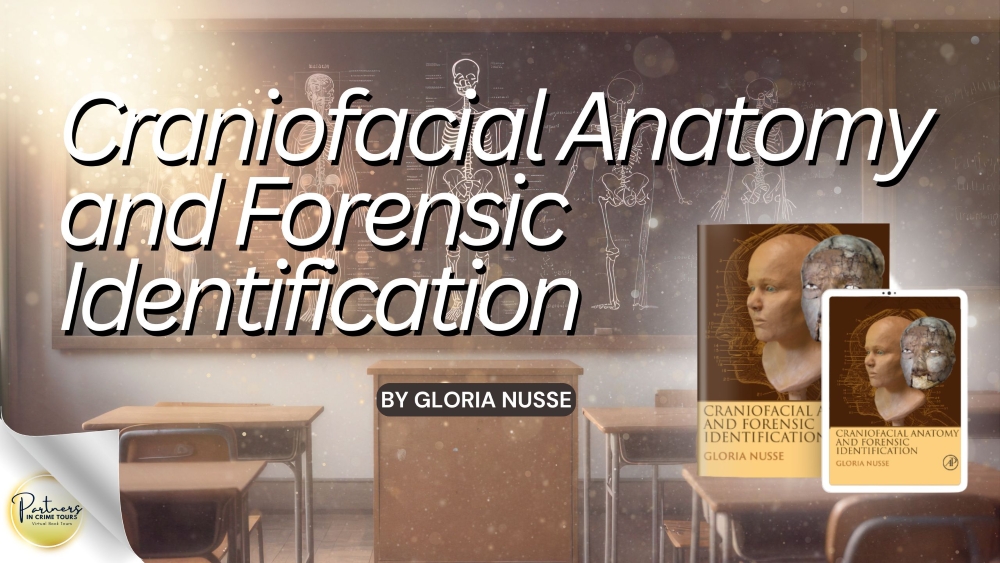
Part of the Partners in Crime Tours Virtual Book Tour
Book Review: Craniofacial Anatomy and Forensic Identification by Gloria Nusse
Overview
Our bodies record what happens to us physically throughout our lives, including scars from injuries sustained years or even decades ago. Scars tell us how we used our joints or how we may have injured them as children and adults. Our bodies also conform to the environments in which we live, both externally and internally. By examining and observing these key clues, a forensic investigator can reveal the unique characteristics that tell the story of a person’s life and death. (Barnes & Noble, 2026)
Craniofacial Anatomy and Forensic Identification is an atlas that covers all aspects of facial reconstruction and the anatomy of the head and neck. It explores facial expression, the anatomical basis of facial development, and the effects of muscle movement in detail.
Written by a world-renowned forensic artist with decades of experience as a scientific illustrator, portraitist, anthropologist, and lecturer in anatomy and biology, Gloria Nusse brings a rare balance of scientific rigor and artistic mastery to this work.
What’s Inside
- Chapter 1: Introduction and identity from the skull’s perspective
- Chapter 2: History and research of facial identification
- Chapter 3: Bones, muscles, and tissues
- Chapter 4: Facial features
- Chapter 5: Analysis and interpretation
- Chapter 6: Age, archetype, and expression
- Chapter 7: Grave goods and artifacts
- Chapter 8: Mold making and reproduction
- Chapter 9: Clay work and finishing
- Chapter 10: Lefty, an exemplar
Highlights
Chapter 2
This chapter includes a fascinating history of facial identification, beginning with mortuary practices of preserving the head that date back approximately 80,000 years to Jericho and the Middle East. It also highlights influential figures in the field, such as Wilton Marion Krogman, a professor of physical anthropology who along with sculptor Mary Jane McCue created a 3D facial reconstruction on a male skull in 1946. Modern identification methods are largely based on this groundbreaking work.
Chapter 8
This section goes into detailed methods of mold making, skull preparation, and techniques for working with damaged skulls, making it especially valuable for practitioners.
Review
Craniofacial Anatomy and Forensic Identification is a visually rich atlas that bridges science and art with remarkable accuracy. Designed for forensic artists, anthropologists, and anatomy students, the book offers a comprehensive examination of the head and neck, grounding facial reconstruction in anatomical knowledge rather than artistic intuition alone.
Nusse guides readers through craniofacial anatomy, facial musculature, and the structural basis of expression, clearly demonstrating how bone, muscle, and soft tissue interact to create recognizable human faces. I especially appreciated her focus on facial development and muscle movement, which shows how subtle anatomical variations can dramatically alter a person’s appearance, which is an essential insight for forensic identification. The atlas format, supported by detailed illustrations, allows complex concepts to be easily understood and reinforces the text’s scientific clarity.
As a world-renowned forensic artist and scientific illustrator, Nusse writes with the authority of a scientist and the sensitivity of an artist. Her explanations are precise yet accessible, reflecting deep respect for both disciplines.
Overall, Craniofacial Anatomy and Forensic Identification is a valuable reference that elevates facial reconstruction from technique to discipline. It gives readers a deeper understanding of the human face as both a biological structure and an expressive form. An extra plus is the history of facial reconstruction; fans of history will appreciate the detailed background information.
“It is impossible to know all of anatomy. She is a mysterious mistress and refuses to be put into a box. Each time you think you have figured it out, you see something else that changes all you knew before.”
Pick up your copy today!
Amazon Barnes & Noble Walmart Thriftbooks ScienceDirect Elsevier
About the Author
Gloria Nusse is a forensic artist, anatomist, and anthropologist who has taught numerous professional workshops, including for the FBI.
She has aided in the identification and return of the unidentified remains of more than 14 individuals to their families. Her work includes recreations of ancient peoples of the Middle East and the reconstruction of the crystal skull for National Geographic, among others. Her work has been featured on 48 Hours, Forensic Files, Dateline, National Geographic specials, Unsolved History, and more.
Nusse worked as a scientific artist for over 35 years and taught human dissection and anatomy at San Francisco State University for 12 years, where she is currently Emeritus. She has authored and co-authored multiple journal articles and book chapters and was the invited speaker for the Chalmers Historical Address at the Association of Oral and Maxillofacial Surgeons meeting in 2013.
*Thank you to Partners in Crime Tours and the author for my gifted copy for review as part of the tour. I haven’t been compensated for this review and all views and opinions expressed are my own.
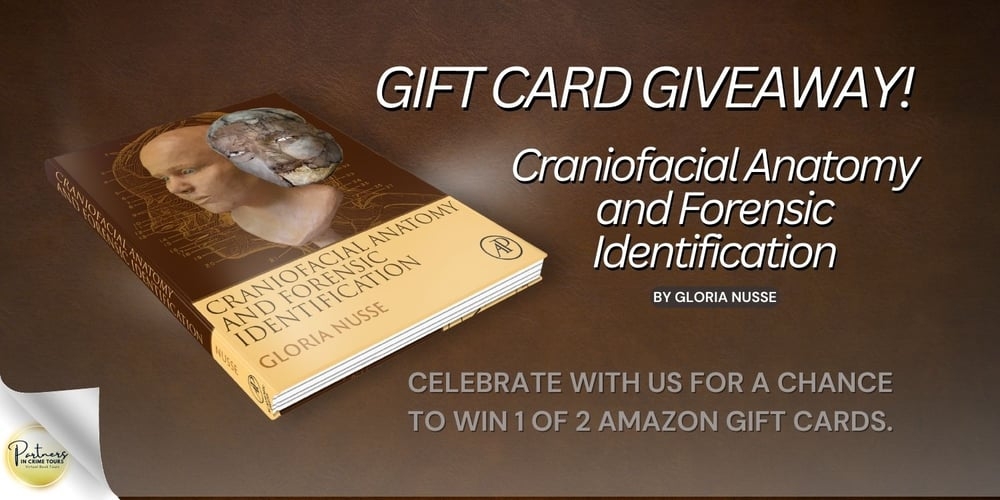
Partners in Crime Tours is hosting a gift card giveaway! Enter now for a chance to win 1 of 2 Amazon gift cards. Terms and conditions apply. Void where prohibited.



 SA Examiner