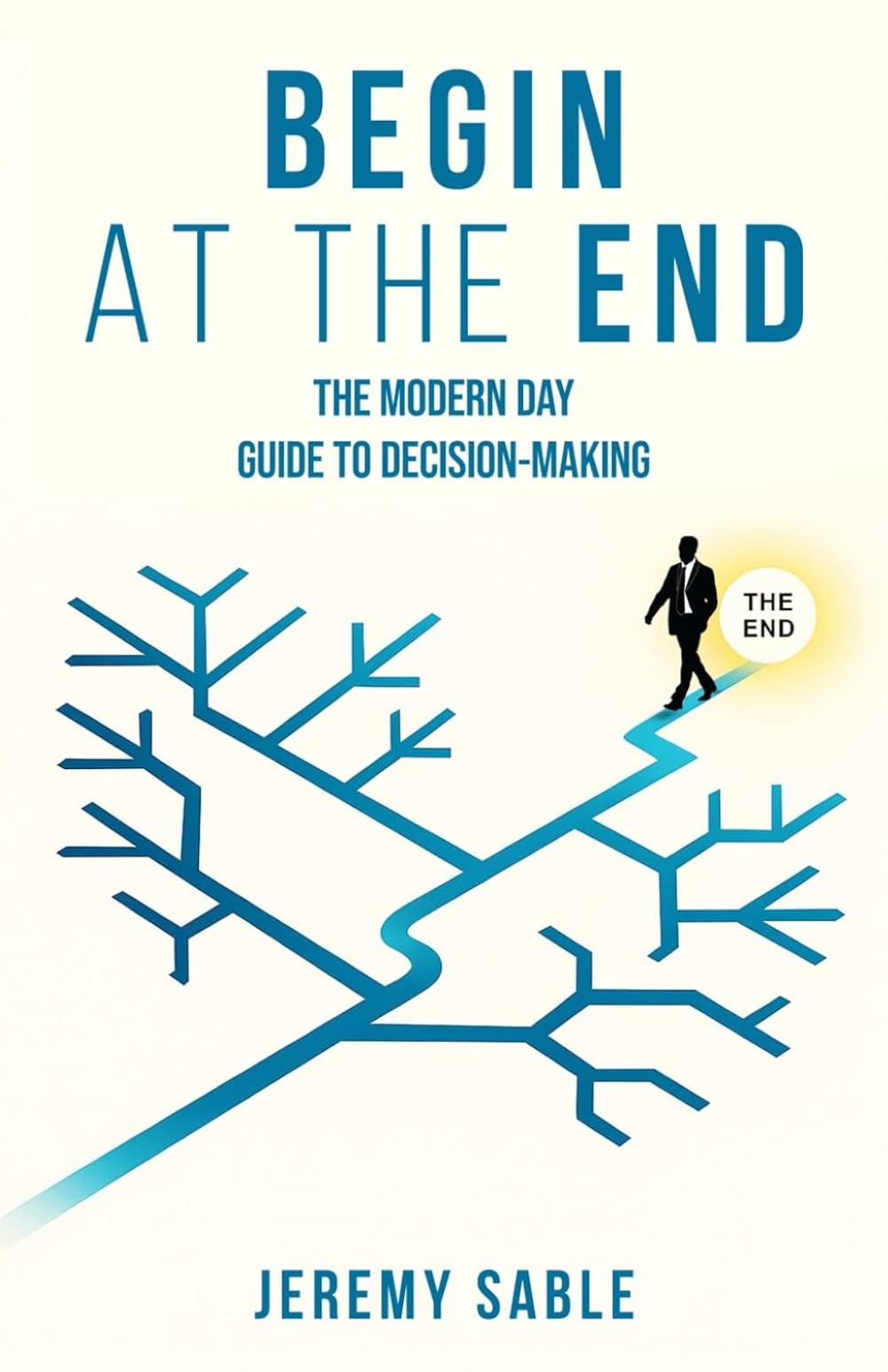
Begin at the End: A Smarter Way to Make Decisions in an Overwhelming World

Decision fatigue is real and this book offers a way out. Photo: Amazon

Related Post: The Leadership Skill That Shapes Every Business Decision (And a Book That Explains It)

Book Review: Begin at the End by Jeremy Sable

Begin at the End: The Modern Day Guide to Decision-Making by Jeremy Sable is a timely response to a problem many of us feel but struggle to identify: decision fatigue in a world that never pauses.

He doesn’t offer abstract frameworks or motivational clichés, but rather a practical system rooted in real-world experience. He has spent a decade in mission-critical consulting where decisions aren’t theoretical, they’re consequential.

His goal in writing this book is clear:

“This book is for anyone who is facing tough decisions, feeling stuck, or just looking for a better way to think things through.”

The Core Idea: Outcome-First Thinking

The premise is simple yet powerful. We need to stop reacting to the options in front of us and start anchoring every decision to the outcome we actually want.

This Outcome-First approach flips traditional decision-making advice on its head. Instead of weighing endless pros and cons, Sable encourages clarity first—defining success before choosing a path. The result is faster, more confident decisions with far less mental noise.

What’s Inside the Book

The book is divided into four clear sections:

  • Part I: Framing the End
  • Part II: Navigating the Messy Middle
  • Part III: Making the Call
  • Part IV: Becoming a Decision Maker by Design

Key Highlights

Part I, Chapter 1: Outcome-First Thinking
Sable immediately addresses artificial intelligence, noting that AI will increasingly influence both personal and professional decisions. While AI can provide predictive analytics and real-time simulations, it can also begin to make decisions for us if we aren’t clear on our goals.

“AI is not your enemy, but it’s not your decision maker either. You are.”

Part I, Chapter 5: Generate Better Options — Decision-Making Under Pressure
When faced with two bad options, Sable challenges readers to create better ones. He uses Tyler Perry as a case study: when told his work wasn’t mainstream enough for Hollywood, Perry didn’t conform or quit, he built his own studio.

“So the next time you’re told it’s either A or B, remember—you are writing the test, not just taking it.”

Why This Book Works

Sable acknowledges the speed, complexity, and constant pressure of modern life and designs his approach accordingly. The writing is clear, direct, and refreshingly free of jargon. He reinforces concepts through illustrations, case studies, and interactive exercises, with each chapter ending in summaries and key takeaways.

Several chapters also explore how artificial intelligence fits into modern decision principles, making the book especially relevant right now.

Final Thoughts

For readers who feel overwhelmed or paralyzed by choice, Begin at the End is an effective antidote. It restores agency and focus by reminding us that better decisions start with knowing where we want to go.

Looking for fresh decision-making ideas? This book is worth making your next guide.

“Whether in markets or in life, if you wait for perfect signals, you’ll miss the opportunities that come from moving forward with intention, even when the picture is messy.”

Rating: 4 out of 5.

*Thank you to Jeremy Sable for the gifted copy for review consideration. I haven’t been compensated for this review and all views and opinions expressed are my own.

The Leadership Skill That Shapes Every Business Decision (And a Book That Explains It)

Begin at the End is the new book on decision making and problem solving by Jeremy Sable. Photo: Amazon

Best Leadership and Business Books for Smarter Decision-Making

Books on leadership and business offer timeless lessons for anyone seeking to grow professionally and personally. The best leadership books explore how effective leaders communicate vision, make thoughtful decisions, and build workplace cultures rooted in trust and accountability.

Strong business books go beyond theory. They bridge strategy and execution, showing how values-driven leadership can drive sustainable business success. Readers gain practical insight into navigating change, managing teams, and balancing strategy with empathy. More than manuals for profit, leadership and decision-making books encourage self-reflection, resilience, and ethical thinking, reminding us that strong businesses are built by leaders who understand people as deeply as they understand performance.


📘 Book Recommendation: A Must-Read Leadership and Decision-Making Book

Begin at the End: The Modern Day Guide to Decision-Making

By Jeremy Sable

Begin at the End is a modern leadership and decision-making book for people who feel stuck, overthink important choices, or want a clearer way to navigate careers, relationships, finances, and life’s inevitable tradeoffs. Rather than promising perfect answers, the book focuses on choosing a direction with confidence and moving forward without regret.

This book is especially valuable for business leaders, professionals, and entrepreneurs seeking better decision-making frameworks in an increasingly complex world.


Decision Overload in the Modern Workplace

We are living in the middle of the greatest decision overload in human history and most people underestimate how much it impacts their performance, focus, and well-being.

Every day brings an avalanche of choices: endless information, constant notifications, shifting priorities, and pressure to move faster than the human brain was designed to operate. In today’s business environment, this overload leaves many professionals feeling scattered, burned out, or unsure whether their decisions are leading anywhere meaningful.

Begin at the End offers a practical solution for decision-making in high-pressure environments.


A Practical Framework for Better Business Decisions

Drawing from more than a decade of mission-critical consulting, Jeremy Sable explains why much of today’s decision-making advice is outdated. He introduces a modern system that helps leaders, professionals, and teams make smarter, faster, and more confident decisions.

Instead of reacting to available options, readers learn how to anchor every decision to a clearly defined outcome. This outcome-first approach improves clarity, focus, execution, and creativity, skills essential for leadership, business growth, and long-term success.


Key Takeaways from Begin at the End

In this leadership and decision-making book, readers will learn how to:

  • Apply Outcome-First Thinking to bring clarity to every decision
  • Use AI as a strategic decision-making tool, not a distraction
  • Generate better options under pressure and tight deadlines
  • Avoid false either/or thinking that limits leadership potential
  • Build feedback loops that turn decisions into long-term momentum
  • Reduce decision fatigue and make clarity a daily habit

This is not theoretical advice. It’s a real-world playbook for business leaders, professionals, and anyone responsible for making high-stakes decisions.


Why This Book Matters for Leaders and Professionals

If you’ve ever thought, “There has to be a better way to make decisions at work and in life,” this book delivers that solution. Begin at the End provides a practical clarity system that helps leaders align decisions with purpose, values, and long-term outcomes.

For anyone interested in leadership development, business strategy, or personal growth, this book is a valuable addition to your reading list.


About the Author: Jeremy Sable

Jeremy Sable helps people make better decisions when the stakes are real and the answers aren’t obvious. Raised in the suburbs of Atlanta, he studied engineering at Virginia Tech before beginning his career in government consulting in Washington, DC, an environment where leaders regularly make decisions with incomplete information and real consequences.

His work blends consulting and engineering frameworks with personal experience and real-world constraints. Jeremy believes most people aren’t bad at decision-making, they’re overwhelmed, overinformed, and rarely taught how to decide effectively.

How Daniel Patrick Forrester’s ‘Consider’ Challenges Conventional Thinking

‘Consider: Harnessing the Power of Reflective Thinking in Your Organization’ by Daniel Patrick Forrester

Daniel Patrick Forrester founded THRUUE, Inc., an expert consultancy that supports leaders and boards bridge the gap between strategy and culture. With the explosion of data and hyperconnectivity, Daniel’s curiosity led him to research how leaders responded to the onslaught of available data and to publish his first book, “Consider: Harnessing the Power of Reflective Thinking in Your Organization.” It centers around the role reflection can play in dramatically improving corporate outcomes. As a top nonfiction leadership book, it has impacted the lives and work habits of small and large organizations from around the world. (Amazon, 2024)

“Consider: Harnessing the Power of Reflective Thinking in Your Organization”

“STOP, THINK, AND DON’T DO SOMETHING STUPID!” This is the warning Dr. Robert Bea drills into his Civil and Environmental Engineering students at the University of California in Berkeley. Bea wants to dramatize what he terms the inevitable “oh shit” moments that present themselves—before an actual engineering calamity like the Deepwater Horizon/BP disaster happens.

There’s an intangible and invisible marketplace within our lives today where the products traded are four fold: attention, distraction, data and meaning.

The stories and examples within “Consider” demonstrate that the best decisions, insights, ideas and outcomes result when we take sufficient time to think and reflect. While technology allows us to act and react more quickly than ever before, we are taking increasingly less time to consider our decisions before we make them. Reflection supplies an arsenal of ideas and solutions to the right problems. Including interviews with leaders such as General David Petraeus, attorney Brooksley Born and global investor Kyle Bass, Forrester shows us that taking time and giving ourselves the mental space for reflection can mean the difference between total success and total failure.

Review:
This book is an insightful exploration into how reflective thinking can revolutionize organizational dynamics and decision-making. Forrester suggests that the ability to pause, reflect, and engage in deep thinking is essential for encouraging innovation and strategic clarity in today’s fast-paced business environments.

It is organized around practical strategies and real-world examples, demonstrating how reflective practices can be systematically integrated into organizational cultures. He explains that reflection is not necessarily a passive activity but an active, intentional process that can lead to more informed and creative decision-making. By introducing concepts such as “reflective leadership” and “strategic pauses,” Forrester provides actionable tools for leaders seeking to cultivate a reflective culture within their teams. One term that stands out is “plastic time,” what people are now experiencing when they are in “a constant state of interruption and movement between many different tasks.”

It is divided as follows:

Introduction: The Space between Data and Meaning
1. The Human Need for Think Time
2. Forcing Think Time
3. Thinking Out Loud
4. Promoting Think Time
5. Taking a Step Back
6. Too Big to Think?
7. Rapid Contemplation
8 .Outside the Day-to-Day
9 .Reflection and Extreme Situations
10. The Future of Think Time and Reflection

By combining theoretical insights and practical advice, the information is accessible to both senior executives and mid-level managers. Forrester’s writing is clear and engaging, with a focus on real-world applications rather than abstract theories.

Overall, “Consider” is a valuable resource for leaders looking to harness the power of reflection to drive organizational growth and resilience. It is recommended for readers interested in books on workplace culture and leadership/motivation.

“I do not wish to suggest that being alone and thinking always leads the mind to positive and beneficial outcomes… Alone time and reflection when one’s mental model of the world is perverse can give rise to the unimaginable.”

*The author received a copy of this book in exchange for an honest review. The views and opinions expressed here belong solely to her.

Rating: 4 out of 5.