With the formalities out of the way, it is time to get into the deeper topics of Ryan Gutierrez’ “Scars in Time: A Novel (The Nowhen Stories).” Here is the second and final part of my Q & A with the author.
Sandra Cruz: Have you ever considered going back in time for purely altruistic reasons? Ryan Gutierrez: You know, if I could, I think I would have to. When you talk about time-travel, people often go to the baby Hitler conundrum. Would you kill baby Hitler to stop the Holocaust? Well, perhaps I’d just kidnap baby Hitler and help him find a nice adoptive family in our time, but I would have to do something. You can’t not try to stop the heinous murder of millions of innocents.
That’s why it was so important for me to limit the time travel in my story to a micro and personal level. I wanted Brennan to be limited to what he could do within his own lifetime only. I didn’t want him getting sidetracked stopping the holocaust.
SC: Your book reminds me of the movie The Butterfly Effect. Did it inspire your story? RG: I haven’t actually seen that movie. I think it came out during this weird time when I was on an anti-Kutcher kick for some reason. I actually admire the heck out of him now and all he’s done for victims of the sex trade. I did, however, draw inspiration from the Butterfly Effect that is a part of chaos theory. Basically, a small change to proceeding events could have massive repercussions on the resulting consequences.
SC: Is this the first book in a series? I would love to read more of Brennan’s travels. RG: Yes and no. It is the first book of the Nowhen Stories, but Brennan will be taking a backseat role to let others shine. I wanted Brennan’s focus to return to his family and living life well. However, Brennan’s travels through time opened the world to the effects of the Nowhen, the realm that functioned as a sort of way-station between times. The Nowhen is going to be for South Texas, what the Hellmouth was for Sunnydale, what the meteor shower was for Smallville, or the particle accelerator explosion was for Central City. A catalyst for supernatural and extraordinary.
The Nowhen Stories will tell those tales.
SC: Were you concerned that some readers might not understand some of the Spanish you used? RG: I was. I decided to do it anyway because I wanted the book to reflect and connect to the heavily Latino roots of the RGV and South Texas in general. I wanted to tell a story that felt universal, but also felt close to the heart of Latinos who may feel underrepresented in pop-culture.
SC: Considering that it contains religious themes/topics, it is geared towards a Christian audience? RG: Not really. I would love for Christian people to enjoy the book, though I think some of my fellow Christians might frown upon some of the language and the level of violence. I really want the book to express hope for people in general, whether they are or aren’t Christian. It’s a crazy and entertaining story, if I may say so myself, but it’s ultimately a story of hope and restoration. I think that’s a message we all need. It just so happens that in my experience, hope and restoration tend to be intricately woven up with God.
Ryan Gutierrez’ debut novel, “Scars in Time: A Novel (The Nowhen Stories)” is about Brennan Ramirez, a man determined to change his wife’s traumatic past by going back in time. As Brennan test drives The Machine, he begins to experience true power, true control, or so he thinks. With every trip, every choice, Brennan realizes that his newfound control may be an illusion. I found the book entertaining and enlightening so in an effort to get to know the author and his motivations for writing it, I recently asked him a series of questions. Here is the first part of my author Q & A.
Sandra Cruz: Was this a hard book to write or is this a story you have been thinking about for some time? Ryan Gutierrez: “Scars in Time” was definitely a difficult story to write, but not necessarily in terms of creativity. The outline process took a few months and once that was complete, the first draft went quite smoothly. The most difficult part about writing “Scars” was the real life scars I was picking at, pun most definitely intended. There are real life events, real trauma, that I exaggerated and fictionalized for the story.
SC: How much research did you have to do into the topic of time traveling? RG: Honestly, not too much. I’m a huge sci-fi geek, so in a way I’ve been researching for this my whole life. I think my biggest time-travel related influence for this story is 11/22/63 by the great Stephen King. 11/22/63 starts as a bigger-than-life journey, stop the JFK assassination, but it becomes this personal story of love and growth. That aspect definitely influenced me.
SC: Some authors base their characters on people they know, was this the case with Brennan? Is it in any way autobiographical? RG: It definitely is. I’m not Brennan, but there are parts of Brennan that are definitely from me. The PTSD and feelings of powerlessness stemming from his time in CPS were a reflection of my own. The panic disorder symptoms in the book are basically a walkthrough of the panic attacks that I faced in my life. Brennan is the most like a real person, but there are elements of Deidre taken from my wife, elements of Abby taken from both my daughters, elements of James taken from my brother, and so forth.
SC: Do you consider Brennan a hero/superhero? RG: No, I don’t. The thing with Brennan is that HE thinks he’s the hero. He wants to be Batman or Superman, but the more power he gets, the closer he is to playing the role of tragic villain. I think that when Brennan realizes he’s not a superhero, he notices the heroic characteristics of those around him. Abby’s immutable joy and unique perspective, Deidre’s resilience and strength, or James’ ability to look to tomorrow. He has to learn from them in order to take his final heroic turn.
SC: As someone who suffers from panic attacks, I sympathize with Brennan as he suffers through his. His experiences are hauntingly realistic. Is this your way of reaching out to those in similar situations? RG: Yes, definitely. Brennan’s panic attacks are realistic because they’re based on the real attacks I suffered. I wanted people who have suffered with them to be able to relate to a character who is flawed and doesn’t overcome them by just having some feel good mantra or attitude. By the end, Brennan knows this may be a lifelong struggle, but he knows there is hope in that struggle. As for people who have never suffered from them, I wanted them to get a little peek into them, a way for them to better understand their loved ones who do have those struggles.
Pearsol opened the mortuary cooler and pulled out the stainless steel tray supporting the victim. “Lieutenant, meet Jane Doe,” he said sliding the woman’s bloated body under Driscoll’s gaze. “Harbor Patrol fished her out of the muck. I’d say she was a feast for the gulls for a day. Maybe two.”
“What’s that smell? Paint thinner?”
“Phenol.”
“She was doused in phenol?”
“Injected.”
Driscoll’s eyes narrowed.
“The complete autopsy will fill in the blanks, but I’d bet my pension I already know what killed her. The who, and the why, I’ll leave to you.” Pearsol handed the preliminary lab report to Driscoll. It identifies a mixture of substances inside her vascular system.
“Phenol, formaldehyde and Chloride of Zinc?” Driscoll looked perplexed.
“The same Chloride of Zinc they put in dry cell batteries?”
Pearsol nodded. “There’s three more.”
“Myrrh, aloe and cassia,” Driscoll read aloud. “That’s a strange mix.” He glanced at Pearsol, who nodded. “Says here you drained 851 milliliters from her circulatory system. What’s that? About two pints?”
“Just under.”
“A body contains five to six quarts of blood. So the rest of this mixture?”
“Still in her.”
Using his finger, Driscoll pushed back a lock of the victim’s hair. “What could you have done to warrant this?” he whispered, eyes on the corpse.
“Right now the unofficial cause of death is phenol poisoning by arterial injection. Familiar with the German word, ‘abgespritzt’, Lieutenant?”
“No.”
“Abgespritzt was a method of genocide favored by the Nazis in the early 1940s. Hitler’s henchmen delivered instantaneous death by injecting 15 milliliters of phenol directly into the heart.”
“What kind of syringe injects six quarts?”
“More than likely he used a centrifugal pump. And he knew what he was doing.” Pearsol pointed to the side of the victim’s neck, where a semi- translucent latex adhesive covered a two inch stretch of rippled flesh between the carotid artery and the jugular vein. “An extreme method of murder, Lieutenant. He arterially embalmed her.”
Driscoll winced.
“There’s more.” The M.E. produced a transparent evidence bag containing a locket. It was an inch in diameter and featured Saint Vitalis of Gaza; his name etched in a half circle below his likeness. “I found it under her tongue. Someone apparently placed it there before suturing the tongue to the floor of her mouth.”
“What’s that about?” Driscoll wondered aloud.
“Good question. I’m not familiar with that saint. You?”
“She‘s the patron saint of prostitutes.”
“Well, there’s a lead. Oh, and there’s one other bit of information you’re sure to find intriguing. The myrrh, aloe, and cassia injected with the embalming fluid were once embalming solutions on their own. Sort of.”
“Sort of?”
“They were the purifying fragrances applied to the linens that wrapped the crucified Christ before he was laid in his tomb.”
*************************************************** Thomas O’Callaghan’s work has been translated for publication in Germany, Slovakia, Indonesia, the Czech Republic, China, and Italy. As an internationally acclaimed author, Mr. O’Callaghan is a member of both the Mystery Writers of America and the International Thriller Writers associations. His debut novel “Bone Thief” introduces NYPD Homicide Commander Lieutenant John W. Driscoll. “The Screaming Room” is the second in the John Driscoll series. The third book in the series, “No One Will Hear Your Screams,” is now available from WildBlue Press.
‘Scars in Time’ is Ryan Gutierrez’ exciting debut novel. Photo: google
Ryan Gutierrez is an American author born and raised in Texas and currently resides in the small South Texas town of Los Fresnos. He graduated from The University of Texas – Brownsville with a bachelor’s degree in Criminal Justice and worked as a Child Abuse Investigator with the state of Texas for five years. His debut novel, “Scars in Time: A Novel (The Nowhen Stories)” is about Brennan Ramirez, a man determined to change his wife’s traumatic past by going back in time. As Brennan test drives The Machine, he begins to experience true power, true control, or so he thinks. With every trip, every choice, Brennan realizes that his newfound control may be an illusion.
“Scars in Time” begins with a Twilight Zone-like introduction of the main character Brennan “Like all people, we could describe Brennan Ramirez in many ways. …Any time he wasn’t expressing some positive emotion, he looked furious with the world. He had a few decent reasons to be, but we’ll get to that later.” The first part introduces readers to his wife Deidre and her traumatic childhood in the hands of her mother’s boyfriend and an emotionally distant mother. He test drives The Machine a couple of times before he realizes that he can use it to change the past. After quitting his job as a Child Abuse Investigator due to his debilitating anxiety and panic disorder, he feels useless. He is constantly haunted by one of his past cases: Kaylee, a young girl who ends up dead because he failed to help her. The first time he travels to the past is to fix Kaylee’s life but what he wants more than anything is to go back and prevent Deidre’s traumatic abuse. At first it seems to work and he thinks he is in control, but it turns out to be just an illusion and he is reminded that life is unpredictable and not subject to manipulation. It is divided into four parts: Part I – The Present, Part II – 1994 (when he goes back to help Deidre) Part III – The New Present (includes the consequences of his time meddling) and Part IV – Nowhen (the new normal).
With his impressive debut novel, Ryan Gutierrez does an excellent job of introducing readers to Brennan, a complex and flawed character who ultimately just wants to do the right thing. Due to his anxiety and panic disorder, he feels out of control and the only way to regain some of that control is to go back in time to fix other people’s lives. Through it all, he undergoes a transformation because with each person he kills, it bothers him less and less and justifies it by telling himself that they deserved it. The focus is not so much the science of time traveling, but rather in using it to fix life’s “mistakes” and its consequences. He is constantly popping anti-anxiety pills and the vivid descriptions of his panic and anxiety attacks, especially when driving, are hauntingly realistic. The story flows naturally from page to page and the language is easy to understand, even though there is some sporadic Spanish. It has deep character development and is an emotional roller coaster ride, especially when he realizes how his time travelling is changing the “present” and it turns out that he created two timelines by initially jumping back to 1994. The author’s background in Criminal Justice gives the story an authentic voice as Brennan deals with the fall out of being a Child Abuse Investigator and when he is a Detective in the new present. Despite some Christian themes and scripture quotes, it does not come across as preachy. Hopefully, this is just the beginning of Brennan’s adventures. “Scars in Time” is a must-read page turner filled with action, drama and romance centered around a deeply troubled main character. It is recommended for science fiction fans who appreciate time travel stories, Hispanic characters and culture and an abundance of pop-culture references.
“Though the memories of all the changes he’d made, all the rips and stitches in time, were crystalline in his mind, all other memories were as they usually were. Blurrier, murkier, and more likely to be inventions of a mind trying to fill gaps the farther back you go.”
*The author received a copy of this book for an honest review. The views and opinions expressed here belong solely to her.
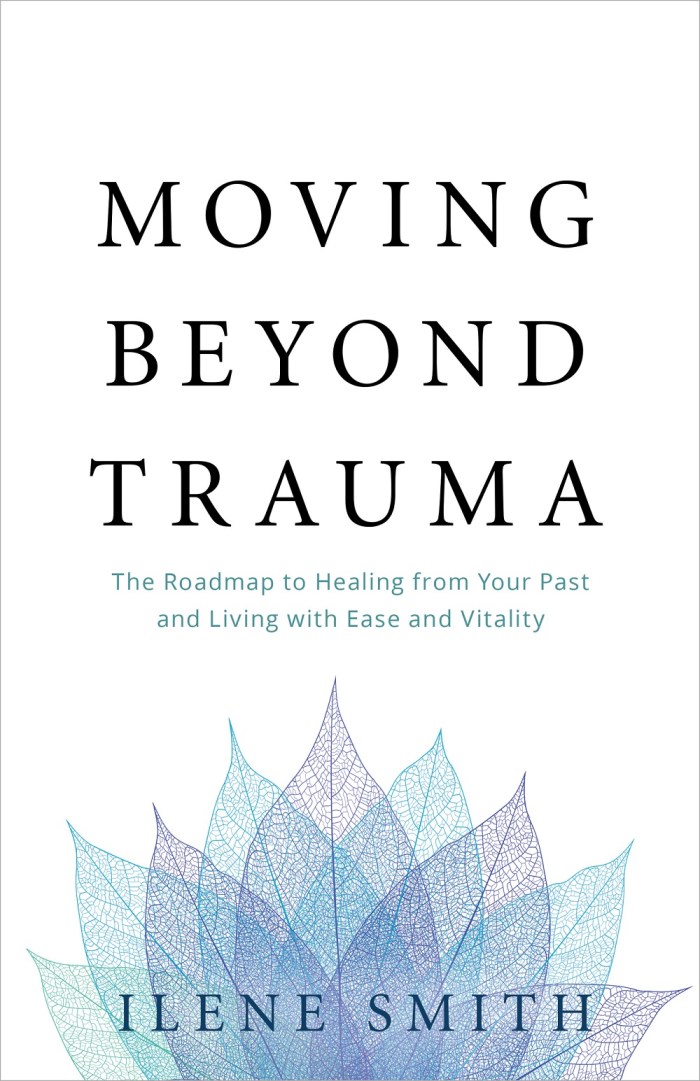
‘Moving Beyond Trauma’ by Ilene Smith. Photo: google
Ilene Smith is a certified professional coach and Somatic Experiencing practitioner with master’s degrees in exercise physiology and mental health counseling. Her research into Somatic Experiencing and eating disorders has contributed to the importance of Somatic Experiencing and body-based therapies in recovery. With master’s degrees in exercise physiology and mental health counseling, Ilene blends talking, touch work and movement to create synergy between a client’s body and mind. In her first book “Moving Beyond Trauma: The Roadmap to Healing from Your Past and Living with Ease and Vitality,” Ilene Smith introduces readers to Somatic Experiencing, a body-based therapy capable of healing the damage done to the nervous system by trauma. She breaks down the way in which trauma impacts the nervous system and presents a program designed to process trauma in a non-threatening way.
It is important to note that, as the disclaimer at the beginning states, “This book is not intended as a substitute for medical or psychological advice from professionals.” “Moving Beyond Trauma” is divided into two parts: Part One: Understanding the Mind-Body Connection which consists of chapters like ‘My Journey to Healing’ and ‘What Healing Looks Like’ and Part Two: Creating Change where in Chapter 5 the reader can assess his or her problem behaviors by taking a series of quizzes and in subsequent chapters, apply healing exercises and get tips for living a healthy lifestyle. In the Introduction, the author emphasizes that because the body and mind are connected, “psychological stress is held and manifests in our physical body.” Even though she believes in talk therapy up to a point because it does have its benefits, most of the time it dredges up past experiences, which are often traumatic. Due to this, some people end up re-traumatizing themselves instead of healing. What she offers in Somatic Experiencing is a way to track and notice body sensations and experiences so that the body can begin to heal.
Since not all human beings are the same, not everyone experiences healing the same way so it is natural that not all methods of therapy work for everyone. While some do benefit from talk therapy, for some, retelling their story can reactive the trauma and therefore they can not move past it. This is where “Moving Beyond Trauma” can help by defining the different types of trauma: developmental, collective and generational and providing healthy ways of coping. Through case stories about her past clients that dealt with anxiety, trauma, depression and eating disorders the author successfully presents her case that by confronting the body’s pain reactions, particularly to the nervous system, people can push past and begin the healing process. The language is not overly clinical so it is easy to comprehend the material. Readers will be able to understand their own trauma and, by doing the self-assessments, hopefully learn more about themselves and what triggers their anxiety and stress. It is an easy read and recommended for anyone looking for self-enrichment or for healthy living tips.
“I believe that it is when we are placed right in the middle of the most adverse experiences life has to present us with that we have the opportunity to build the most resilience for ourselves.”
*The author received a copy of this book for an honest review. The views and opinions expressed here belong solely to her.
I awoke that Friday morning in a serious sweat, the kind that is not immediately relieved by rising and washing one’s face with cold water. I noted that the clock in the bathroom read 4:38, twenty-two minutes before my designated alarm setting. After staring at the clock for a minute, maybe two, I felt my right radial pulse. The accelerated throbbing confirmed that tachycardia was still my predominant rhythm. I decided to attend to ritualistic morning bathroom chores, make coffee, read the paper, and at least try to pretend that it was a normal Friday morning.
Upon completion of the bathroom routine, as quietly as possible, I punched in the five-digit alarm code and started to leave the bedroom to go downstairs. Unfortunately, even the sound of punching in the numbers was unduly shrill, and it caused Mary Louise, my bride of twenty-four years, to stir.
“Jim Bob?”
“Yes?”
“It’s not even five yet. Why are you up?”
“Couldn’t sleep. Woke up with the sweats again. Sorry to wake you. I thought I’d go downstairs, make some coffee, and sit outside and think for a while. Okay?”
“Want some company?”
Normally, I would never turn down such an offer. I loved my wife dearly. She was, in fact, my best friend. That particular morning, however, I responded in the negative.
“I don’t want to hurt your feelings, sweetie, but this is just one of those times I need to collect my thoughts. Know what I mean?”
“I do. I’m sorry you’re having to go through all this. It isn’t fair. After all you’ve done for everybody else. I know in my heart it will be all right, just maybe not today. Try not to get too upset. Promise?”
“I’ll do my best.” I leaned down and kissed her warm cheek. She smelled so good, I considered taking off my robe and getting back into bed. I finally chose not to. “Go back to sleep. I’m not leaving until about eight o’clock.”
I left her reluctantly and plodded downstairs barefooted, in my cotton robe, with lights still off, toward coffee heaven. I selected Twin Peaks Blend coffee beans, which we kept in the freezer to avoid staleness, ground them, and began the ten-minute process to achieve as perfect a cup of coffee as I could make. I waited on the back porch in my “spot,” a large white cane rocker. The month of August was a stifling time of year in Houston, even at that hour of the morning. The heat and humidity were almost unbearable during July, August, and early September. I turned on the outdoor ceiling fan that hovered above my chair and hoped it would make the weather more pleasant. It didn’t.
I considered my life that morning. I, Dr. James Robert Brady, who had done my best to be a compassionate and dedicated orthopedic surgeon for the past seventeen years, was being sued for medical malpractice. I was not a neophyte when it came to lawsuits. I had been sued twice before, not an unusual occurrence in a city of four million people, with far too many law school graduates sitting in their quiet offices with nothing to do. The other two suits were quite minor and did not linger but were dismissed rather quickly, meaning over a year-or-two period. The current lawsuit, the cause of my awakening before five with the sweats and intense gastrointestinal distress, had not been dismissed.
I stepped back inside to the relatively cool air, although during August even the air-conditioning system labored heavily. I poured my coffee into a large black mug with a removable top that allowed intermittent filling of the cup but twisted on securely so as not to spill during the drive to work. While I wasn’t yet ready to leave, I used the “to go” cup anyway, being a creature of habit, a trait inherited from my dear departed father, and one which drove even me to distraction on occasion.
I returned to the French door to head back to the humidity and spotted Cat perched on the back doorstep, peering through the lowest windowpane, awaiting her breakfast. I sipped my coffee and prepared her Prime Feast in a disposable dish, probably not recyclable because I am sure it isn’t possible to remove the smell of mixed seafood, no matter what treatment is available at the nearest recycling plant.
Strolling to the door, feast in hand, I greeted the discriminating feline.
“Morning, Cat. I have your breakfast.”
No response. Just a simple twitch of the sensitive nose. There was no tail-wagging or jumping on my bare leg to greet me, sure signs that man’s best friend loved you and missed you. Rather, Cat simply did what she did best. She remained aloof and distinctly noncommittal. I bent down, sat her dish on the patterned concrete deck, and stroked her damp fur as she sampled my selection. She did give me a brief look of gratitude, then resumed her nibbling. I returned to my chair and continued to assess my life and its worth.
I was most critical of self that morning, pondering the effects of aging on a once-athletic physique. While Mary Louise considered me to be a handsome specimen, I lamented my shrinkage from six feet plus one inch to slightly less than the “manly” six feet. I continued to disguise my shortening by wearing Western boots, and only on weekends did I allow myself the comfort of high-topped athletic shoes—not that I used them for athletics.
I remembered my previously full head of hair that had slowly thinned, especially at the front, to allow for enlargement of my forehead while a balding spot was created on the crown of my head. My sideburns were a little long and gray and transitioned to brown at an always-increasing distance from the top of my ears. I criticized the extra minute I spent every morning to carefully position my combed-straight-back locks over that bare spot I had grown to hate.
I had begun to study myself each morning before showering to confirm that I indeed resembled Alfalfa of Little Rascals fame, with thin wisps of hair sticking straight up toward the heavens. I then reminded myself of my need to wear bifocals and of my need to start a workout program to slim my waist from its size 38—although I had noticed lately that the cleaners had been shrinking my best jeans.
I tried to take comfort in Mary Louise’s love of what she called my “charming cleft chin” and “captivating smile” but was unsuccessful. I felt old that morning, which, along with words like useless, worthless, out-of-shape, and four-eyed, drove me to an even fouler mood than when I awoke to cold sweats and the dreaded digestive-tract blues.
By six o’clock I was sweating again, that time from drinking an entire pot of coffee and from the oppressive heat that had already risen to a sultry 80 degrees with the humidity at drip level. I threw off my robe and dove into the pool, taking care to avoid a cervical spine injury in the four-foot-deep water. It did cool me off temporarily, so after two laps I simply stood in the healing waters, naturally, in the buff. As I reminisced over the treatment of the patient that had decided to sue me, the back door of the house opened and the Tipster bounded outside. He saw me in the pool and almost dove in with me. Fortunately, I was able to hold him back while I ruffled his shaggy mane and scratched his ears. At least he was glad to see me and acted as though we had been apart for years, not just the six hours since we had bid him good night.
His official title was “Tippecanoe and Tyler Too,” a typical name given by a particular breeder who prized his full-blooded intelligent golden retrievers. But “Tip,” “Tipper,” or “the Tipster,” as Mary Louise intermittently called him, had failed the IQ test for well-bred dogs and was lovingly given to me by that grateful patient, who had many more golden retrievers than insurance dollars.
Tip had been presented to me in the office five months previously at the end of the day as a surprise. The man didn’t ask me if I wanted a dog, but simply showed up at my office with a large, overly friendly seven-month-old golden retriever puppy. I still suspected that Fran and Rae, my faithful office staff, had somehow conspired with my darling wife to bring some new joy into my life. At the time, I was highly skeptical and hoped to rid myself of the constantly-shedding beast who had disrupted our lives. Over the next few months, however, I had grown to love, without restraint, this large, adorable dog, whose only faults were that he was too much a friend to strangers and a poor fetcher of dead birds. Neither flaw bothered me. I didn’t hunt much anymore, and we rarely had anyone to the house that I despised. Besides, considering we had yet to be burglarized, the Tipster’s camaraderie with those stealers of one’s things was an untested character defect.
My mood improved significantly after seeing Tip, and I watched with interest as he bounded over to greet Cat with a friendly good morning. He had attempted to make Cat his new best friend every day since his arrival at our abode but had been miserably unsuccessful. Cat’s reaction to his energetic playfulness was to leap gracefully into the rocking chair next to mine, back herself up as far as possible to the rear of the chair, and wait. When Tip happily padded over to see her and put his whole head onto the seat of the chair, she would strike out at his sensitive nose with one of her front paws, prompting an episode of howling. For five months, this scenario had occurred each and every time the two animals had a backyard encounter. I believed that Cat had become bored with the whole routine and had actually become embarrassed at what seemed to be the retriever’s inability to learn.
“Tip? Be careful over there. She scratches your nose every day! It’s so raw, you almost need stitches.”
I obviously had lost my mind. I was talking to the dog as though he understood my every word. Just before pushing his fat head into the seat of the chair to smell the gray bundle of fur, though, he turned his head toward me and perked up his ears. I didn’t know if he had actually understood what I had said or simply had forgotten that I was in the pool, since he had wandered into the bushes to relieve himself before approaching Cat. He stared at me for a moment, seemed to consider what I had said, then pushed his tender, scarred nose toward the she-beast, and . . . I couldn’t believe it! She didn’t hurt him! He licked her fur, and Cat just stood there. I guessed she finally decided that Tip was harmless and just wanted to play. She might have also figured out that a large dog like that could be an impressive ally when trying to ward off neighborhood cats who strayed into her domain looking for a free meal.
And so it was that on that hot, steamy morning in August, my cat and dog became friends. I thought that maybe Mary Louise was right, having told me repeatedly that everything would be okay. Alas, that small, backyard miracle was the only one I witnessed for a while.
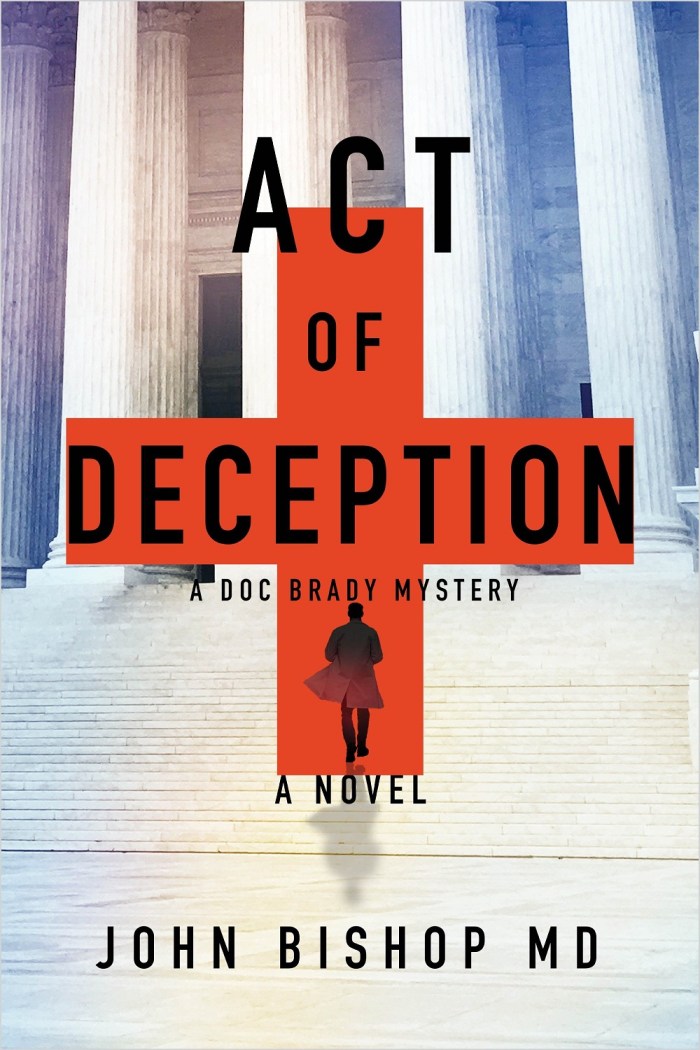
John Bishop MD is the author of “Act of Deception: A Doc Brady Mystery.” Dr. Bishop has practiced orthopedic surgery in Houston, Texas, for 30 years. His Doc Brady medical thriller series is set in the changing environment of medicine in the 1990s. Drawing on his years of experience as a practicing surgeon, Bishop entertains readers using his unique insights into the medical world with all its challenges, intricacies, and complexities, while at the same time revealing the compassion and dedication of health care professionals.
‘In Service to Love Book One: Love Remembered’ by Darlene Green. Courtesy photo, used with permission.
“In Service to Love” began the morning of December 26, 2017. When I awoke, I felt immediately overcome with Love, appreciation, and enveloped in the rich, palpable presence of the sacred divine. I could feel and see the exquisite, brilliant light of Masters, and the Elohim before me. I could do no other than sob. An invitation was extended to sit with the Masters of the Council of Light as Scribe for one year in collaboration. I said, “Yes!” I knew in an instant this was the mission I had always felt at the depths of my being and was so sacredly kept I dared not even utter the words. And “Day 1” poured through my fingers.
I have always been deeply empathic, intuitive and sensitive. This created a chasm between what I sensed and the physical reality I saw. I became an avid student of spirituality and pieces of the puzzle started lining up. I never thought of myself as a writer. My natural inclinations are as a healer and teacher. In 2015 I connected powerfully with my own history as Scribe with profound events at sacred sites in Southern France. I began to practice reaching for the fine frequencies that contain inspiration. It was both beautiful and frustrating as the experience required developing adeptness at sensing my own inner realms. Following a car accident in February of 2017, all work stopped as I turned deeply inward for healing. Then December 26, 2017 occurred.
As I sat down each day to write “In Service to Love,” I was guided by the Council of Light to what I can only describe as a field of fine, exquisite frequency that contains depth, concepts, pictures and colors. Each day was written from a different frequency even as my mind struggled to understand the process. Sometimes full concepts landed in my awareness as a picture that contained all the information then, my work was to interpret the picture I was given utilizing words that were a frequency match. Some days I was invited to expand my reach as the Council of Light moved into even finer light realms. Other times there was no thinking at all as the words flowed like honey onto the keyboard.
I continue to live a Master’s class in accessing original thought. At times I work to reach the space of connection and ultimately realize there is some limitation I am taking into the space that clouds my vision. My personality left to its own devices is fraught with doubt. So, my goal is to access my unlimited divine knowing by raising my awareness and frequency. In those moments in meditation I ask, “What may I release that I may see clearly?” Mostly what shows up are ways I discount myself. When I release my limitations, the air clears as I reach my truth unfettered by the beliefs of my personality. An expansive sense of freedom and delight ensues.
Two of the keys to access my most potent creativity:
1) Immaculate presence in the Now: I visualize myself within a series of concentric circles, with my center-most point being the exquisite stillness of the present moment. When my attention is in the outer-rings I am highly distracted, so, I watch myself walk to my center. There I experience the absence of thought. I take a deep breath and allow.
2) Willingness to not know: Accessing my greatest innovative capacity only occurs as I move beyond what I already know. Potent creating is not about rearranging what already has been, it is about accessing my own high frequency field where innovation arises in my awareness only in the Now moment.
Central messaging of “In Service to Love” invites us each to consider our own innovative capacity. Not as something that is unreachable, or only for a few of us, but as something that is deeply, intrinsically connected to our soul’s voice. As we connect to our own heart’s essence, we become the contribution we each intend. I continue to lean into the unknown to move beyond my own limited perceptions as I write daily. I feel the time we are in now requests our best to show up. With works inspired through the lens of our essential Self, how could we be anything else?
I am hoping the works of “In Service to Love” invites a new perspective for the reader. One that resonates powerfully with their own exquisite truth. Enlightenment is not a state to be earned; it is a natural process where we claim our wholeness. When we gently release the burden of who we are not, who we are shines brilliantly.
************************************************************************
As a natural empath, healer, teacher and scribe, Darlene Green has followed her heart’s direction in discovery of the sacred in life. After many years of spiritual practice and study, Darlene experienced an invitation by the Masters of the Council of Light to sit with them as scribe, daily, for one year and one day. The result is the extensive body of work that is In Service to Love, relayed through three books: “In Service to Love Book One: Love Remembered,” “In Service to Love Book Two: Love Elevated” and “In Service to Love Book Three: Love Now.”
The movie adaptation of ‘Hide’ is available on Amazon Prime. Photo: google
Lisa Gardner is the New York Times’ bestselling author of thrillers that include the series FBI Profiler, Detective D.D. Warren and Tessa Leoni as well as several stand alone novels and romance novels written under the Alicia Scott pseudonym. Lisa’s books have received awards from across the globe. Her novel “The Neighbor” won Best Hardcover Novel from the International Thriller Writers and she was recognized with the Daphne du Maurier Award in 2000 for “The Other Daughter.” She received the Grand Prix des Lectrices de Elle in France and the Silver Bullet Award from the International Thriller Writers in 2017 for her work on behalf of at-risk children and the Humane Society. On the lighter side, Lisa invites her readers to enter the annual “Kill a Friend, Maim a Buddy” Sweepstakes on her website. Every year, one Lucky Stiff is selected to meet a grand end in Lisa’s latest novel. Past winners have nominated spouses, best friends and even themselves. Her second Detective D.D. Warren novel “Hide” was adapted into a movie which aired on TNT and is now available on Amazon Prime. Her newest release is “When You See Me,” the eleventh book in the Detective D.D. Warren series.
In “Hide,” Bobby Dodge has to deal with the return of a killer he thought was dead and buried. It all begins with the gruesome discovery of six mummified corpses in an underground chamber of the grounds of an abandoned Massachusetts mental hospital. One of those bodies is wearing a necklace bearing the name Annabelle Granger; the only problem is the real Annabelle is still alive. To solve this mystery, Bobby must team up with his former lover, partner and friend D.D. Warren from the Boston P.D. and search deep into Anabelle’s past. A past that includes a childhood that included a blur of new cities and assumed identities as she and her father seemed to be running from an unknown stalker.
“When You See Me” reunites Boston Detective D.D. Warren, FBI Agent Kimberly Quincy and vigilante Flora Dane to investigate a cold case that quickly turns red hot in a small town where nothing is as it seems. Flora always assumed her kidnapper Jacob Ness took his secrets to the grave but with lives hanging in the balance, she must finally learn the explosive truth. For all the evil he committed while alive, his worst secret is still to be revealed and Quincey and D.D. must use their exceptional skills and experience to solve the most disturbing case of their career. Flora must also face her own past to save others.
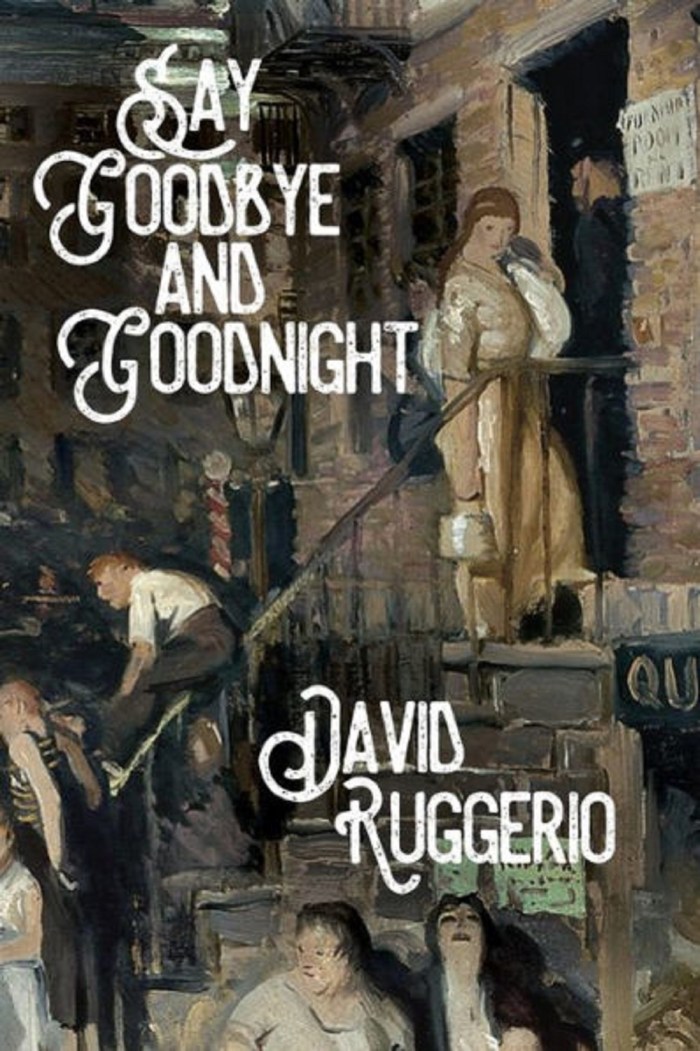
‘Say Goodbye and Goodnight’ by David Ruggerio will be released June 11. Photo: google
Known worldwide as a celebrity chef, David Ruggerio’s life story is one of redemption, sacrifice and a new lease on life as an award-winning genre fiction writer. By age 25, he rose to the position of top chef at the famous La Caravelle in New York. In 1995, Robert Mondavi, the noted vintner, named him one of the thirteen best young chefs in America. With two acclaimed cookbooks under his belt, David Ruggerio became known as a “Super Chef” and was called for television guest spots that quickly became opportunities. He hosted the iconic TV shows ‘Ruggerio to Go’ on the Food Network and ‘Little Italy with David Ruggerio’ on PBS. Throughout his outstanding career as a chef, Ruggerio cooked for five US Presidents. Today, Ruggerio lives on the East Coast and spends his days writing mostly genre fiction. He is an Amazon bestselling author and the recipient of the Maxy Award for Best Horror 2019 for his debut horror novel, “A Wistful Tale of Gods, Men and Monsters.” Now, David Ruggerio introduces a love story to his readers with “Say Goodbye and Goodnight” which will be released Thursday June 11, 2020. It is available on pre-order on Amazon. (Black Château, 2020)
“Say Goodbye and Goodnight” takes readers to Brooklyn in 1977 where an up-and-coming fighter named Anthony Marino falls for Gia, who becomes the love of his life. But the hatred their affair attracts could be their demise. Set against the backdrop of disco music and the grit of the city, this book takes readers to a time in history that liberated a generation. Ruggerio’s “Say Goodbye and Goodnight” has received advance praise from prestigious reviewers. Reader’s Favorite refers to it as to a “modern-day retelling of a classic Shakespearean tale of love enduring all forms of tragedy” and Sublime Book Review recommends it as “a well-written, unexpected, and unconventional love story.”
“Say Goodbye and Goodnight is a novel that I lived. I have laced this tale with real people and real places, and most of all, real romance. It was truly a labor of love that at times I had trouble putting down my feelings on paper.” – author David Ruggerio
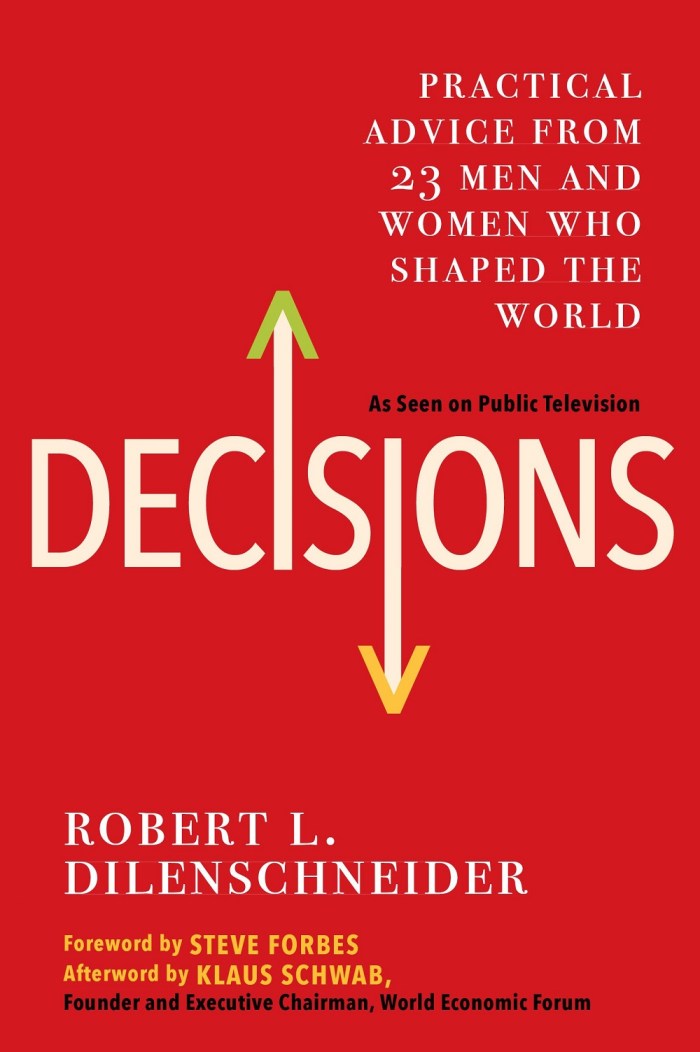
‘Decisions’ is one of Robert L. Dilenschneider’s best selling books about business and professional advice. Courtesy photo, used with permission.
Robert L. Dilenschneider has hired more than 3,000 successful professionals and advised thousands more. He is the founder of The Dilenschneider Group, a corporate strategic counseling and public relations firm based in New York City. Formerly president and CEO of Hill & Knowlton, he is the author of the bestselling books “A Briefing for Leaders,” “The Critical First Years of Your Professional Life,” “50 Plus! Critical Career Decisions for the Rest of Your Life,” “Decisions: Practical Advice from 23 Men and Women Who Shaped the World” and others. They all offer readers practical life and business advice for whatever stage in life they happen to be experiencing.
“Decisions: Practical Advice from 23 Men and Women Who Shaped the World” begins with a catchy sentence: ‘This book is intended to make your life better’ and it certainly delivers on its promise. Decisions are a part of everyday life for everyone, regardless of background. How people make decisions is critical to their future. This remarkable book focuses on twenty-three individual who made decisions that shaped the world and their stories stretch from 218 B.C to the present. It is divided into four parts which are in turn divided into individual chapters about a particular person and the most important decision he/she made. These are: Part One: War and Peace (Harry Truman, Elie Wiesel) Part Two: Commerce and Invention (Johann Gutenberg, Henry Ford) Part Three: Science (Marie Curie, Rachel Carson) and Part Four: Breaking Boundaries (Julius Caesar, Abraham Lincoln).
As a whole it analyzes not just the decision but provides background and history regarding the subject matter. The one major lesson to be learned is that many advances in civilization were made because most inventions, like the printing press, the automobile and general banking, were designed to reach everyone, not just the rich. This is turn made room for advances in society which is beneficial to growth. At the end of each chapter there is a decision section that summarizes the lessons readers can use in their own lives.
“The Critical First Years of Your Professional Life” is targeted to young people about to enter the real world of business and professional careers but the advice in these pages is invaluable to anyone, regardless of age or expertise. The Introduction gives a chapter by chapter synopsis to help readers focus on a specific topic. First off, it explains why the book is so important: because it is the paper or electronic version of a mentor in a world increasingly without any generous men and women who at one time would have helped young people entering the workforce. It also emphasizes the five goals in reading this helpful guide: 1)gaining self-knowledge 2)feeling empathy 3)presenting yourself well 4)retrieving information effectively and being informed and 5)solving problems. Standout chapters include: Networking, Making Allies of Your Elders and Image. The best part about this guide is that depending on what advice readers need, they can go back and re-read chapters on their own or if need be, read the whole book more than once because the information contained is ageless.
Lastly, “50 Plus! Critical Career Decisions for the Rest of Your Life” strives to help the more mature worker navigate the everchanging workforce rules. It emphasizes the importance of refreshing skillsets to meet the challenges of competing in today’s job market. The target audience “includes people who are highly accomplished and economically secure but intellectually bored or emotionally dissatisfied.” Some of the chapters include: The New Rules, Time to Change, On Your Own and Becoming a Consultant. Readers may be at a crossroads or unsure of how to proceed with the rest of their lives and this book gives helpful advise on finding a new career direction, growing within their current field, starting their own business or finally realizing a dream. Regardless of what they decide, the author ends by stating that retiring to just play golf or lay around the house is synonymous with giving up and that is never a good thing.
“Be ready to take criticism, and even ridicule and derision. Think about this as part of your decision process. Rather than turning away, be prepared to develop a thick hide.” – from “Decisions”
*The author received a copy of these books for an honest review. The views and opinions expressed here belong solely to her.