
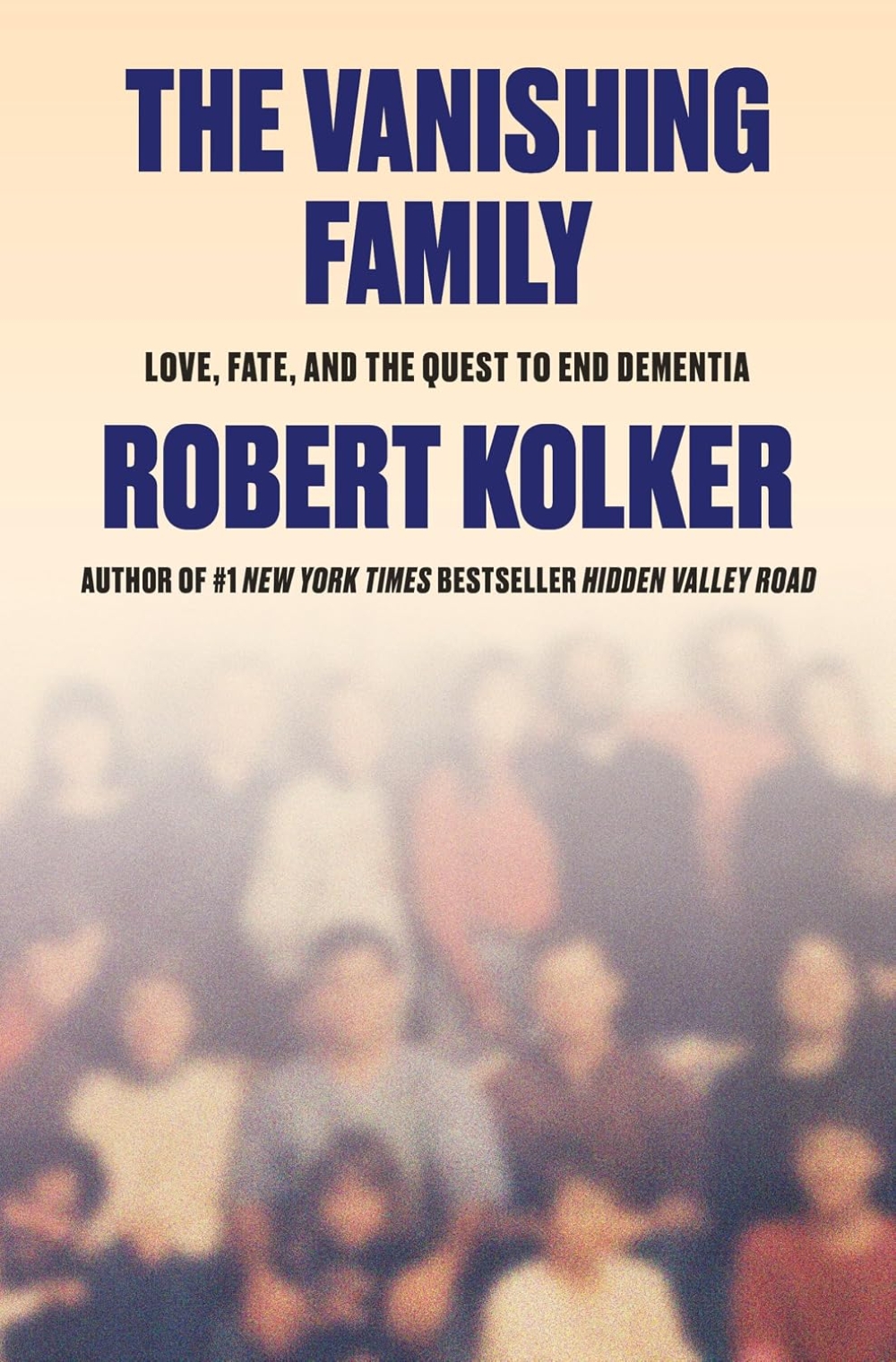
Book Review: The Vanishing Family: Love, Fate, and the Quest to End Dementia
Author: Robert Kolker
Genre: Nonfiction / Narrative Journalism / Science
The Story
The narrative opens with a tense prologue: after years of delaying testing, 41-year-old Barb receives a lab letter that will confirm whether she carries a devastating genetic mutation. She’s currently the same age her mother, Jean, was when symptoms first emerged.
Oliver and Jean lived in Pleasant Hills, Pennsylvania, raising nine children: Kathy, Christy, Sue, Dutch, Mary, Peggy, Scott, Jenny, and Barb. As the older siblings moved out to start their adult lives, Barb remained at home to witness their vibrant mother fall under a dark, gothic spell, transforming into someone withdrawn, neglectful, and entirely unrecognizable.
A Cruel Genetic Mutation
The family carries a rare genetic mutation (V337M) that causes frontotemporal dementia (FTD) with a cruel twist. Striking early, often in a person’s early forties, it causes formerly devoted parents and high-achieving executives to:
- Lose their jobs unexpectedly
- Have reckless affairs and take up heavy drinking
- Shed all social inhibitions and moral responsibility
- Experience total personality loss, leaving families with strangers
With a 50/50 chance of inheritance, the children face the constant terror of an impending genetic fate.
Alongside this human tragedy, Kolker documents the high-stakes scientific race against neurodegenerative disease. Decades of research into this single family’s rare FTD mutation may ultimately provide the key to preventing and treating all forms of dementia, including Alzheimer’s disease.
Pick up your copy of ‘The Vanishing Family!’
Review
The Vanishing Family unfolds like a heartbreaking psychological thriller as the siblings watch the illness strike one by one: first Christy, then Mary, and beyond. Kolker captures the agonizing tension between love and fear, forcing the family to confront profound questions about predetermined fate, obligation, and identity.
Key Themes Explored
- Identity and Disintegration: The erosion of character when the brain’s frontal lobe declines.
- Family Resilience and Devotion: How siblings step up to care for one another despite emotional devastation.
- Medical Discovery and Hope: The scientific journey to turn a family curse into a cure for millions.
The Science Behind the Story
Beyond the personal narrative, Kolker guides readers through the history of neuroscience:
- Historical Milestones: From the famous 19th-century case of Phineas Gage, whose altered personality after a brain injury proved that specific brain regions govern behavior, to early diagnostic breakthroughs that established dementia as an organic physical disease rather than a mental defect.
- The Clinical Battle: A clear overview of genetics, clinical trials, and the decades of frustrating dead ends that have challenged medical researchers.
Chapter Highlights
- Chapter 10: Barb has been caring for Christy, the first sibling to display symptoms, when Mary arrives unexpectedly. Seeing the exact same behavioral shifts in Mary, Barb realizes with horror that the disease is genetic and that every sibling is at risk.
- Chapter 11: A deep dive into neuroscience for readers who want the exact mechanics of FTD, Alzheimer’s, and brain pathology.
- Chapter 20: A crucial breakdown comparing Alzheimer’s and FTD. While Alzheimer’s primarily destroys memory and cognition, FTD attacks emotional processing. Patients lose the ability to recognize their own physiological responses to emotion, causing drastic changes in personality without self-awareness or shame.
“It’s a conclusion with relevance beyond dementia. We most profoundly lose ourselves, it seems, when we can no longer see, feel, or touch the minds and hearts of others.”
Final Thoughts
Overall, The Vanishing Family is a compelling look at family genetics that balances intimate human drama and medical detective work. It’s deeply tragic without ever feeling hopeless, showing how severe illness can reshape a family while highlighting extraordinary resilience.
Kolker never lets complex science obscure the real people at the center of the narrative. For readers who enjoy family sagas, medical mysteries, or popular science, this is an unforgettable read. It serves as a powerful reminder of how much of our identity is tied to memory, personality, and the people who love us, and how hope remains a force even against inherited fate.
“The tragedy is that because some elements of the person are still detectable, the sense of loss is ongoing – like witnessing a living death.”
About The Author
Robert Kolker is a contributing writer at The New York Times Magazine and author of the #1 New York Times bestseller Hidden Valley Road, named an Oprah’s Book Club Pick, a New York Times Book Review Top 10 book of the year, a GQ Best Book of Literary Journalism of the 21st Century, and a Kirkus Reviews Best Nonfiction Book of the Century. His first book was Lost Girls, named a New York Times Notable Book and a Publishers Weekly Best Book of 2013.
** Thank you to Michael Goldsmith and Penguin Random House for the gifted ARC for review consideration. I haven’t been compensated for this review and all views and opinions expressed are my own.

