‘Escaping the Dashia’ is Rebecca Inch-Partridge’s new YA science fiction novel. Photo: Amazon
Rebecca Inch-Partridge is an author, an editor, and an avid science fiction fan who grew up imagining a more inclusive world for women in SFF. Today, she is helping to shape that reality. Her first novel, “Escaping the Dashia,” is a YA science fantasy published by Black Rose Writing. Rebecca is a member of the Editorial Freelancers Association and Broad Universe and frequently speaks at writers’ conferences and science fiction conventions. Her short stories and articles have appeared in several magazines, and she has won Honorable Mention in both Writer’s Digest and Writers of the Future contests. “Escaping the Dashia” is the first book in The Paradox Star Cluster series and invites readers to root for the main character, young telepath Twyla, as she runs from one of the most notorious crime families in the Universe – the one led by her mother. (Black Château, 2023)
“Escaping the Dashia” is a meticulously crafted, immersive young adult (YA) science fiction (SF) novel that explores the complexities of family, betrayal, and the painful feelings of being an outsider. It follows young telepath Twyla, who is abducted by her mother and forced into her family’s criminal enterprise. Now, Twyla must navigate the blurred lines between right and wrong, good and evil, and the precarious position her family has put her in. Rebecca Inch-Partridge, a longtime SF fan, writer and speaker at science fiction conventions, uses her world-building skills to craft a richly detailed universe.
“I believe science fiction and fantasy has the power to challenge us and to inspire change. With ‘Escaping the Dashia,’ I hope to engage readers in a thrilling adventure while exploring important issues such as family dynamics, morality, and justice, all within a universe that I hope readers will enjoy exploring as much as I enjoyed creating it.” – Rebecca Inch-Partridge
Rebecca Inch-Partridge is a member of the Editorial Freelancers Association and Broad Universe. As someone who grew up imagining a more inclusive world for women in SFF, today she is a strong supporter of women in SFF as well as women in STEM.
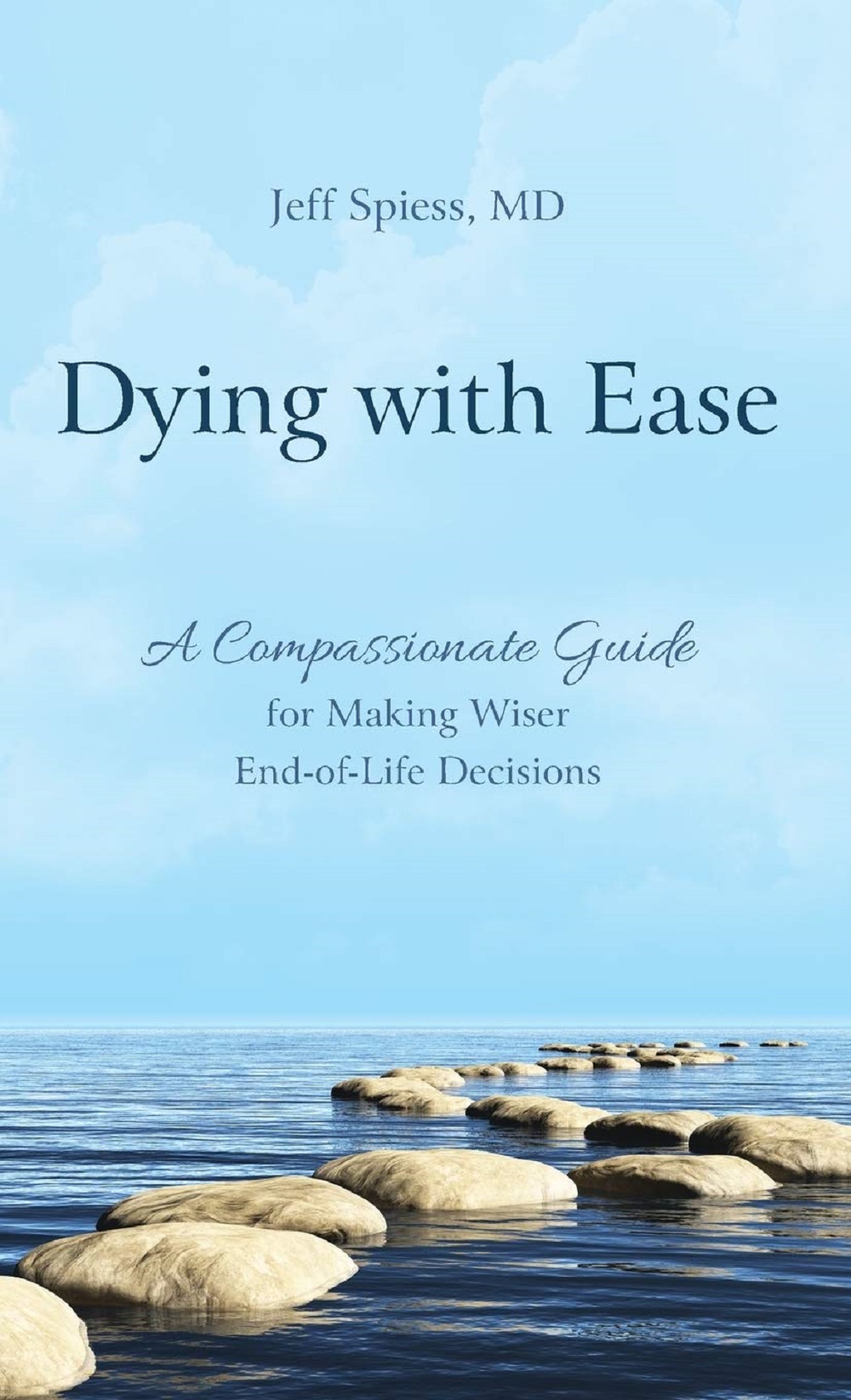
‘Dying with Ease: A Compassionate Guide for Making Wiser End-of-Life Decisions’ is the new book by Jeff Spies, MD. Courtesy photo, used with permission.
“You matter because you are you, and you matter to the last moment of your life. We will do all we can, not only to help you die peacefully, but to live until you die.”
—Dame Cicely Saunders
In 1948, Cicely Saunders met a man who would change her life. She was a thirty-year-old nurse and social worker, volunteering part time at St. Luke’s Hospital in London, an institution that had been founded a half century earlier as a home for the “dying poor.” She became captivated by a patient named David Tasma, a Polish Jewish refugee who had escaped from the Warsaw ghetto, worked as a waiter in London, and was now dying of cancer. Through her work and this relationship, she developed an awareness of the suffering and indignity experienced by dying patients, and, together with David, shared ideas as to how this could be different. When he died, David bequeathed her £500 (about $23,600 today) to be “a window in your home.” It was the beginning of an entirely new type of medical care, a care specifically focused on the needs of the dying. She called it hospice.
The word “hospice” was not new, but this meaning was. The term is derived from the same Latin root as our words “hospital,” “hostel,” and “hospitality.” This Latin term first meant “stranger,” but over time usage changed and it came to refer to a host, one who welcomes the stranger. During the medieval era, hospices were inns, boarding houses along pilgrim routes that served as places of rest and refreshment. On these long treks through Europe, many pilgrims became ill, often fatally. The hospices served then as places of care, possible recovery, often death. The word had been used since the mid-nineteenth century in Britain and Ireland for homes for the dying, places where the poor with nowhere else to go died. What Dr. Saunders did was to create a new connotation of the word “hospice,” keeping the welcoming but transforming it from a place to a model, a system of caring for the dying.
Cicely Saunders did not start out in health care. Her initial training was in politics, philosophy, and economics. In 1940, she entered nursing school, but because a back injury prevented her from doing the heavy work that nursing required, she went back to school and qualified as a medical social worker. The years she spent at St. Luke’s as part of a staff that cared deeply about the plight of those who were dying in their care demonstrated to her the impotence of the care system in the face of the patients’ ongoing pain. Knowing that the medical establishment would be resistant to hearing the ideas of an upstart social worker, she went to medical school. She then practiced for seven years at St. Joseph’s hospice in east London, listening to patients, keeping meticulous records, and monitoring the results of her treatments to relieve pain and other symptoms.
One of the first practices she challenged was the method of prescribing opioids, strong pain relievers like morphine. The prevailing practice had been to only use these drugs, given as injection, when the pain appeared severe, when it seemed to the doctor or nurse that the patient was hurting enough to “deserve” relief. The common result was that patients were either in unrelieved pain or briefly asleep after a drug dose. Then, as now, what most people “knew” about opioids was that they were addictive and dangerous. What Dr. Saunders recognized was that patients were the only ones who knew how bad their pain was and that their reports could be trusted. Since an oral dose of morphine lasts about four hours, she decided to give doses that often, by the clock, not by waiting until the pain had recurred. She also added smaller doses of analgesics between the scheduled doses if the pain “broke through.” This simple yet revolutionary idea, when put into practice, demonstrated that pain could be effectively relieved, and when this was accomplished, the patients could function more fully, engage with others more effectively, and contend with their other symptoms as well as the hopes and fears that came from the fact that they were terminally ill. In other words, they were able to live.
In 1967, Dr. Saunders opened St. Christopher’s Hospice in London, incorporating what she had learned into its structure and operations. The architecture included a sheet of glass at the entrance honoring Mr. Tasma’s bequest. She saw the mission of St. Christopher’s as providing not only excellent patient care but also a center of education and research, focusing on improving symptom relief and broadening the appreciation of this knowledge into the larger world of health care.
Dr. Saunders identified that pain was not just a physical phenomenon. Morphine was not all that was needed. She described “total pain,” the hurting that occurred in the physical body, the emotional psyche, the spiritual depths, and the surrounding family. She attacked it with a model of care aimed at all facets of life that contributed to that pain. Effective analgesia was, of course, a priority. But she recognized that it takes a team of skilled and caring professionals to do the job completely: bedside nursing to promote symptom relief and bodily integrity; social work to address financial and family concerns and to mobilize community resources; and clergy to provide empathic listening, words of comfort and advice, and insight into the realms of meaning and transcendence. She extended this care model into the community, providing services for patients dying in their homes, and she introduced family support during the patient’s illness and also after the death. Her ideas remain the bedrock of modern hospice care as well as its sister discipline, palliative care. In 1979, Queen Elizabeth II named Dr. Saunders a Dame Commander of the Order of the British Empire.
Dr. Saunders’s model of care spread across the Atlantic, finding fertile ground especially among nurses who were frustrated by the way the medical establishment seemed to be both overtreating and abandoning the dying. Florence Wald, dean of the School of Nursing at Yale University, served as the catalyst and, with a small group of colleagues, founded Connecticut Hospice in 1974, modeling their program after St. Christopher’s but adapting it to the local medical and social culture. This was two decades before the SUPPORT study would formally describe the suffering and intensive care endured by dying patients, but these visionaries and many like them recognized that a more humane way of dying was possible. Hospices began springing up around the country—small, mostly volunteer agencies, often associated with hospitals or religious institutions. As most of these relied mainly on donations and volunteers, the services offered varied widely.
A watershed moment in the care of the dying in the United States came in 1982 when the US Congress and President Reagan enacted the Medicare Hospice Benefit (MHB). This established a funding mechanism for hospice care and set standards for the organizational structures and for patient care. The MHB, as initially conceived, envisioned a “typical” hospice patient as someone with advanced cancer and no further treatment options, one whose course after hospice enrollment would be manageable, predictable, and short. In the ensuing thirty-five years, medical (e.g., AIDS epidemic, hospice for multiple other illness), financial (e.g., drug costs, federal budget deficits), and demographic (e.g., aging baby boomers) pressures have resulted in tweaks and modifications of the regulations, but the MHB continues to define how hospice care is provided in the United States.
Pearsol opened the mortuary cooler and pulled out the stainless steel tray supporting the victim. “Lieutenant, meet Jane Doe,” he said sliding the woman’s bloated body under Driscoll’s gaze. “Harbor Patrol fished her out of the muck. I’d say she was a feast for the gulls for a day. Maybe two.”
“What’s that smell? Paint thinner?”
“Phenol.”
“She was doused in phenol?”
“Injected.”
Driscoll’s eyes narrowed.
“The complete autopsy will fill in the blanks, but I’d bet my pension I already know what killed her. The who, and the why, I’ll leave to you.” Pearsol handed the preliminary lab report to Driscoll. It identifies a mixture of substances inside her vascular system.
“Phenol, formaldehyde and Chloride of Zinc?” Driscoll looked perplexed.
“The same Chloride of Zinc they put in dry cell batteries?”
Pearsol nodded. “There’s three more.”
“Myrrh, aloe and cassia,” Driscoll read aloud. “That’s a strange mix.” He glanced at Pearsol, who nodded. “Says here you drained 851 milliliters from her circulatory system. What’s that? About two pints?”
“Just under.”
“A body contains five to six quarts of blood. So the rest of this mixture?”
“Still in her.”
Using his finger, Driscoll pushed back a lock of the victim’s hair. “What could you have done to warrant this?” he whispered, eyes on the corpse.
“Right now the unofficial cause of death is phenol poisoning by arterial injection. Familiar with the German word, ‘abgespritzt’, Lieutenant?”
“No.”
“Abgespritzt was a method of genocide favored by the Nazis in the early 1940s. Hitler’s henchmen delivered instantaneous death by injecting 15 milliliters of phenol directly into the heart.”
“What kind of syringe injects six quarts?”
“More than likely he used a centrifugal pump. And he knew what he was doing.” Pearsol pointed to the side of the victim’s neck, where a semi- translucent latex adhesive covered a two inch stretch of rippled flesh between the carotid artery and the jugular vein. “An extreme method of murder, Lieutenant. He arterially embalmed her.”
Driscoll winced.
“There’s more.” The M.E. produced a transparent evidence bag containing a locket. It was an inch in diameter and featured Saint Vitalis of Gaza; his name etched in a half circle below his likeness. “I found it under her tongue. Someone apparently placed it there before suturing the tongue to the floor of her mouth.”
“What’s that about?” Driscoll wondered aloud.
“Good question. I’m not familiar with that saint. You?”
“She‘s the patron saint of prostitutes.”
“Well, there’s a lead. Oh, and there’s one other bit of information you’re sure to find intriguing. The myrrh, aloe, and cassia injected with the embalming fluid were once embalming solutions on their own. Sort of.”
“Sort of?”
“They were the purifying fragrances applied to the linens that wrapped the crucified Christ before he was laid in his tomb.”
*************************************************** Thomas O’Callaghan’s work has been translated for publication in Germany, Slovakia, Indonesia, the Czech Republic, China, and Italy. As an internationally acclaimed author, Mr. O’Callaghan is a member of both the Mystery Writers of America and the International Thriller Writers associations. His debut novel “Bone Thief” introduces NYPD Homicide Commander Lieutenant John W. Driscoll. “The Screaming Room” is the second in the John Driscoll series. The third book in the series, “No One Will Hear Your Screams,” is now available from WildBlue Press.
I awoke that Friday morning in a serious sweat, the kind that is not immediately relieved by rising and washing one’s face with cold water. I noted that the clock in the bathroom read 4:38, twenty-two minutes before my designated alarm setting. After staring at the clock for a minute, maybe two, I felt my right radial pulse. The accelerated throbbing confirmed that tachycardia was still my predominant rhythm. I decided to attend to ritualistic morning bathroom chores, make coffee, read the paper, and at least try to pretend that it was a normal Friday morning.
Upon completion of the bathroom routine, as quietly as possible, I punched in the five-digit alarm code and started to leave the bedroom to go downstairs. Unfortunately, even the sound of punching in the numbers was unduly shrill, and it caused Mary Louise, my bride of twenty-four years, to stir.
“Jim Bob?”
“Yes?”
“It’s not even five yet. Why are you up?”
“Couldn’t sleep. Woke up with the sweats again. Sorry to wake you. I thought I’d go downstairs, make some coffee, and sit outside and think for a while. Okay?”
“Want some company?”
Normally, I would never turn down such an offer. I loved my wife dearly. She was, in fact, my best friend. That particular morning, however, I responded in the negative.
“I don’t want to hurt your feelings, sweetie, but this is just one of those times I need to collect my thoughts. Know what I mean?”
“I do. I’m sorry you’re having to go through all this. It isn’t fair. After all you’ve done for everybody else. I know in my heart it will be all right, just maybe not today. Try not to get too upset. Promise?”
“I’ll do my best.” I leaned down and kissed her warm cheek. She smelled so good, I considered taking off my robe and getting back into bed. I finally chose not to. “Go back to sleep. I’m not leaving until about eight o’clock.”
I left her reluctantly and plodded downstairs barefooted, in my cotton robe, with lights still off, toward coffee heaven. I selected Twin Peaks Blend coffee beans, which we kept in the freezer to avoid staleness, ground them, and began the ten-minute process to achieve as perfect a cup of coffee as I could make. I waited on the back porch in my “spot,” a large white cane rocker. The month of August was a stifling time of year in Houston, even at that hour of the morning. The heat and humidity were almost unbearable during July, August, and early September. I turned on the outdoor ceiling fan that hovered above my chair and hoped it would make the weather more pleasant. It didn’t.
I considered my life that morning. I, Dr. James Robert Brady, who had done my best to be a compassionate and dedicated orthopedic surgeon for the past seventeen years, was being sued for medical malpractice. I was not a neophyte when it came to lawsuits. I had been sued twice before, not an unusual occurrence in a city of four million people, with far too many law school graduates sitting in their quiet offices with nothing to do. The other two suits were quite minor and did not linger but were dismissed rather quickly, meaning over a year-or-two period. The current lawsuit, the cause of my awakening before five with the sweats and intense gastrointestinal distress, had not been dismissed.
I stepped back inside to the relatively cool air, although during August even the air-conditioning system labored heavily. I poured my coffee into a large black mug with a removable top that allowed intermittent filling of the cup but twisted on securely so as not to spill during the drive to work. While I wasn’t yet ready to leave, I used the “to go” cup anyway, being a creature of habit, a trait inherited from my dear departed father, and one which drove even me to distraction on occasion.
I returned to the French door to head back to the humidity and spotted Cat perched on the back doorstep, peering through the lowest windowpane, awaiting her breakfast. I sipped my coffee and prepared her Prime Feast in a disposable dish, probably not recyclable because I am sure it isn’t possible to remove the smell of mixed seafood, no matter what treatment is available at the nearest recycling plant.
Strolling to the door, feast in hand, I greeted the discriminating feline.
“Morning, Cat. I have your breakfast.”
No response. Just a simple twitch of the sensitive nose. There was no tail-wagging or jumping on my bare leg to greet me, sure signs that man’s best friend loved you and missed you. Rather, Cat simply did what she did best. She remained aloof and distinctly noncommittal. I bent down, sat her dish on the patterned concrete deck, and stroked her damp fur as she sampled my selection. She did give me a brief look of gratitude, then resumed her nibbling. I returned to my chair and continued to assess my life and its worth.
I was most critical of self that morning, pondering the effects of aging on a once-athletic physique. While Mary Louise considered me to be a handsome specimen, I lamented my shrinkage from six feet plus one inch to slightly less than the “manly” six feet. I continued to disguise my shortening by wearing Western boots, and only on weekends did I allow myself the comfort of high-topped athletic shoes—not that I used them for athletics.
I remembered my previously full head of hair that had slowly thinned, especially at the front, to allow for enlargement of my forehead while a balding spot was created on the crown of my head. My sideburns were a little long and gray and transitioned to brown at an always-increasing distance from the top of my ears. I criticized the extra minute I spent every morning to carefully position my combed-straight-back locks over that bare spot I had grown to hate.
I had begun to study myself each morning before showering to confirm that I indeed resembled Alfalfa of Little Rascals fame, with thin wisps of hair sticking straight up toward the heavens. I then reminded myself of my need to wear bifocals and of my need to start a workout program to slim my waist from its size 38—although I had noticed lately that the cleaners had been shrinking my best jeans.
I tried to take comfort in Mary Louise’s love of what she called my “charming cleft chin” and “captivating smile” but was unsuccessful. I felt old that morning, which, along with words like useless, worthless, out-of-shape, and four-eyed, drove me to an even fouler mood than when I awoke to cold sweats and the dreaded digestive-tract blues.
By six o’clock I was sweating again, that time from drinking an entire pot of coffee and from the oppressive heat that had already risen to a sultry 80 degrees with the humidity at drip level. I threw off my robe and dove into the pool, taking care to avoid a cervical spine injury in the four-foot-deep water. It did cool me off temporarily, so after two laps I simply stood in the healing waters, naturally, in the buff. As I reminisced over the treatment of the patient that had decided to sue me, the back door of the house opened and the Tipster bounded outside. He saw me in the pool and almost dove in with me. Fortunately, I was able to hold him back while I ruffled his shaggy mane and scratched his ears. At least he was glad to see me and acted as though we had been apart for years, not just the six hours since we had bid him good night.
His official title was “Tippecanoe and Tyler Too,” a typical name given by a particular breeder who prized his full-blooded intelligent golden retrievers. But “Tip,” “Tipper,” or “the Tipster,” as Mary Louise intermittently called him, had failed the IQ test for well-bred dogs and was lovingly given to me by that grateful patient, who had many more golden retrievers than insurance dollars.
Tip had been presented to me in the office five months previously at the end of the day as a surprise. The man didn’t ask me if I wanted a dog, but simply showed up at my office with a large, overly friendly seven-month-old golden retriever puppy. I still suspected that Fran and Rae, my faithful office staff, had somehow conspired with my darling wife to bring some new joy into my life. At the time, I was highly skeptical and hoped to rid myself of the constantly-shedding beast who had disrupted our lives. Over the next few months, however, I had grown to love, without restraint, this large, adorable dog, whose only faults were that he was too much a friend to strangers and a poor fetcher of dead birds. Neither flaw bothered me. I didn’t hunt much anymore, and we rarely had anyone to the house that I despised. Besides, considering we had yet to be burglarized, the Tipster’s camaraderie with those stealers of one’s things was an untested character defect.
My mood improved significantly after seeing Tip, and I watched with interest as he bounded over to greet Cat with a friendly good morning. He had attempted to make Cat his new best friend every day since his arrival at our abode but had been miserably unsuccessful. Cat’s reaction to his energetic playfulness was to leap gracefully into the rocking chair next to mine, back herself up as far as possible to the rear of the chair, and wait. When Tip happily padded over to see her and put his whole head onto the seat of the chair, she would strike out at his sensitive nose with one of her front paws, prompting an episode of howling. For five months, this scenario had occurred each and every time the two animals had a backyard encounter. I believed that Cat had become bored with the whole routine and had actually become embarrassed at what seemed to be the retriever’s inability to learn.
“Tip? Be careful over there. She scratches your nose every day! It’s so raw, you almost need stitches.”
I obviously had lost my mind. I was talking to the dog as though he understood my every word. Just before pushing his fat head into the seat of the chair to smell the gray bundle of fur, though, he turned his head toward me and perked up his ears. I didn’t know if he had actually understood what I had said or simply had forgotten that I was in the pool, since he had wandered into the bushes to relieve himself before approaching Cat. He stared at me for a moment, seemed to consider what I had said, then pushed his tender, scarred nose toward the she-beast, and . . . I couldn’t believe it! She didn’t hurt him! He licked her fur, and Cat just stood there. I guessed she finally decided that Tip was harmless and just wanted to play. She might have also figured out that a large dog like that could be an impressive ally when trying to ward off neighborhood cats who strayed into her domain looking for a free meal.
And so it was that on that hot, steamy morning in August, my cat and dog became friends. I thought that maybe Mary Louise was right, having told me repeatedly that everything would be okay. Alas, that small, backyard miracle was the only one I witnessed for a while.
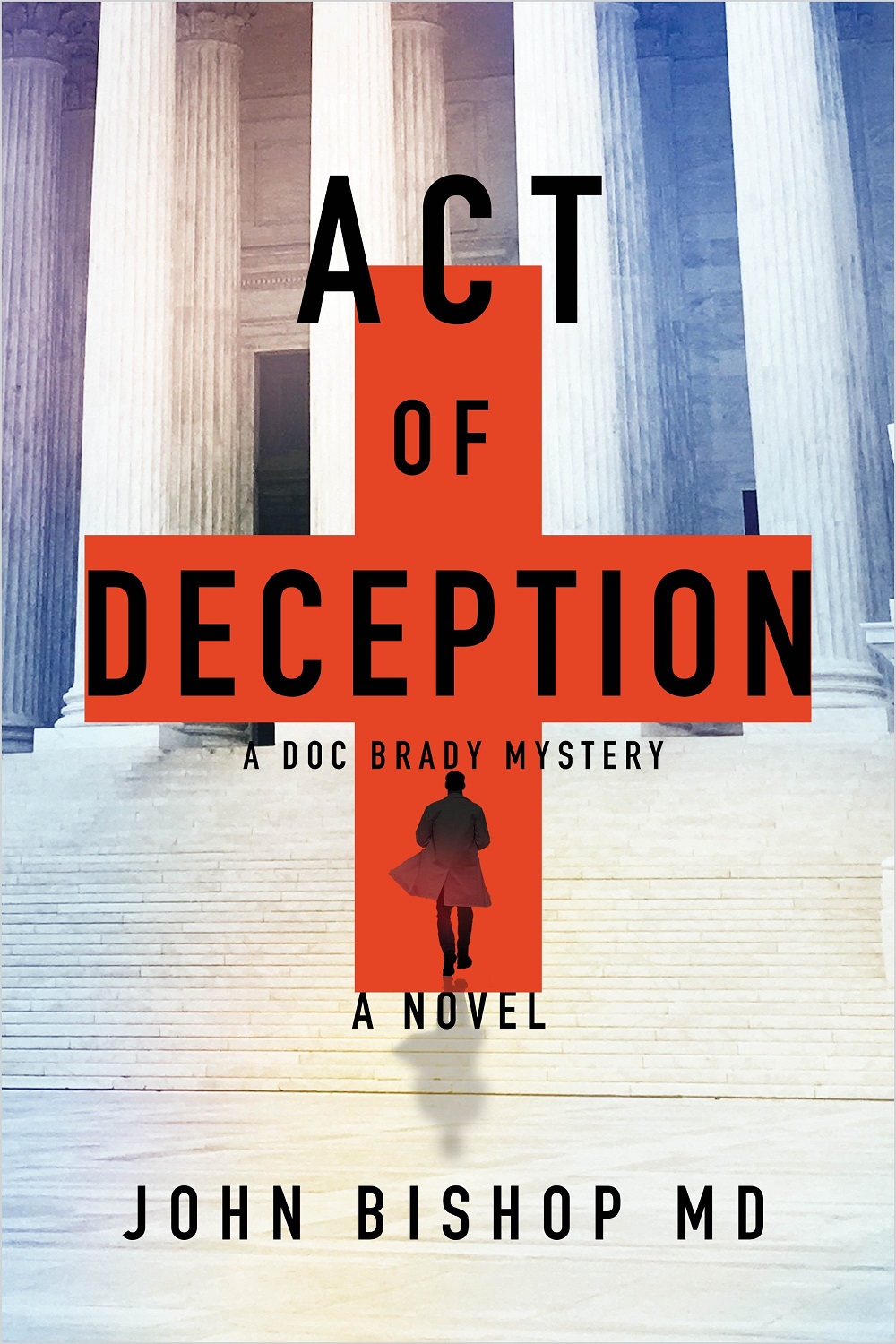
John Bishop MD is the author of “Act of Deception: A Doc Brady Mystery.” Dr. Bishop has practiced orthopedic surgery in Houston, Texas, for 30 years. His Doc Brady medical thriller series is set in the changing environment of medicine in the 1990s. Drawing on his years of experience as a practicing surgeon, Bishop entertains readers using his unique insights into the medical world with all its challenges, intricacies, and complexities, while at the same time revealing the compassion and dedication of health care professionals.
Nettie glided along the sidewalk in her best dress, her mother’s creation that would soon be too small. That Saturday, however, the colorful outfit still fit and perfectly complemented her wide smile and earnest stride. The dress was spring blue with flower patterns bursting open into full blossoms, quite like Nettie herself.
She stayed out of the way of the white pedestrians inspecting her with what appeared to be a mixture of curiosity and irritation. “What’s that one doin’ here?” one woman asked as she passed by. So Nettie hugged the buildings as she moved, trying to disappear against the facades. There was something big going on in the square, but Nettie couldn’t see over or through the gathering, since she was just seven years old.
She had pleaded with her parents to go with her father from their home in Mooretown, Lynwood’s section for blacks, to a nearby town while he delivered a meal to a close friend who was gravely ill. At the last minute, Nettie’s mother had wanted one more item added to the delivery from a store on Lynwood’s downtown square—an establishment that served them only from the back door off an alley. Nettie was supposed to wait in the car, but despite her father’s admonishments, the strange and festive noises drew her out into the nearby crowd where she was protected only by her look of youthful wonder.
Lynwood’s civic core was comprised of an expanse of lawn with a massive oak reigning over the surroundings. Four perpendicular streets framed the lawn, and they had been closed for several hours so people could mingle without regard to sputtering cars. The attendees had obliged the gesture by swarming the entire area by midmorning. The day’s activities appeared to originate across the street nearer the tree, allowing the spectators along the periphery to wander about with more freedom. From where Nettie was she could see the crown of the tree, and she moved in that direction as if pulled by some invisible force.
The day was hot and humid. High clouds had gathered through the morning and darkened the midday sky, but the music played on and people chatted in small groups as if they were at an annual parish fair.
After several minutes of distant rumbling a sprinkle started, and it soon developed into cascading water pouring from invisible pots in the sky. The drenching dispersed the crowd into stores and under awnings. Deserted chairs and soda bottles lay across the lawn.
The scattering of the masses created large openings around the square. What was an impenetrable wall of people became a flat, open field of vision. The oak, of course, remained right where it had begun decades before as a sapling.
Nettie couldn’t run into any of the stores like the others caught out in the street during the rainstorm. So, like the oak, she remained standing, although now she had a clear view of the square. Her dress—dripping and heavy with water—would have distracted her in any other setting, but unanswered curiosity kept her searching the square for clues about the day’s festivities.
The oak tree had long, thick branches, like the heavy arms of a giant. A braided rope was slung over one of these arms, out about ten feet from the trunk. The rope was wrapped once about the branch and secured to a large stake in the ground. The other end of the rope was fashioned into a noose, and suspended from it was the still body of a black man. The man’s neck was grotesquely angled, and the feet were bare. His hands were bound behind his back.
Nettie leaned forward like she was about to rush toward the oak. But she neither ran away nor went to it. She stared up at what had been until moments before a living, breathing person. She was frozen in place and time—alone in the moment when her world changed forever.
Her father came running from behind and snatched her up with such force that the dress ripped along a side seam. He covered her with his protective embrace and spirited her away to the car that waited in the alley. They headed straight home using back streets and little-known shortcuts, the car not speeding despite the urgency of the situation. The trip to deliver the meal basket was abandoned as her father kept swearing that he’d never go to the square again.
Nettie didn’t look outside the car. She kept her head down and stared at one of the dress’s printed blossoms, the flower part of the pattern ending at the hemline to reveal her trembling knees.
**************************************************************************** Michael McAuliffe is the author of ‘No Truth Left to Tell’ and has been a practicing lawyer for thirty years. He was a federal prosecutor serving both as a supervisory assistant US attorney in the Southern District of Florida and a trial attorney in the Criminal Section of the Civil Rights Division at the Department of Justice in Washington, DC. In 2008, Michael was elected and served as the state attorney for Palm Beach County, leading an office of approximately 125 prosecutors. He was known for leading the ethics reform movement in county that resulted in the creation of a permanent inspector general, an ethics commission and new ethics code. Michael and his wife Robin Rosenberg, a US district judge, have three children and live in Florida and Massachusetts.
But there was no decision to make. This was my calling. Some powerful force had come to dwell inside me, something bigger and stronger than me. —Malala Yousafzai
Malala Yousafzai, as the world knows, was shot in the head by the Taliban on October 9, 2012, as she rode home on the school bus in the Swat Valley, Pakistan. Malala was fifteen at the time. She survived the attack, recuperated in England, and has continued her education. She was awarded the Nobel Peace Prize in 2014 for her “struggle against the suppression of children and young people and for the right of all children to education.”
Can a child, an adolescent, a young person—make a world-changing decision? Is someone ever too young?
Let’s take a look at Malala’s story, because none of this came out of the blue. The “struggle” the Nobel Committee cited, was a decision that was so deeply embedded into her character that, at age fifteen, it had already become her way of life. And continues to be.
Seemingly from birth, Malala loved education. Her biographical material makes much of the fact that she sought to emulate her father, Ziauddin Yousafzai, who was so dedicated to education that he had founded his own school, the one she attended. Such “private” schools are not uncommon in Pakistan.
But Ziauddin’s school and his outspoken daughter became special targets of the Taliban. The fundamentalist group had issued an edict against educating girls and death threats against the entire family (mother Toor Pekai Yousafzai and two sons). The school was forced to close for a time and had re-opened shortly before Malala was shot.
You might say that the child was merely following the example—or the dictates—of the father (who was supported in all endeavors by the mother). That the child made no decisions on her own. That happens in families all the time. I can think of many examples in my own life—involving my parents and the decisions they made for me when I was young, and about how my wife and I did the same for our sons. None of these decisions involved defying the Taliban and bringing danger to our family. But, that may not be the right way to look at what Ziauddin did. Were his decisions part of doing what parents claim we always try to do—leading by example?
Do you ever think about the phrase “an accident of birth”? It means that none of us are responsible for the circumstances of our birth—who our parents are, our family, our nationality or state or town, our genetic make-up, economic status and so on.
Among the things that Malala was not responsible for: That she was a first-born daughter in a culture that values boys over girls; that she was born into a troubled country being over-run by violent extremists. But it was also an accident of birth that she had two parents who were, by all accounts, as dedicated to her welfare, education, and growth as they were to that of her two younger brothers. It seems to me that Malala took what she was given and decided to run with it.
By the time she was shot in 2012, Malala had shown by her own example that she recognized her “accident of birth.” Her dedication to education for girls was in fact her own decision based on parental example. Consider her words, written just a year later in her autobiography:
“I was very lucky to be born to a father who respected my freedom of thought and expression and made me part of his peace caravan and a mother who not only encouraged me but my father too in our campaign for peace and education.”
At an even younger age than fifteen, Malala was already an ardent activist. She blogged for the BBC on the oppressions of life under the Taliban and was the subject of a New York Times documentary. She made speeches often, including one entitled “How dare the Taliban take away my right to an education.” The year before she was shot, she won both the International Children’s Peace Prize and Pakistan’s first Youth Peace Prize. As the Taliban’s noose ever tightened around her country, her family, and her safety, Malala’s outspokenness and visibility grew. As she wrote in her autobiography, “I decided I wasn’t going to cower in fear of [the Taliban’s] wrath.”
In the years since she survived the Taliban assassination attempt, Malala has become a global symbol for the cause of education for girls specifically and for the welfare of all children. Not even a year after she was shot, she addressed the “Youth Takeover” at the United Nations. Two years almost to the day after she was shot, the Nobel Committee announced that she would share the 2014 Peace Prize with Kailash Satyarthi, who made his name with international peaceful protests on behalf of children. Even with constant visibility while traveling the world to event after event, she completed the studies necessary to be accepted in 2017 into Oxford University (which fact she announced on her new Twitter account). Also in 2017, Malala was designated a United Nations Messenger of Peace “to help raise awareness of the importance of girls’ education.”
Malala is still enveloped in the support of her family, which left Pakistan to settle in the UK. The Economist, noting that “Pakistani education has long been atrocious,” included the following in a detailed and dismal examination of the current status:
“From 2007 to 2015 there were 167 attacks by Islamic terrorists on education institutions . . . When it controlled the Swat River valley in the north of the country, the Pakistani Taliban closed hundreds of girls’ schools. When the army retook the area it occupied dozens of them itself.”
Malala has written two books. The first, “I Am Malala,” was published a year after her shooting and tells, with the help of writer Christina Lamb, of her early life in Pakistan and the event that put her onto a new trajectory. Published in 2017, the second book is for children, “Malala’s Magic Pencil.” In it, young Malala yearns for a special pencil that would let her do all sorts of special, interesting things, including drawing “a lock on my door, so my brothers couldn’t bother me.” I think every child wants a lock like that. Eventually, she describes what we adults will recognize as an intention, a determination, a decision: “I knew then that if I had a magic pencil, I would use it to draw a better world, a peaceful world.”
Time will tell us how Malala’s decisions as a girl, a teenager, a young adult, and into the future will all play out, how world-changing they will be. My hope is that the answer is— immensely.
Malala’s story offers all of us one overarching lesson about decision-making that will help us all lead better lives:
If you are a parent or other adult in a position to influence children and young people, remember how important your own example is. The decisions you make on behalf of others may turn out to be the template that helps form their lives.
If that’s all you glean, that’s enough. But there are many other lessons to take:
Have courage to do the right thing, whether it is large or small.
Understand you may be attacked and plan for that in advance. I mean physically attacked, as well as the more expected verbal criticisms.
Recognize you may be a symbol for others and prepare for that in ways they will embrace and admire. And behave that way.
Follow your decision. Give it a chance to shape your life.
Do not give up.
Depend on each other. Know whom you can trust, and be that trustworthy person to others to the best of your ability.
Seek education and take every other opportunity to broaden your knowledge of the world and its people.
Robert L. Dilenschneider is the founder of The Dilenschneider Group, a corporate strategic counseling and public relations firm based in New York City. Formerly president and CEO of Hill & Knowlton, he is the author of the bestselling books “Power and Influence, A Briefing for Leaders,” “On Power” and newly released “Decisions: Practical Advice from 23 Men and Women Who Shaped the World.”
Most feelings of discomfort in life have clear solutions. For a stuffy nose, decongestants do the trick. For a pounding headache, aspirin or Tylenol comes in handy. But what do you do about a relentlessly aching back? As most of us know, the answer is not nearly as clear-cut as we’d wish. And unlike infectious diseases that often have targeted remedies (think antibiotics for bacterial infections and vaccines for viruses), ailing backs are like misbehaving, obnoxious family members—we can’t easily get rid of them or “fix” them. They also have a tendency to stick around and bother us nonstop, lowering our quality of life considerably and indefinitely.
Perhaps nothing could be more frustrating than a sore or hurting back. It seems to throw off everything else in our body, and makes daily living downright miserable. With the lifetime prevalence approaching 100 percent, virtually all of us have been or will be affected by low back pain at some point. Luckily, most of us recover from a bout of back pain within a few weeks and don’t experience another episode. But for some of us, the back gives us chronic problems. As many as 40 percent of people have a recurrence of back pain within six months.
At any given time, an astounding 15 to 30 percent of adults are experiencing back pain, and up to 80 percent of sufferers eventually seek medical attention. Sedentary people between the ages of forty-five and sixty are affected most, although I should point out that for people younger than forty-five, lower back pain is the most common cause for limiting one’s activities. And here’s the most frustrating fact of all: A specific diagnosis is often elusive; in many cases it’s not possible to give a precise diagnosis, despite advanced imaging studies. In other words, we doctors cannot point to a specific place in your back’s anatomy and say something along the lines of, “That’s exactly where the problem is, and here’s how we’ll fix it.” This is why the field of back pain has shifted from one in which we look solely for biomechanical approaches to treatment to one where we have to consider patients’ attitudes and beliefs. We have to look at a dizzying array of factors, because back pain is best understood through multiple lenses, including biology, psychology, and even sociology.
The Challenge
So, why is back pain such a confounding problem? For one, it’s lumped into one giant category, even though it entails a constellation of potential culprits. You may have back pain stemming from a skiing accident, whereas your neighbor experiences back pain as the consequence of an osteoporotic fracture. Clearly, the two types of back pain are different, yet we call them “back pain” on both accounts, regardless. Back pain has an indeterminate range of possible causes, and therefore multiple solutions and treatment options. There is no one-size-fits-all answer to this malady. That is why diagnosing back pain, particularly persistent or recurrent pain, is so challenging for physicians.
Some people are able to describe the exact moment or series of moments when they incurred the damage to their back—a car accident, a slip and fall, a difficult pregnancy, a heavy-lifting job at work, a sports-related injury, a marathon, and so on. But for many, the moment isn’t so obvious, or what they think is causing them the back pain is far from accurate.
The Two Types of Back Pain
If you are going to experience back pain, you’d prefer to have the acute and temporary kind rather than the chronic and enigmatic kind. The former is typically caused by a musculoskeletal issue that resolves itself in due time. This would be like pulling a muscle in your back during a climb up a steep hill on your bicycle or sustaining an injury when you fall from the stepladder in the garage. You feel pain for a few weeks and then it’s silenced, hence the term self-limiting back pain. It strikes, you give it some time, it heals, and it’s gone.
The second type of back pain, though, is often worse, because it’s not easily attributed to a single event or accident. Often, either sufferers don’t know what precipitated the attack, or they remember some small thing as the cause, such as bending from the waist to lift an object instead of squatting down (i.e., lifting with the legs) or stepping off a curb too abruptly. It can start out of nowhere and nag you endlessly. It can build slowly over time but lack a clear beginning. Your doctor scratches his head, trying to diagnose the source of the problem, and as a result your treatment options aren’t always aligned with the root cause of the problem well enough to solve it forever. It should come as no surprise, then, that those with no definitive diagnosis reflect the most troubling cases for patients and doctors.
What Are the Chances?
Chances are good that you’ll experience back pain at some point in your life. Your lifetime risk is arguably close to 100 percent. And unfortunately, recurrence rates are appreciable. The chance of it recurring within one year of a first episode is estimated to be between 20 and 44 percent; within ten years, 80 percent of sufferers report back pain again. Lifetime recurrence is estimated to be 85 percent. Hence, the goal should be to alleviate symptoms and prevent future episodes.
Jack Stern, M.D., Ph.D., is the author of “Ending Back Pain: 5 Powerful Steps to Diagnose, Understand, and Treat Your Ailing Back.” He is a board-certified neurosurgeon specializing in spinal surgery, and cofounder of Spine Options, one of America’s first facilities committed to nonsurgical care of back and neck pain. Dr. Stern is on the clinical faculty at Weill Cornell Medical College and has published numerous peer- and non-peer– reviewed medical articles. He lives and practices in White Plains, New York.
The emergency call came in at breakfast. They could hear Wolfie’s shortwave radio belting out his call sign, repeatedly declaring, “Come in 5Z4WD, most urgent call for Pero Baltazar.” Pero got up and made his way to Wolfie’s office, asking Amal, their waiter, to get Wolfie. “Kwenda kupata bwana Wolfgang haraka, tafadhali, Amal.” (Go get boss Wolfgang quickly, please, Amal.)
Pero knew better than to touch Wolfgang’s sole means of communication with the outside world. Besides, Wolfgang had once allowed him to use the radio transmitter set, commonly called an RT set, to reach out to Pero’s old contacts at the CIA and State Department in Washington. Pero had been a runner for them, collecting papers and making note of fellow passengers at airports when asked, fortunately infrequently—nothing dangerous, nothing remotely exciting. Then two events had caused Pero to get deeper into the world of anti-terrorism than he ever wanted. Unable to cope alone those two times, he had involved his friends, including Heep, Mary, Susanna, and, of course, Mbuno, who were once again on location with him, this time along the shore of Lake Rudolf. Pero desperately hoped this emergency call had nothing to do with his old Washington contacts.
He had quit after the Berlin package incident, after he had nearly died, mainly because he had married for the second time in his life as soon as he had left the hospital and recovered. Susanna was a brilliant sound engineer, as devoted to Pero as he was to her. The name of Pero’s first wife, Addiena, who had died in the Lockerbie disaster, was tattooed on the underside of his right forearm. He used to sleep with it across his heart so he would not forget her after she perished. Her tragic death was the reason he had offered his minor services to the CIA in the first place, wanting to do something to thwart terrorism. It was heartwarming for Pero that his new wife, Susanna, now insisted she drift off to sleep lying to his right, making him put out his arm for her to use Addiena’s name as a pillow. “She loved you and you, her. It is how I can remember her, thank her, for teaching you how to love, you dummer Mann.”
Susanna’s native German expression of “dumb man” had been a scolding term for him originally deployed during the Berlin dangers, which was when she had revealed she cared for Pero deeply. Since then, it had become a term of endearment between them, their bond cemented by past events.
Adrenaline pumping because of the radio call, Pero weaved his way past tightly packed breakfast tables, careful not to allow his large, six-foot frame to disturb fellow guests. He heard Amal calling out to Wolfgang. By the time Pero got to the radio office, he could hear Wolfgang replying, “I am coming, I am coming.” The RT set was almost a living thing to Wolfgang, and Pero was used to hearing the man talk to it as a father would his child. Pero, waiting at the door, opened it for Wolfgang, who entered, sat, and flicked the on switch all in one practiced movement. He keyed the mike, gave his call sign 5Z4WD in answer, and said, “What is the message?”
The voice faded suddenly, coming in faintly, and Wolfgang gently turned the tuning dial. “Okay, Nairobi, I read you now, the sun’s up here so this may break up.” A woman’s voice came on the radio, asked if Baltazar was available, and Wolfie told her he was present and standing by.
“Message from Flamingo Tours, for Pero Baltazar, urgent, Mwana Wambuno, on safari, Moyowosi Game Reserve, missing for over ten hours. Safari clients being flown back to Nairobi. No trace of Ube. Over.” Ube was the nickname of Mbuno’s nephew, Mwana Wambuno. Pero immediately knew Mbuno would take the news of his favorite nephew hard.
Pero asked, “Wolfie, may I speak directly to her?” Wolfgang nodded and indicated the mike button. “Pero here, who’s that? Sheila Ndelle? Over.” Sheila, the backbone of Flamingo Tours, was also the sister of the UN security police chief and totally reliable.
“Ndiyo, over.” Yes, came the reply.
“Hi Sheila, give me all the details you have, and also, where’s Tone? Over.” Anthony Bowman was the owner of Flamingo Tours, known to everyone over the decades as simply Tone. An ex–white hunter, Tone ran the best safari outfitters anywhere—expedition tents, private toilets, dinner with white table linens, client’s wishes always fulfilled.
“Hi Pero, Mr. Anthony is down at the Tanzanian Embassy trying to find out more information, if there is any known terrorist or poaching problems in the area. There wasn’t any when we sent the clients there. All we know is that Ube took three clients out on a walking safari yesterday morning, camera clients”—by which she meant not hunters—“and they took leopard images in the tall grass, a kill of a bushbuck, treeing the carcass, you know the drill.” Pero did. Leopard was one of Africa’s big five—lion, leopard, rhino, elephant, and cape buffalo. Originally a hunting list, these animals still presented a challenge for the lens hunter. “On the plane’s HF radio, briefly, the clients have reported that suddenly as they were heading back to camp, Ube told our two bearers to make the clients crawl back to the Land Rover and fly back to Nairobi without stopping or talking to anyone. They said Ube told them to do this quietly if they valued their lives. They did as they were told. They have no idea what Ube did or where he went.” Sheila paused. “But, Pero, they said they heard a shot. Over.”
Pero’s producer instincts kicked in. “You say the clients are en route for Wilson Airport? Over.” Wilson Airport was on the western side of Nairobi and the jumping off small airport for most safaris and the Flying Doctor air services. Wolfgang glanced at Pero, clearly wondering why Pero should be interested in the clients since he knew Ube’s disappearance would be of paramount importance to Mbuno and, therefore, presumably to Pero.
Sheila’s tone also had an edge. “Yes, yes, they are inbound but had to wait for Tanzanian air traffic control for permission to depart. We had a plane waiting, in case, for medical reasons on the client’s instructions. They will be back in about two hours. But it is Ube we are worried about, and we need to tell Mbuno. Over.”
Pero nodded. “Agreed, I’ll take care of that. But Sheila, listen to me, please, I need you to go immediately to the airport, see Sheryl at Mara Airways, arrange for a Cessna 414 for us here immediately, plane and pilots—note, I said pilots—on loan, indefinite period. Over.” Sheila gave her confirmation. “Good, then call the Langata police station and ask for Sergeant Gibson Nabana. He’s the one I shot during that terrorist attack two years ago, remember? Over.” Sheila laughed and said she remembered it well. It had made the front page of the Daily Standard paper. At the time Pero had needed to gain control of a difficult confusion of authority at Wilson Airport and had only slightly wounded the sergeant. They subsequently became good allies and, since then, drinking buddies. “Okay, Sheila, tell Gibson to stop your clients and confiscate every piece of camera equipment they have. Tell him that I will be in Nairobi as soon as possible. Look, we need to review every shot to see if those camera-happy clients caught anything that can help us figure out what has happened to Ube. Once Mbuno and I see what is there, or not, we will reboard the Mara Cessna and proceed to . . . where was the landing strip? Remember that Sheryl at Mara Airways will need to have that information while you are at Wilson Airport, okay? Over.”
Sheila understood the flight would have to leave Kenya and land in Tanzania, an everyday occurrence as long as the paperwork was filled in properly with Customs and Excise on both sides of the border. “The Moyowosi Airport we used for the clients was actually at Mgwesi at the southwestern end of the Lake Nyagamoma, and then there is a three-hour slow drive into the game reserve. Should I lay on transport? Our drivers are still there, packing up the tents. I have not given them instruction to drive back to base. Over.”
“Yes, Sheila, hold your people in place, reestablish the camp, but move it at least a mile or more away. We’ll use it, and we’ll pay the fare. And one more thing, your clients will get back to Wilson before we do, so you have to make sure to tell them, before they land, that if Ube had reason to get your clients out secretly, whatever his reasons were, it is serious and if they value their lives they will not, I repeat, not talk with anyone. And keep them at the airport. Over.” Sheila said she understood and signed off.
Wolfgang looked over at Pero and simply said, “I guess you’ll be leaving then. The pool is full; I was thinking about draining it, but you might as well use it before you go while you wait for transport.” It was as friendly a gesture Pero had ever heard the owner of the Oasis make.
**************************************************
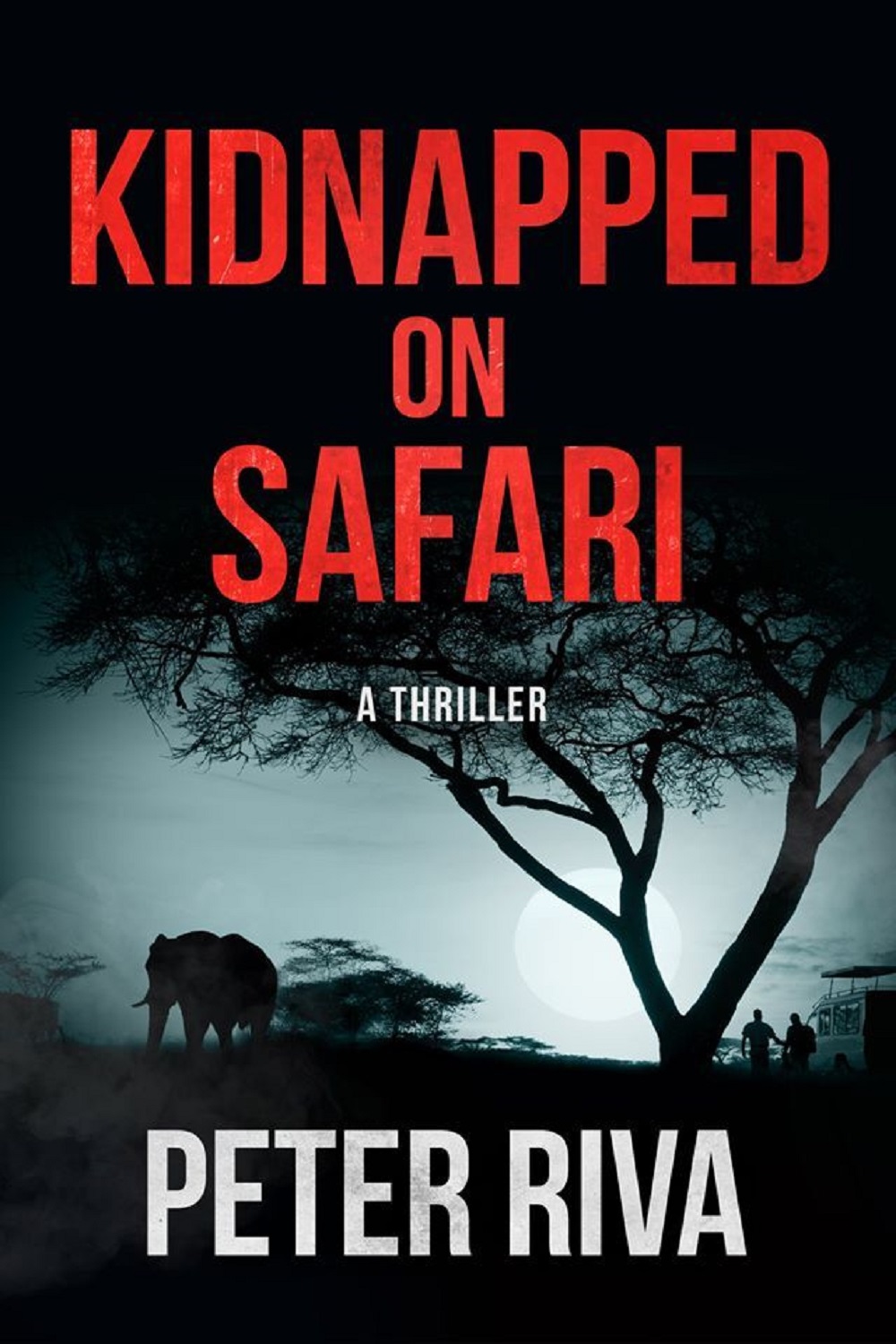
Peter Riva is the author of “Kidnapped on Safari.” He has spent many months over thirty years traveling throughout Africa and Europe. He created the 1995 series Wild Things for Paramount. Passing on the fables, true tales and insider knowledge of the last reserves of true wildlife is his passion. He has been working as a literary agent for the past forty years. In his spare time, Riva writes science fiction and African adventure books, including the Mbuno and Pero Adventures series, “Murder On Safari” and “The Berlin Package.” He lives in Gila, New Mexico.






 SA Examiner