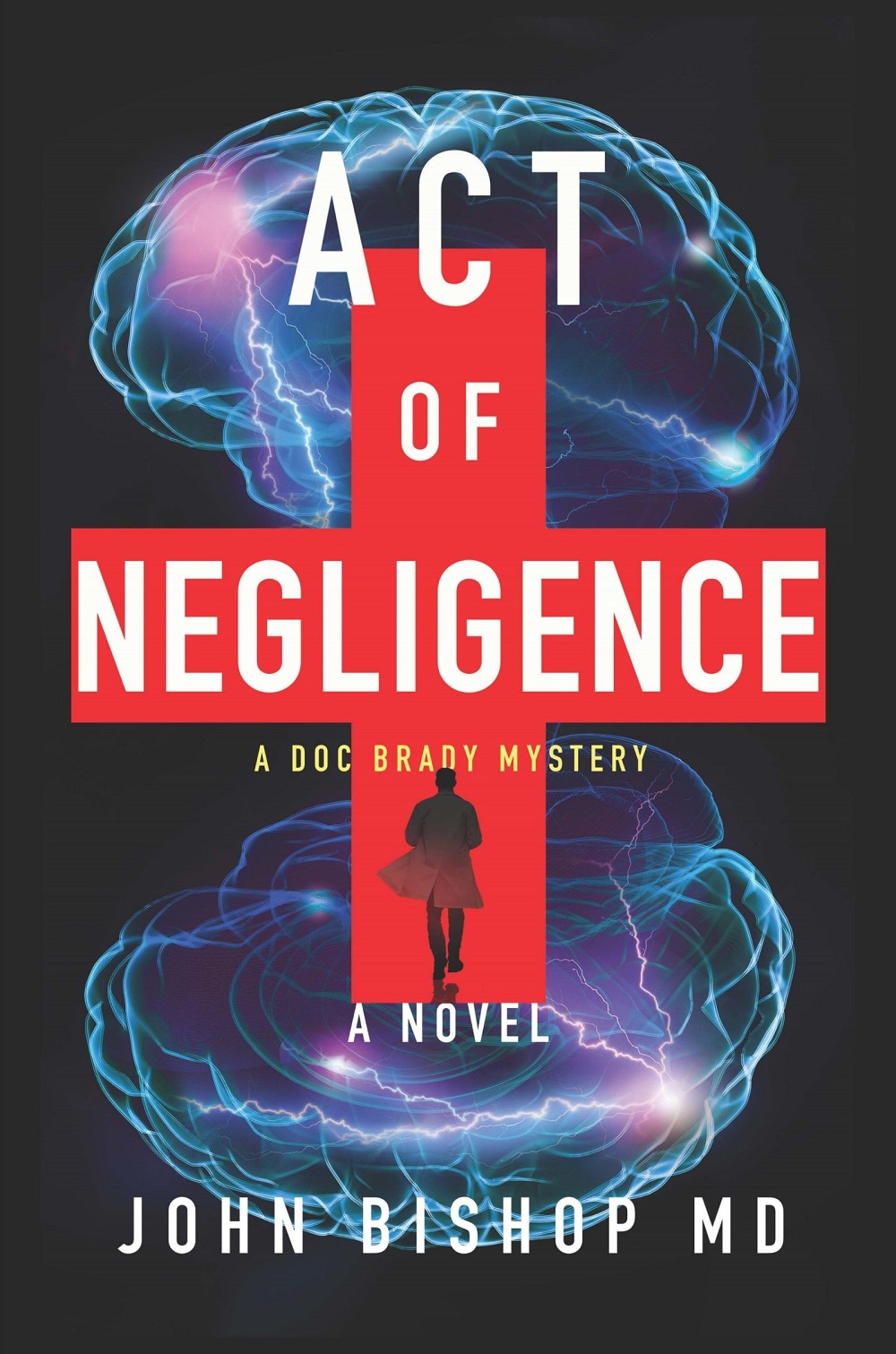
‘Act of Negligence’ is the fourth book of the Doc Brady mystery series by John Bishop. Photo: amazon
John Bishop M.D. is an orthopedic surgeon, keyboard musician, and author of the beloved Doc Brady mystery series. The series includes “Act of Murder,” “Act of Deception,” “Act of Revenge,” “Act of Negligence,” “Act of Fate,” and “Act of Atonement.” His 30 years as a practicing orthopedic surgeon give the reader a unique glimpse into the medical world with all its problems, intricacies, and complexities, while at the same time revealing the compassion and dedication of most health care professionals. Jim Bob Brady, the series protagonist, is an accomplished orthopedic surgeon with a talent for solving medical mysteries who also moonlights as a blues musician. In “Act of Negligence,” Dr. Jim Bob Brady finds himself investigating why dementia patients with orthopedic problems are dying after surgery. It is the fourth book in the Doc Brady mystery series.
“Act of Negligence” is now set in the year 2000, whereas the previous ones take place in the 1990s. The story begins as Dr. Brady is visiting Beatrice Adams, a nursing home patient with Alzheimer’s who was transferred to University Hospital. He was sent in as a consultant because she has a bad knee but at fifty-seven years old, she is too young to have Alzheimer’s. His friend and colleague Dr. James Morgenstern refers him a series of dementia patients with orthopedic problems from Pleasant View Nursing Home. Soon, they each die, not because of Dr. Brady’s treatments, but because of irregular heart rates. This shakes him up because as a surgeon, he is not used to so many of his patients dying. After Dr. Jeff Clarke, who performs the autopsies, finds unusual brain pathology in each patient, Dr. Brady begins investigating the nursing home and its owner and CEO, Dr. Theodore Frazier. His curiosity and tenacity have gotten him in serious trouble before, including kidnappings and beatings, but this time, his life is dangerously on the line, but thankfully, his resourceful wife Mary Louise always has his back and saves the day. Even though those he considered allies turn out to be anything but, Dr. Brady uncovers the unconscionable research that Dr. Frazier was doing on Alzheimer’s patients.
Being an orthopedic surgeon, John Bishop once again brings his knowledge of the medical field to another exciting Dr. Brady adventure. Despite being heavy in medical terminology and drama, the author makes it easy to follow along and readers end up learning more about a specific medical ailment. This time it is Alzheimer’s disease. Dr. Frazier was experimenting on his patients in the hopes of curing Alzheimer’s and even though some died, there were others who improved. This brings about the controversial question ‘do the ends justify the means?’ The overall language is easy to understand and the action flows easily from page to page. With a first person narration, the reader has a front row seat when Dr. Brady is in trouble: “So, with an unconscious Jeff Clarke and a silent, concussed Cynthia Drummond, no brakes, a stuck carburetor, a speeding car, and no way to turn off the engine, I did the only thing I knew to do. I tried to steer the vehicle.” Highlights include Chapter 5 as one of the patients coded during surgery after the epidural needle slips and her heartrate grows erratic and Chapter 27 when Dr. Brady is drugged, nearly crashes a car and almost dies. In the series, even though the good guys always win, the plot twists at the end make for excellent storytelling. With compelling characters and nail-biting action, “Act of Negligence” by John Bishop is another must-read in the Doc Brady mystery series. It is comparable to works by Robin Cook and recommended for fans of medical dramas who are open to learning more about illnesses and appreciate that in ethical matters, there are always grey areas.
“I was interrupted by the rhythmic beeping of the pulse oximeter, showing the patient’s oxygen saturation had fallen below 50 percent. Tim Kelly and I quickly closed the skin with an unattractive continuous stitch and watched Fred Green frantically administer various drugs to increase the patient’s heart rate, and thereby increase her blood oxygen level. He had Loretta call for another anesthesiologist stat, which brought two more docs into the room.”
*The author received a copy of this book for an honest review. The views and opinions expressed here belong solely to her.
‘Act of Negligence’ will be out on Tuesday, June 15, 2021. Courtesy photo, used with permission.
John Bishop MD is the author of “Act of Negligence: A Medical Thriller” (A Doc Brady Mystery). Dr. Bishop has led a triple life. This orthopedic surgeon and keyboard musician has combined two of his talents into a third, as the author of the beloved Doc Brady mystery series. Beyond applying his medical expertise at a relatable and comprehensible level, Dr. Bishop, through his fictional counterpart Doc Brady, also infuses his books with his love of not only Houston and Galveston, Texas, but especially with his love for his adored wife. Bishop’s talented Doc Brady is confident yet humble; brilliant, yet a genuinely nice and funny guy who happens to have a knack for solving medical mysteries. Above all, he is the doctor who will cure you of your blues and boredom. Step into his world with the first four books of the series, and you will l be clamoring for more. The following is an excerpt from “Act of Negligence” which will be released on Tuesday, June 15, 2021.
Act of Negligence: A Medical Thriller (A Doc Brady Mystery) Chapter 1 by John Bishop, MD
There was no response from the patient in Room 823 of University Hospital. She was crouched on the bed, in position to leap toward the end of the bed in the direction of yours truly. I could not determine her age, but she definitely appeared to be a wild woman. Her hair was a combination of gray and silver, long and uncombed and in total disarray. She had a deeply lined face, leathery, with no makeup. Her brown eyes were frantic, and her head moved constantly to the right and left. She was clad only in an untied hospital gown which dwarfed her small frame. My guess? She wasn’t over five feet tall.
“Ms. Adams? Dr. Morgenstern asked me to stop by and see about your knee?”
She did not move or speak; she just continued squatting there in the hospital bed, bouncing slightly on her haunches, and staring at me while her head moved slowly to and fro.
I looked around the drab private room with thin out-of-date drapes and faded green-tinted walls. There were no flowers. I judged the patient to most likely be a nursing-home transfer.
I made the safe move by backing out of the patient’s room, and I walked the twenty yards to the nurses’ station. The white-tiled floors were freshly waxed, but the medicinal smell was distinctly different from the surgical wing. There was an unpleasant pine scent in the air that could not hide the odor of decaying human beings and leaking body fluids. It was the smell of chronic illness and disease.
“Cynthia?” I asked the head nurse on the medical ward, or so announced her name tag. She was sitting at the far side of the long nursing station desk performing the primary duty of a nursing supervisor: paperwork. She was an attractive Black woman in her mid-forties, I estimated.
“Yes, sir?”
“Dr. Morgenstern asked me to see Mrs. Adams in consultation. Room 823? What’s the matter with her? She won’t answer me. She just stares, sitting up in the bed on her haunches, bouncing.”
She smiled and shook her head. “You must be a surgeon.”
“Yes, ma’am. Orthopedic. Dr. Jim Brady.”
“Cynthia Dumond. Mrs. Adams has Alzheimer’s. Sometimes she gets confused. Want me to come in the room with you? Maybe protect you?” she said with a smile.
“Well, I wouldn’t mind the company,” I said, a little sheepishly. “Not that I was afraid or anything.”
“She’s harmless, Doctor. She’s just old and confused.”
We walked back to the hospital room together. The patient seemed to relax the moment she saw the head nurse, a familiar face. “Hello, Ms. Adams,”
Cynthia said. “This is Dr. Brady. He needs to examine your . . .” She gazed at me, smiling again. “Your what?” “Her knee.”
“Dr. Brady needs to look at your knee. Okay?”
The patient had ceased shaking and bouncing, leaned back, slowly extended her legs, laid down, and became somewhat still.
“Very good, Ms. Adams. Very good,” Cynthia said, grasping the elderly woman’s hand and holding it while she looked at me. “Go ahead, Doctor.”
The woman’s right knee was quite swollen, with redness extending up and down her leg for about six inches in each direction. When I applied anything but gentle skin pressure, her leg seemed to spasm involuntarily. How in the world she had managed to crouch on the bed with her knee bent to that degree was mystifying.
“Sorry, Ms. Adams,” I said, but continued my exam. The knee looked and felt infected, but those signs could also have represented a fracture or an acute arthritic inflammation such as gout, pseudo-gout, or rheumatoid arthritis, not to mention an array of exotic diseases. I tried to flex and extend the knee, but she resisted, either due to pain—although I wasn’t certain she had a normal discomfort threshold—or from a mechanical block due to swelling or some type of joint pathology.
“What’s she in the hospital for?” I asked Nurse Cynthia.
“Dehydration, malnutrition, and failure to thrive, the usual diagnoses for folks we get from the nursing home. The doctor who runs her particular facility sent her in.”
“Who is it?”
“Dr. Frazier. Know him?”
“Nope. Should I?”
“No. It’s just that he sends his patients here in the end stages. Most of the folks that get admitted from his nursing home die soon after they arrive.”
“Most of them are old and sick, aren’t they?”
“Yes.”
I looked at her expression while she continued to hold Mrs. Adams’s hand.
“Were you trying to make a point?”
“Not really.” She glanced at her watch. “Are you about through, Doctor Brady? I have quite a bit of work to do.”
“Follow that paper trail, huh?”
“Yes. That’s about all I have time for these days. Seems to get worse every month. Some new form to fill out, some new administrative directive to analyze. Whatever.”
“I know the feeling. There isn’t much time to see the patients and take care of whatever ails them these days. If my secretary can’t justify to an insurance clerk why a patient needs an operation, then I have to waste my time on the phone explaining a revision hip replacement to someone without adequate training or experience. One of my partners told me yesterday about an insurance clerk that was giving him a bunch of—well, giving him a hard time—about performing a bunionectomy. He found out during the course of a fifteen-minute conversation that the woman didn’t know a bunion was on the foot. Her insurance code indicated it was a cyst on the back and she couldn’t find the criteria for removal in the hospital. She was insisting it had to be an office procedure, and only under a local anesthetic. Crazy, huh?”
“Yes, sir. It’s a brave new world.”
“Sounds like a good book title, Nurse Cynthia.”
“I think it’s been done, Doctor.”
“Well, thanks for your help. I do appreciate it. Not every day the head nurse on a medical floor accompanies me on a consultation.” “My pleasure. You seem to be a concerned physician, an advocate for the patient, at least. As I remember, that’s why we all went into the healing arts.”
She turned to Mrs. Adams. “I’ll see you later, dear,” she said, patting the elderly woman’s forehead. Still holding the nurse’s other hand with her own wrinkled hand, Mrs. Adams kissed Cynthia’s fingers lightly, probably holding on for her life.
I poured a cup of hospital-fresh coffee, also known as crankcase oil, and reviewed Beatrice Adams’s chart. I sat in a doctor’s dictation area behind the nursing station and looked at the face sheet first, being a curious sort. Her residence was listed as Pleasant View Nursing Home, Conroe, Texas. Conroe is a community of fifty thousand or so, about an hour north of Houston. I noticed that a Kenneth Adams was listed as next of kin and was to be notified in case of emergency. His phone number was prefixed by a “409” exchange, and I therefore assumed that he was a son or a brother and lived in Conroe as well.
Mrs. Adams was fifty-seven years old, which was young to have a flagrant case of Alzheimer’s disease, a commonly-diagnosed malady that was due to atrophy of the brain’s cortical matter. That’s the tissue that allows one to recognize friends and relatives, to know the difference between going to the bathroom in the toilet versus in your underwear, and to know when it’s appropriate to wear clothes and when it isn’t. Alzheimer’s causes a patient to gradually become a mental vegetable but doesn’t affect the vital organs until the very end stages of the disease. In other words, the disease doesn’t kill you quickly, but it makes you worse than a small child—unfortunately, a very large and unruly child.
It can, and often does, destroy the family unit, sons and daughters especially, who are caught between their own children and whichever parent is affected with the disease, which makes it in some ways worse than death. You can get over death, through grief, prayer, catharsis, and tincture of time. Taking care of an Alzheimer’s-affected parent can be a living hell, until they are bad enough that the patient must go to a nursing home. Then the abandonment guilt is hell, or so my friends and patients tell me.
Mrs. Adams had been admitted to University Hospital one week before by my friend and personal physician, Dr. James Morgenstern. I guessed that either he had taken care of the patient or a family member in the past, or that Dr. Frazier, physician-owner or medical director of Pleasant View Nursing Home, had a referral relationship with Jimmy.
Mrs. Adams’s initial blood work revealed hyponatremia (low sodium), hyperkalemia (high potassium), and a low hematocrit (anemia). Clinically, hypotension (low blood pressure), decreased skin turgor, and oliguria (reduced urine output) suggested a dehydration-like syndrome. For a nursing-home patient, that could either mean poor custodial care or failure of the patient to cooperate— refusing to drink, refusing to eat—or some combination of the two. Neither scenario was atypical of the plight of the elderly with a dementia-like illness.
According to Dr. Morgenstern’s history, the patient had been diagnosed with Alzheimer’s disease six years before, at age fifty-one, which by most standards was very young for brain deterioration without a tumor.
“Dr. Brady?” head nurse Cynthia asked, appearing beside my less-than-comfortable dictating chair.
“Yes?”
“I’m sorry to bother you, but might I have one of your business cards?”
“Sure,” I said, handing her one from the top left pocket of my white clinical jacket. “Don’t ever apologize for bothering me if you’re trying to send me a patient.”
She laughed. “It’s for my mother. She has terrible arthritis.” She paused and read the card. “You’re with the University Orthopedic Group?”
“Yes. Twenty-two years.”
“If I might ask, where did you do your training?”
“I went to med school at Baylor, then did general and orthopedic surgery training here at the University Hospital. I then traveled to New York and spent a year studying hip and knee replacement surgery, then came back to Houston to the land of the free and the home of the brave.”
“Is your practice limited to a certain area? I mean, do you just see patients with hip and knee arthritis?”
“Yes. Unless, of course, it’s an emergency situation, like one of those rare weekends when I can’t find a young, hungry surgeon with six kids to cover emergency room call for me.”
“Well, thanks,” she said, smiling. “I’ll be seeing you. I’ll bring my mother in.”
“Thank YOU, Cynthia. By the way, I’m curious. Why me? I would think you see quite a few docs up here, and I would imagine that your mother has had arthritis for years. Why now?”
Cynthia was an attractive, full-figured woman with close-cropped jet-black hair, a woman who made the required pantsuit nursing uniform look like a fashion statement. She looked me up and down as I sat there with Mrs. Adams’s chart in my lap, my legs crossed, holding the strong black cooling coffee.
“You’re wearing cowboy boots. I figure that all you need is a white hat,” she said, turning and walking away.
Not my sharp wit, nor my kind demeanor with her patient, nor my vast training and experience.
My boots.
John Bishop, M.D. Photo: Greg Moredock, used with permission.
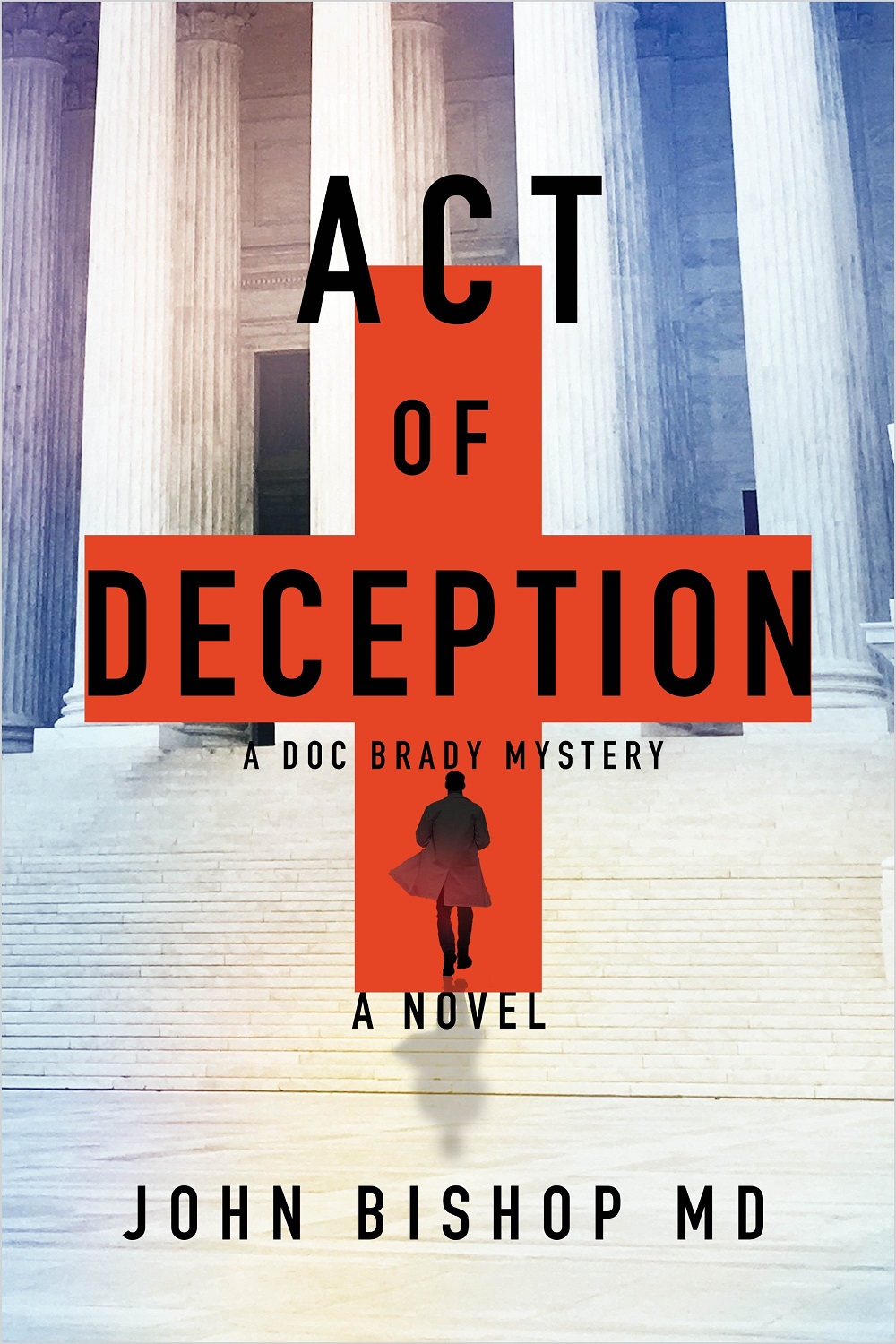
‘Act of Deception’ is the second novel in the Doc Brady mystery series by John Bishop, M.D. Courtesy photo, used with permission.
John Bishop M.D. is an orthopedic surgeon, keyboard musician and author of the beloved Doc Brady mystery series. The series includes “Act of Murder,” “Act of Deception,” “Act of Revenge,” “Act of Negligence,” “Act of Fate” and “Act of Atonement.” Doc Brady is the protagonist and his fictional counterpart – an accomplished orthopedic surgeon with a talent for solving medical mysteries who moonlights as a blues musician. The series is set in the 1990s and features Houston and Galveston locales. In “Act of Deception,” Doc Brady, a Houston orthopedic surgeon, is being sued for medical malpractice because a mysterious infection caused a knee replacement to end up as an amputation.
In the second book in the Doc Brady mystery series, “Act of Deception,” the story takes place in 1995 and begins with Doc Brady waking up with the sweats again. He is preoccupied with his impeding lawsuit even though it is not the first time he has been sued. Nothing in his notes or recollection of the event backs up the malpractice claim but he is determined not to settle even though everyone from his lawyer to his co-workers tell him it is the best thing to do. The case involves William Jones, a farmer whose treatment for severe arthritis in his right knee joint ended with an amputation. Preparations for the trial begin to take a toll on him until he ends up in a coma after he is assaulted in a parking garage. There is also an ambulance chaser on the loose and no one knows where he is getting his information. As it turns out, Mr. Jones received treatment from a doctor covering for his usual doctor while he was out on vacation but the page that notated this in Mr. Jones’ medical record was missing, which is why no one was able to figure out what went wrong. In the end, after all the sleuthing and help from his family and friends, Doc Brady is exonerated and the hospital worker responsible for the medical records leak is fired.
This is another excellent medical novel from John Bishop M.D. and this time he combines legal drama and medical mystery. In this case, the mystery involves how one of his patients could have developed an infection that required an amputation. He almost gives away the ending when he mentions the missing medical records page, but not until the end does the reader find out why it was missing and who took it. The story is told in first person narrative which gives the reader an in-depth look into Doc Brady’s mind and the character development makes the characters real. With detailed explanations of the medical and legal issues, the balance between his personal and professional lives makes for fascinating storytelling. The final courtroom scene when Don Shaw, the plaintiff’s attorney, attempts to attack the witness when he realizes he is about to lose the case, is an exciting conclusion to the case: “At the same time, Judge Barbara Woods deftly jumped out of her chair, hopped down to the witness stand, and got in front of the doctor. In the second or two it took for Shaw to reach the stand, she reached inside her robe and stood there, waiting for him, with the biggest handgun I had ever seen.” Even though it stands perfectly well on its own, it would be best to read the first one in the series, “Act of Murder,” to get to know the characters better. As a big plus, there is a sneak peek at the third novel in the series: “Act of Revenge” at the end of this one. “Act of Deception” is recommended for readers who appreciate an exciting mystery novel involving down to earth characters and intriguing plots.
*The author received a copy of this book for an honest review. The views and opinions expressed here belong solely to her.
‘Act of Murder’ by John Bishop, M.D. is the exciting first book in the Doc Brady mystery series. Courtesy photo, used with permission.
John Bishop M.D. is an orthopedic surgeon, keyboard musician and author of the beloved Doc Brady mystery series. The series includes “Act of Murder,” “Act of Deception,” “Act of Revenge,” “Act of Negligence,” “Act of Fate” and “Act of Atonement.” Doc Brady, the protagonist and his fictional counterpart, is an accomplished orthopedic surgeon with a talent for solving mysteries who moonlights as a blues musician. The series is set in the 1990s and features Houston and Galveston locales. In “Act of Murder,” Doc Brady witnesses his neighbor’s ten-year-old son killed by a hit-and-run driver and is prompted to investigate whether it was truly an accident or an act or murder.
“Act of Murder” begins in the spring of 1994 when Doc Brady hears the sounds of an accident in front of his house. At the scene, his neighbor Bobbie is kneeling down over a small blue lump that turns out to be her son Stevie. The distraught mother begs him to do something to help but by the looks of it, it is too late. When Detective Susan Beeson with the Houston Police Department starts investigating the case, details about Stevie surface, including that he had osteogenesis imperfecta, a genetic disorder that affects the bones. At first it looks like a random accident, until days later when another boy with a similar genetic disease and similar looks dies after surgery. Sensing that the two cases are more than just coincidence, Doc Brady starts digging for clues and together with his twenty-year old son J.J. and wife Mary Louise they uncover a sinister plot. The two boys were twins, one given up for adoption under the guise of helping out a family member but with the ultimate plan to gain money and power.
The most original authors are those who write from their own experiences and in this case, John Bishop M.D. successfully takes his real-life knowledge as an orthopedic surgeon to give his writing an authentic voice. The story is a combination hospital drama and murder mystery that draws the reader in right from the first sentence: “What I remember first about that day was the sound of a sickening thud.” It would be a mistake to call it a medical thriller because the case does not exactly involve any kind of medical issues but it centers around a doctor’s daily adventures. The language is easy to understand and does not include complicated medical jargon. Since it takes place in the 1990s, there are pop culture references like Seinfeld and Dave’s World that anyone who remembers those years can chuckle along with the author. Descriptions of his native Texas are spot one, especially Houston and Galveston and the character development makes them believable and relatable. It is a strong beginning for the series. A sure page-turner, “Act of Murder” is a must-read for fans of murder mysteries that center around the medical community and appreciate a behind the scenes look at hospitals and doctors.
*The author received a copy of this book for an honest review. The views and opinions expressed here belong solely to her.
I awoke that Friday morning in a serious sweat, the kind that is not immediately relieved by rising and washing one’s face with cold water. I noted that the clock in the bathroom read 4:38, twenty-two minutes before my designated alarm setting. After staring at the clock for a minute, maybe two, I felt my right radial pulse. The accelerated throbbing confirmed that tachycardia was still my predominant rhythm. I decided to attend to ritualistic morning bathroom chores, make coffee, read the paper, and at least try to pretend that it was a normal Friday morning.
Upon completion of the bathroom routine, as quietly as possible, I punched in the five-digit alarm code and started to leave the bedroom to go downstairs. Unfortunately, even the sound of punching in the numbers was unduly shrill, and it caused Mary Louise, my bride of twenty-four years, to stir.
“Jim Bob?”
“Yes?”
“It’s not even five yet. Why are you up?”
“Couldn’t sleep. Woke up with the sweats again. Sorry to wake you. I thought I’d go downstairs, make some coffee, and sit outside and think for a while. Okay?”
“Want some company?”
Normally, I would never turn down such an offer. I loved my wife dearly. She was, in fact, my best friend. That particular morning, however, I responded in the negative.
“I don’t want to hurt your feelings, sweetie, but this is just one of those times I need to collect my thoughts. Know what I mean?”
“I do. I’m sorry you’re having to go through all this. It isn’t fair. After all you’ve done for everybody else. I know in my heart it will be all right, just maybe not today. Try not to get too upset. Promise?”
“I’ll do my best.” I leaned down and kissed her warm cheek. She smelled so good, I considered taking off my robe and getting back into bed. I finally chose not to. “Go back to sleep. I’m not leaving until about eight o’clock.”
I left her reluctantly and plodded downstairs barefooted, in my cotton robe, with lights still off, toward coffee heaven. I selected Twin Peaks Blend coffee beans, which we kept in the freezer to avoid staleness, ground them, and began the ten-minute process to achieve as perfect a cup of coffee as I could make. I waited on the back porch in my “spot,” a large white cane rocker. The month of August was a stifling time of year in Houston, even at that hour of the morning. The heat and humidity were almost unbearable during July, August, and early September. I turned on the outdoor ceiling fan that hovered above my chair and hoped it would make the weather more pleasant. It didn’t.
I considered my life that morning. I, Dr. James Robert Brady, who had done my best to be a compassionate and dedicated orthopedic surgeon for the past seventeen years, was being sued for medical malpractice. I was not a neophyte when it came to lawsuits. I had been sued twice before, not an unusual occurrence in a city of four million people, with far too many law school graduates sitting in their quiet offices with nothing to do. The other two suits were quite minor and did not linger but were dismissed rather quickly, meaning over a year-or-two period. The current lawsuit, the cause of my awakening before five with the sweats and intense gastrointestinal distress, had not been dismissed.
I stepped back inside to the relatively cool air, although during August even the air-conditioning system labored heavily. I poured my coffee into a large black mug with a removable top that allowed intermittent filling of the cup but twisted on securely so as not to spill during the drive to work. While I wasn’t yet ready to leave, I used the “to go” cup anyway, being a creature of habit, a trait inherited from my dear departed father, and one which drove even me to distraction on occasion.
I returned to the French door to head back to the humidity and spotted Cat perched on the back doorstep, peering through the lowest windowpane, awaiting her breakfast. I sipped my coffee and prepared her Prime Feast in a disposable dish, probably not recyclable because I am sure it isn’t possible to remove the smell of mixed seafood, no matter what treatment is available at the nearest recycling plant.
Strolling to the door, feast in hand, I greeted the discriminating feline.
“Morning, Cat. I have your breakfast.”
No response. Just a simple twitch of the sensitive nose. There was no tail-wagging or jumping on my bare leg to greet me, sure signs that man’s best friend loved you and missed you. Rather, Cat simply did what she did best. She remained aloof and distinctly noncommittal. I bent down, sat her dish on the patterned concrete deck, and stroked her damp fur as she sampled my selection. She did give me a brief look of gratitude, then resumed her nibbling. I returned to my chair and continued to assess my life and its worth.
I was most critical of self that morning, pondering the effects of aging on a once-athletic physique. While Mary Louise considered me to be a handsome specimen, I lamented my shrinkage from six feet plus one inch to slightly less than the “manly” six feet. I continued to disguise my shortening by wearing Western boots, and only on weekends did I allow myself the comfort of high-topped athletic shoes—not that I used them for athletics.
I remembered my previously full head of hair that had slowly thinned, especially at the front, to allow for enlargement of my forehead while a balding spot was created on the crown of my head. My sideburns were a little long and gray and transitioned to brown at an always-increasing distance from the top of my ears. I criticized the extra minute I spent every morning to carefully position my combed-straight-back locks over that bare spot I had grown to hate.
I had begun to study myself each morning before showering to confirm that I indeed resembled Alfalfa of Little Rascals fame, with thin wisps of hair sticking straight up toward the heavens. I then reminded myself of my need to wear bifocals and of my need to start a workout program to slim my waist from its size 38—although I had noticed lately that the cleaners had been shrinking my best jeans.
I tried to take comfort in Mary Louise’s love of what she called my “charming cleft chin” and “captivating smile” but was unsuccessful. I felt old that morning, which, along with words like useless, worthless, out-of-shape, and four-eyed, drove me to an even fouler mood than when I awoke to cold sweats and the dreaded digestive-tract blues.
By six o’clock I was sweating again, that time from drinking an entire pot of coffee and from the oppressive heat that had already risen to a sultry 80 degrees with the humidity at drip level. I threw off my robe and dove into the pool, taking care to avoid a cervical spine injury in the four-foot-deep water. It did cool me off temporarily, so after two laps I simply stood in the healing waters, naturally, in the buff. As I reminisced over the treatment of the patient that had decided to sue me, the back door of the house opened and the Tipster bounded outside. He saw me in the pool and almost dove in with me. Fortunately, I was able to hold him back while I ruffled his shaggy mane and scratched his ears. At least he was glad to see me and acted as though we had been apart for years, not just the six hours since we had bid him good night.
His official title was “Tippecanoe and Tyler Too,” a typical name given by a particular breeder who prized his full-blooded intelligent golden retrievers. But “Tip,” “Tipper,” or “the Tipster,” as Mary Louise intermittently called him, had failed the IQ test for well-bred dogs and was lovingly given to me by that grateful patient, who had many more golden retrievers than insurance dollars.
Tip had been presented to me in the office five months previously at the end of the day as a surprise. The man didn’t ask me if I wanted a dog, but simply showed up at my office with a large, overly friendly seven-month-old golden retriever puppy. I still suspected that Fran and Rae, my faithful office staff, had somehow conspired with my darling wife to bring some new joy into my life. At the time, I was highly skeptical and hoped to rid myself of the constantly-shedding beast who had disrupted our lives. Over the next few months, however, I had grown to love, without restraint, this large, adorable dog, whose only faults were that he was too much a friend to strangers and a poor fetcher of dead birds. Neither flaw bothered me. I didn’t hunt much anymore, and we rarely had anyone to the house that I despised. Besides, considering we had yet to be burglarized, the Tipster’s camaraderie with those stealers of one’s things was an untested character defect.
My mood improved significantly after seeing Tip, and I watched with interest as he bounded over to greet Cat with a friendly good morning. He had attempted to make Cat his new best friend every day since his arrival at our abode but had been miserably unsuccessful. Cat’s reaction to his energetic playfulness was to leap gracefully into the rocking chair next to mine, back herself up as far as possible to the rear of the chair, and wait. When Tip happily padded over to see her and put his whole head onto the seat of the chair, she would strike out at his sensitive nose with one of her front paws, prompting an episode of howling. For five months, this scenario had occurred each and every time the two animals had a backyard encounter. I believed that Cat had become bored with the whole routine and had actually become embarrassed at what seemed to be the retriever’s inability to learn.
“Tip? Be careful over there. She scratches your nose every day! It’s so raw, you almost need stitches.”
I obviously had lost my mind. I was talking to the dog as though he understood my every word. Just before pushing his fat head into the seat of the chair to smell the gray bundle of fur, though, he turned his head toward me and perked up his ears. I didn’t know if he had actually understood what I had said or simply had forgotten that I was in the pool, since he had wandered into the bushes to relieve himself before approaching Cat. He stared at me for a moment, seemed to consider what I had said, then pushed his tender, scarred nose toward the she-beast, and . . . I couldn’t believe it! She didn’t hurt him! He licked her fur, and Cat just stood there. I guessed she finally decided that Tip was harmless and just wanted to play. She might have also figured out that a large dog like that could be an impressive ally when trying to ward off neighborhood cats who strayed into her domain looking for a free meal.
And so it was that on that hot, steamy morning in August, my cat and dog became friends. I thought that maybe Mary Louise was right, having told me repeatedly that everything would be okay. Alas, that small, backyard miracle was the only one I witnessed for a while.
John Bishop MD is the author of “Act of Deception: A Doc Brady Mystery.” Dr. Bishop has practiced orthopedic surgery in Houston, Texas, for 30 years. His Doc Brady medical thriller series is set in the changing environment of medicine in the 1990s. Drawing on his years of experience as a practicing surgeon, Bishop entertains readers using his unique insights into the medical world with all its challenges, intricacies, and complexities, while at the same time revealing the compassion and dedication of health care professionals.





 SA Examiner