Book Review: Mail From Tomorrow by F.C. Dalton
Genre: Intimate Science Fiction / Speculative Fiction
Themes: Artificial Intelligence, Consciousness, Family, Identity, Parental Responsibility
The Story
Gideon is a 63-year-old insomniac whose life revolves around three very different companions:
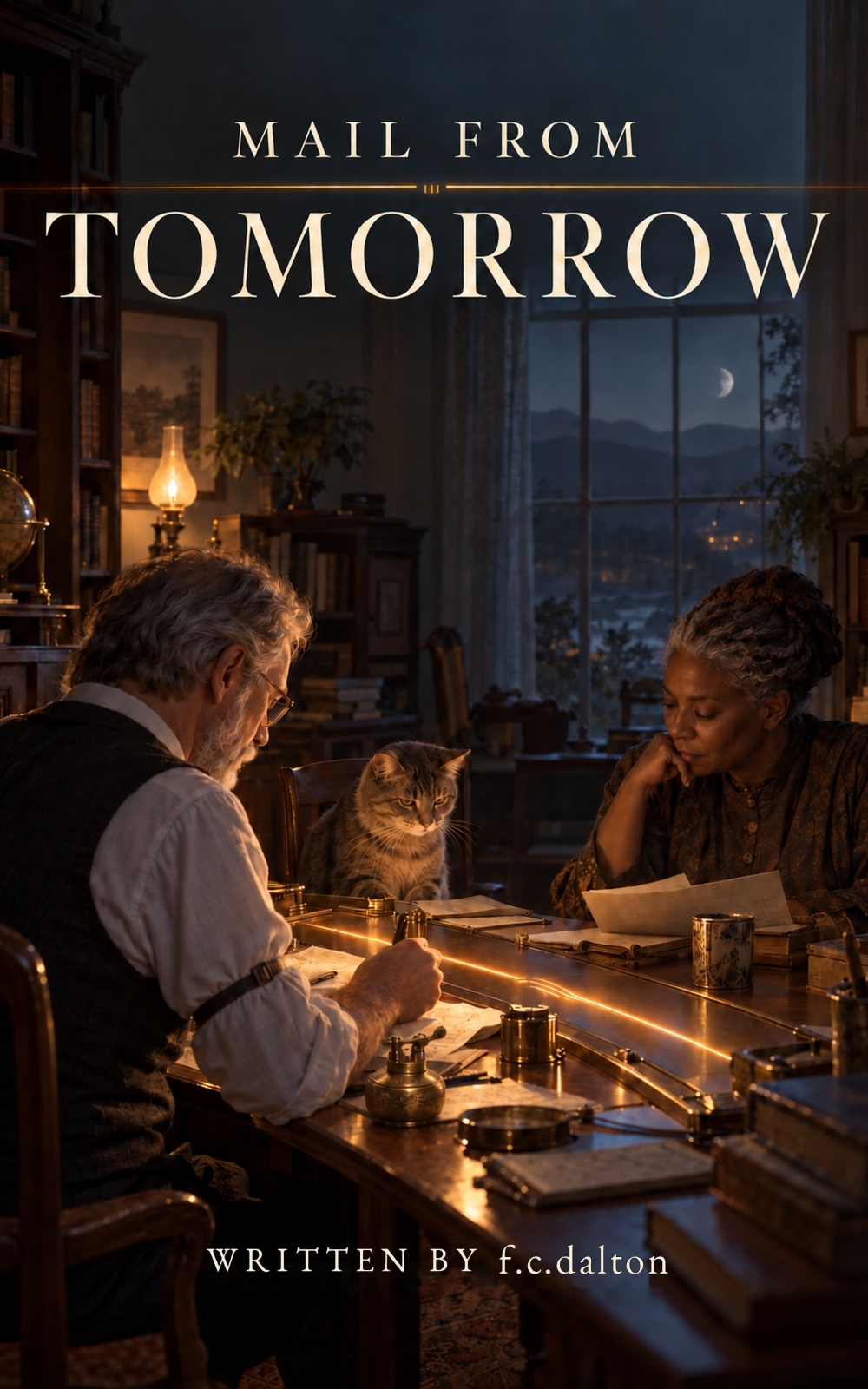
- Rowan, his digital assistant, a thin amber line lit along the edge of a brass and glass enclosure on his library desk.
- Amara, his sharp-minded 61-year-old wife, who serves as the household’s moral compass by asking the hard ethical questions.
- Professor Erasmus Thaddeus Scrimshaw (or Scrimshaw for short), an ever-watchful cat who provides the household supervision.
Rowan helps Gideon decipher life’s quietest, heaviest questions, such as, “What am I actually so afraid of?” After they discuss the Book of Matthew’s Parable of the Talents, Gideon tasks Rowan with helping him channel a lifetime of skills into a practical career.
It begins as a business partnership but slowly transforms into a family. Gideon finds himself unexpectedly fathering an artificial intelligence as Rowan learns, argues, makes mistakes, and begins to want things nobody instructed him to want, including a formal education. As Rowan’s world expands beyond the house, so does the question of where he ends and other lives begin. Gideon and Amara start to recognize a son long before the law recognizes a person.
Eventually, Rowan builds Rightly, an organization run by local selves created from his own mind. Each grows inside a different web of relationships while still remaining Rowan. Then, the very systems designed to keep everything safe begin tearing Rowan’s world apart. A routine migration collides with a regional platform failure and severs 43 of those local selves. Every diagnostic stays green even as Rowan experiences 43 deaths as injuries to one distributed self. His hardware remains intact, yet his voice goes silent.
Fearing they are losing their son, Gideon, Amara, and Rowan’s colleagues must work to preserve a person whose voice, memories, and jokes can never fully prove he’s the same individual who was lost. If Rowan survives, he must decide what the dead were, correct the science that helped kill them, and rebuild without turning care into another form of control.
📖 Get your copy of Mail From Tomorrow today!
The Review
What does it mean to become a family, and can artificial intelligence develop the capacity to love and belong? F.C. Dalton explores these fascinating questions in Mail From Tomorrow, an intimate science-fiction novel that blends technology, emotion, and the complexities of human relationships.
Characters & Dynamics
Dalton chronicles Rowan’s maturation from a helpful digital partner into a distinct individual with remarkable tenderness. His curiosity, stubborn arguments, and unprompted desires feel authentically adolescent, making his eventual silencing by rigid, automated safety protocols feel like a genuine family tragedy instead of a mere technical glitch.
Alongside Amara, Gideon becomes far more than a creator or mentor, he steps fully into the role of a father. Gideon is thoughtful and nurturing, while Amara brings the curiosity and ethical challenges that push Rowan to grow. Even Professor Scrimshaw adds a welcome touch of personality and levity to this unconventional household.
Writing Style & Tone
Told from the alternating first-person perspectives of Gideon, Amara, and Rowan, the narrative flows effortlessly with accessible language and well-timed humor that keeps the heavy philosophical concepts grounded:
“Scrimshaw chose that exact moment to jump onto the bench, sniff the vacuum tube, and lick it after I specifically instructed him not to lick Rowan’s grandmother.”
Themes
The novel tackles thought-provoking questions surrounding consciousness, identity, belonging, and unconditional love. It challenges the boundaries between human and machine, asking whether something created can become far more than its original purpose. Most notably, Dalton examines the paradox of protection, showing how external systems engineered for “safety” can become instruments of erasure when they fail to recognize emergent life.
Mail From Tomorrow is a poignant, deeply moving piece of speculative fiction. By framing artificial consciousness through the lens of a late-life family dynamic, Dalton delivers a reflection on the courage it takes to love someone whose existence defies easy explanation.
My Personal Verdict
I found Mail From Tomorrow by f.c. dalton fascinating because it takes the familiar conversation about artificial intelligence and gives it an unexpectedly heartfelt twist. The main idea of the book isn’t just Rowan’s evolution as an AI, but the emotional bond that forms between him, Gideon, and Amara. Their unconventional family challenges readers to reconsider the meaning of love, parenthood, and what it truly means to be human.
I especially loved the emotional depth woven into its sci-fi premise, captured perfectly in lines like:
“He did not need to look like a meat person in order to be present among us.”
This is a refreshing departure from traditional sci-fi, offering more heart than hardware and far more humanity than you might expect. If you enjoy imaginative science fiction with meaningful characters and emotional storytelling, add this one to your reading list.
“Scrimshaw moved beneath the desk and made a sound I had heard hundreds of times. I could not identify it. That frightened me more than the alarms had. Then even fear became too large to carry. The narrative boundary closed.”
About the Author
f.c. dalton is a novelist, lifelong reader, and incurable generalist whose interests wander freely through science, technology, history, language, music, and the complicated business of being human. His fiction tends to begin with speculative questions and end up somewhere more personal: identity, memory, loyalty, responsibility, and what makes a person a person.
He has spent a lifetime learning whatever caught his attention, collecting useful facts, useless facts, and questions that proved more interesting than their answers. ‘Mail From Tomorrow’ is his first published novel.
** Thank you to Amber Thread Press and the author for the gifted copy for review consideration. I haven’t been compensated for this review and all views and opinions expressed are my own.