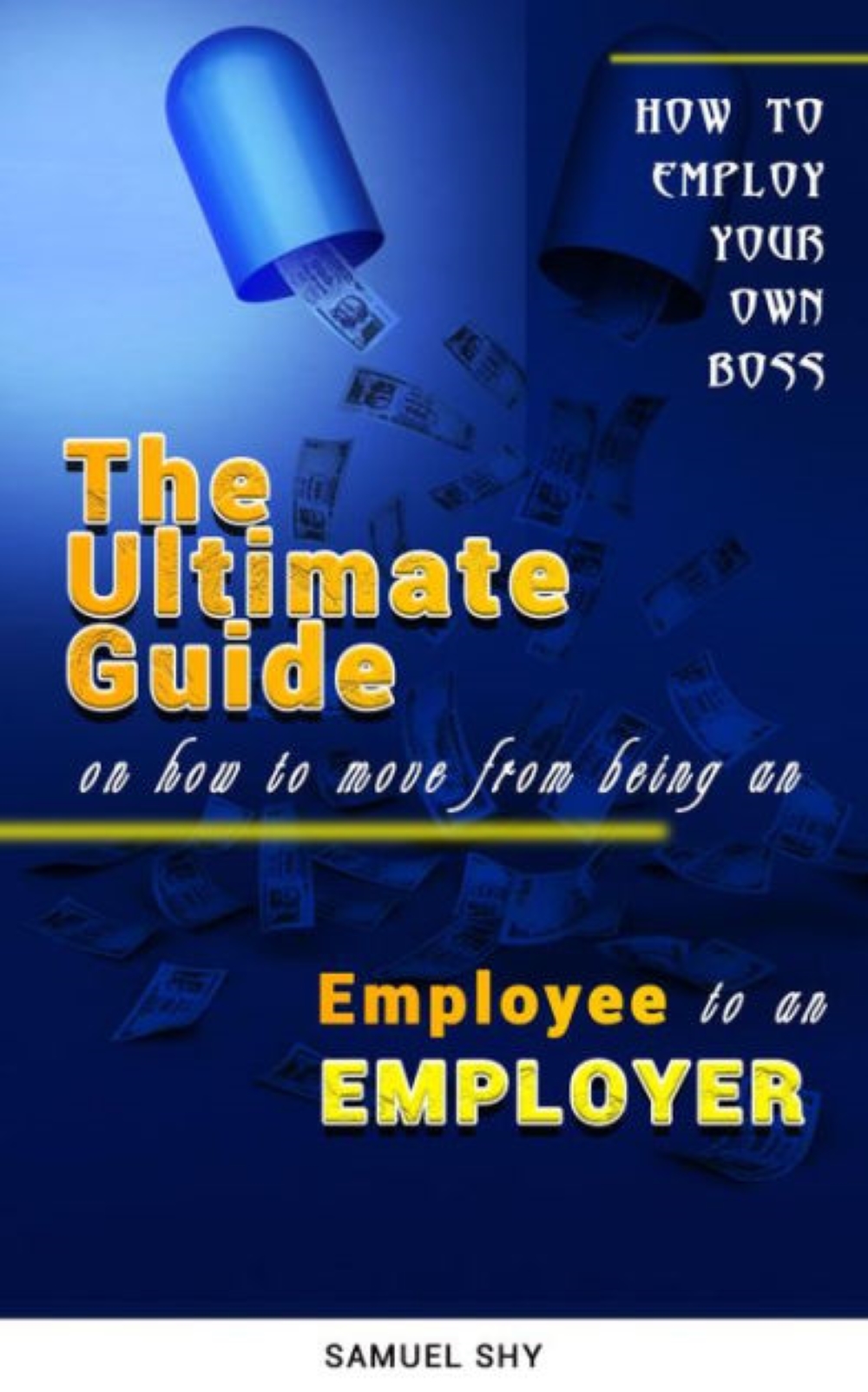
‘How To Employ Your Own Boss: The Ultimate Guide on How To Move From Being An Employee To Employer’ is Samuel Shy’s book about entrepreneurship. Photo: Amazon
From time to time, everyone at one point or another has fantasized about being their own boss. Regardless of what type of job you have, if you work for someone else, it can be exhausting and soul crushing because jobs most require getting up early, long commutes to work, and working at least eight hours a day, which means being cooped up in an office all day and missing out on life’s important events and spending time with loved ones; not to mention stressful office politics and overly critical managers who often demean more than praise employees. When it comes down to it, do you really know what it means to be your own boss? In his new book “How To Employ Your Own Boss: The Ultimate Guide on How To Move From Being An Employee To Employer,” Samuel Shy writes about this important topic that is frequently in every worker’s mind after a long stressful day at work. (Samuel Shy, 2023)
“How To Employ Your Own Boss: The Ultimate Guide on How To Move From Being An Employee To Employer” – is available only as an e-book and is only 62 pages long but it features the basic concepts you should know when considering being self-employed. This includes the definition of an employee, the types of employees, and most importantly, what is self employment. He lists the advantages, disadvantages, and examples of self employment and how to move from being an employee to being self employed. Once you decide that this is the right move for you, he also explains how to start and run your own business along with the advantages and disadvantages of being your own boss which serves as a reality check. He also includes the characteristics that define someone who can be their own boss: could this be you? Are you ready to take the plunge?
This guide dealing with entrepreneurship, business, and economics is available through Lulu.
‘Unfear: Transform Your Organization to Create Breakthrough Performance and Employee Well-Being’ by Gaurav Bhatnagar and Mark Minukas of Co-Creation Partners. Photo: Sandra Cruz
Gaurav Bhatnagar is the founder of Co-Creation Partners and has dedicated more than two decades to helping companies thrive and achieve breakthrough performance. Since founding Co-Creation Partners in 2010, he has designed and led programs and workshops for private, public, and social-sector clients across multiple industries, including financial services, basic materials, manufacturing, healthcare, and technology. Mark Minukas has worked across multiple industries, including financial services, high tech, biotech manufacturing, IT services, and governmental offices to deliver both top-and bottom-line improvements and build high-performing operations. As co-authors of “Unfear: Transform Your Organization to Create Breakthrough Performance and Employee Well-Being,” these top experts on high-performing organizations show you how to reframe your, and your employees,’ relationship with fear and anxiety to create a learning culture of engaged workers at the top of their game. (Amazon, 2022)
“Unfear” – Fear and uncertainty have been undermining performance and well-being in the workplace for as long as we have had workplaces. Mismanaged fear is responsible for almost all of the dysfunction that most organizations experience. While fear can drive short-term results, it does so at the cost of high employee burnout and turnover. It also undermines long-term business performance. We can not eradicate it entirely; it is inherent to the human condition. Winning organizations are not fear-free; they know how to reframe fear into opportunities for learning and growth. They create resilient cultures of unfear. This book is divided into two parts: Part I: Fear with chapters such as Biology of Fear and Unfear and EightFear Archetypes in the Workplace and Part II: Unfear and includes chapters on Unfear Transformation and The Unfear Organization. In the Introduction, the authors explain how it is divided: the first part explores fear including its impact and the different ways in which it is expressed in an organization and the second part explores unfear and how to bring about an unfear transformation. This timely and essential guide shows leaders the impact of fear, the strategies and actions needed to bring about an unfear organization, and so much more.
Fear is a natural part of life and therefore impossible to avoid. Instead of hiding from it, we should learn to not only live with it, but learn how to use it to our advantage in every day life, including in the business world. In their book ‘Unfear,’ the authors define the different types of fear and offer advice on how to ‘unfear’ – to shift our relationship with fear and use it as a tool to learn and grow. It is an extremely useful and easy to read business guide that uses down to earth language that does not include too much business jargon. Highlights include Chapter 2: Biology of Fear and Unfear that explains the biology of fear and its importance “In order to live as an unfear individual, you need to understand the evolutionary function of fear and how it can cause dysfunction in the modern world,” Chapter 3: Eight Fear Archetypes in the Workplace, and Chapter 7: The Unfear Organization which emphasizes the need to control fear mindset in the workplace “Instead of cohesion and focus, it [fear] leads to second-guessing, indifference, and wasteful internal politics.” This proven approach to workplace anxiety reduces stress, boosts engagement, and overcomes obstacles that get in the way of success. In the long run, it leads to personal rewards, greater profits, and sustainable growth which is only possible with a culture of unfear. ‘Unfear’ is an excellent guide for recognizing and overcoming fear not only in our personal lives but in the workplace. It is recommended for readers who appreciate self help and enrichment books as well as books on workplace culture, business, and human resources.
“Look forward rather than backward. Don’t dwell too much on why something went wrong. Instead, recognize the value in reflection and diagnostics, but keep most of your focus on solutions and the future.”
*The author received a copy of this book for an honest review. The views and opinions expressed here belong solely to her.


 SA Examiner