Book review: ‘At Heaven’s Door’ by William J. Peters

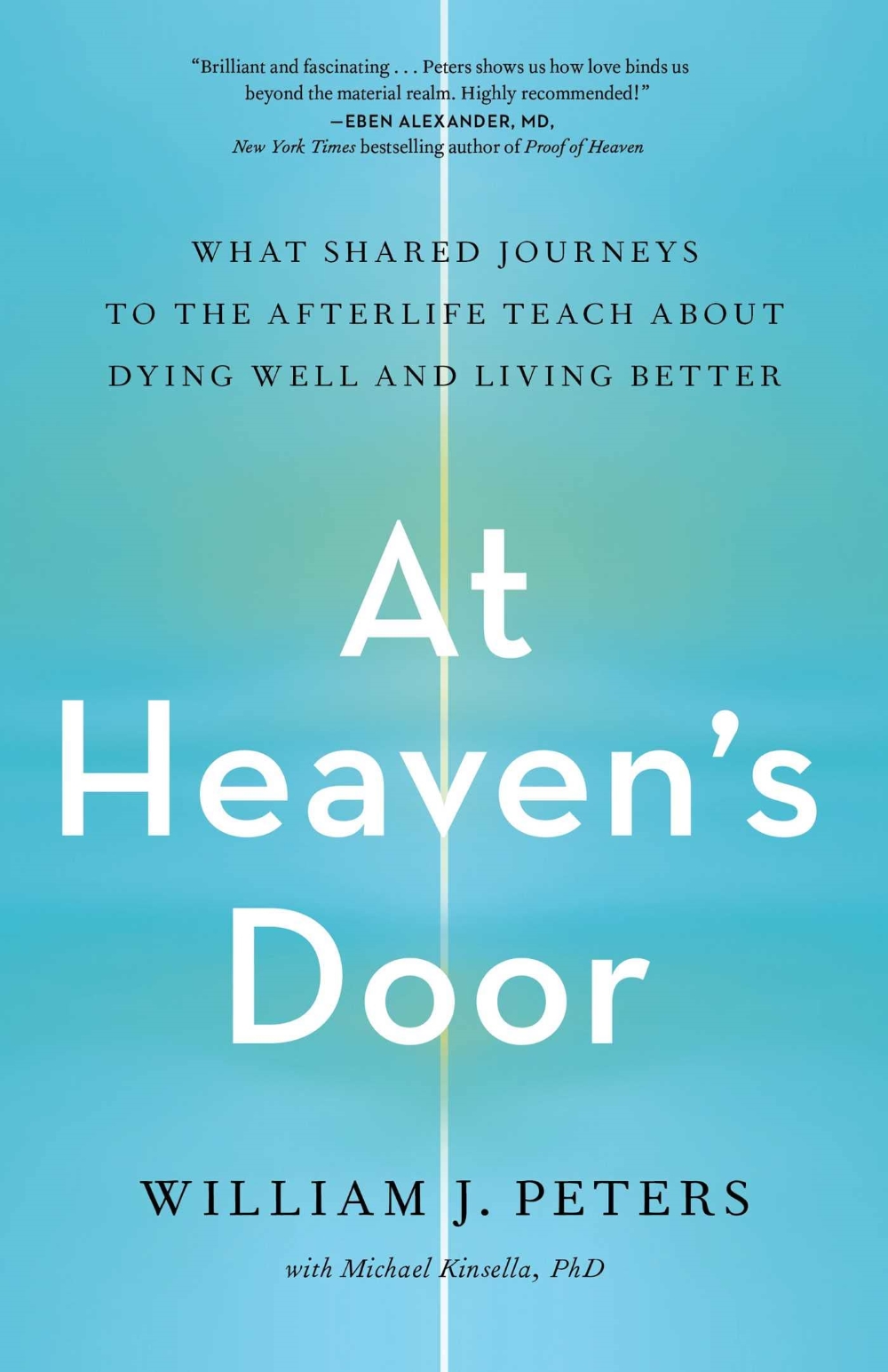
‘At Heaven’s Door’ is William J. Peters’ new book about shared death experiences and what they can teach us about dying well and living better. Photo: Amazon

William Peters is the founder of the Shared Crossing Project and director of its Research Initiative. Recognized as a global leader in the field of shared death studies, he has spent decades studying end-of-life experiences. Previously, Peters worked as a hospice volunteer with the Zen Hospice Project in San Francisco and as a teacher and social worker in Central and South America. A practicing grief and bereavement therapist, he holds degrees from Harvard’s Graduate School of Education and UC Berkeley. His work on end-of-life is informed by his therapeutic work with individuals and families, personal experiences with death and dying across cultures, and his family’s own end-of-life journeys. His new book “At Heaven’s Door: What Shared Journeys to the Afterlife Teach About Dying Well and Living Better” is a groundbreaking, authoritative exploration—rich with powerful personal stories and convincing research—of the many ways the living can and do accompany the dying on their journey into the afterlife. (Amazon, 2022)

“At Heaven’s Door” – In 2000, end-of-life therapist William Peters was volunteering at the Zen Hospice Project in San Francisco when he had an extraordinary experience as he was reading aloud to a patient: he suddenly felt himself floating in midair, completely out of his body. The patient, who was also aloft, looked at him and smiled. The next moment, Peters felt himself return to his body but the patient never regained consciousness and died. Shocked by what had just happened to him, Peters began searching for other people who had similar experiences. The author defines shared death experiences (SDEs) as events when “a person dies and a loved one, family member, friend, caregiver, or bystander reports that they have shared in the transition from life to death or have experienced the initial stages of entering an afterlife with the dying.” He would spend the next twenty years collecting stories and studying the key patterns and features that they all had in common. These similarities included awe-inspiring visual and sensory effects and powerful emotional after-effects. In “At Heaven’s Door,” he shares what he has learned about SDEs. Long whispered about in the hospice and medical communities, he openly explains and discusses these extraordinary moments of final passage. The book is filled with powerful tales of spouses on departing this earth after decades together and bereaved parents who share their children’s entry into the afterlife. It is divided into thirteen chapters including Comfort, Unexpected Gifts, and Ending the Silence Around the Shared Death Experience.

Death is a universal human experience but few people are willing to discuss it. Through rigorous research, Peters examines shared death experiences and their effects on people who have experienced them. Most of the time, they find relief witnessing a loved one finding joy or even feel a sense of reconciliation if the relationship was strained. Highlights include Chapter 12: Ending the Silence Around the Shared Death Experience where he emphasizes that as a culture, we should strive to minimize the stigma surrounding SDEs and that death is the ultimate taboo conversation topic; and Appendix I: The Shared Crossing Research Initiative where he breaks down his finding about SDEs, including Assisting the Dying in Transitioning and Remotely Sensing a Death. The language is easy to understand but some of the stories can be emotional and too much for readers uncomfortable with the subject of death, sickness, and dying. What can shared death experiences teach us? What do these experiences tell us about what lies beyond? And, how can they help take away the sting of death and better prepare us for our own final moments? These questions and more are presented in a compassionate and understanding perspective from someone who has experienced an SDE and knows people who have as well. Whether or not you believe in heaven or even an afterlife, the stories, some of which can be extremely emotional, make the transitioning process between life and death seem less traumatic. “At Heaven’s Door” is a well researched and documented account of shared life experiences and what they can teach us about the dying process. It is recommended for readers interested in grief, bereavement, and shared death experiences or at least open to a different perspective surrounding death and dying.

“Death produces in many of us a great reservoir of emotion, and, for many, a profound sadness. So it has been both profoundly humbling and deeply revelatory to discover that shared life experiences can lead to significant and often lasting comfort.”

*The author received a copy of this book for an honest review. The views and opinions expressed here belong solely to her.

Rating: 4 out of 5.

Book review: ‘Heart Medicine’ by Radhule Weininger

‘Heart Medicine: How to Stop Painful Patterns and Find Peace and Freedom – at Last’ by Radhule Weininger, MD, PhD. Photo: Amazon

Radhule Weininger, MD, PhD is a clinical psychologist, psychotherapist, and meditation teacher. She leads weekly and monthly meditation groups in Santa Barbara and leads retreats in the United States and internationally. She is the author of “Heartwork: The Path of Self-Compassion.” In her new book “Heart Medicine: How to Stop Painful Patterns and Find Peace and Freedom – at Last” she helps readers find freedom from life’s painful recurring patterns in 12 simple steps, with guided practices of self-compassion, mindfulness, and embodiment. (Amazon, 2022)

“Heart Medicine” – Do you ever feel trapped by experiencing challenging feelings over and over again–sometimes without realizing it? Or do you find yourself thinking “Why is this happening to me again?” or “Why do I always feel this way?” You are not alone. With “Heart Medicine,” you can learn to identify your emotional and behavioral patterns through the lens of loving awareness–without self-judgment or blame, learning to hold yourself as you would a dear friend, with space and grace. Radhule Weininger has decades of experience as a therapist and meditation teacher and uses it to help readers understand the trauma behind their patterns and offers twelve simple steps to work toward healing. Each chapter includes short practices so readers can begin to put the book’s concepts to work for transformation in their own lives. In the Introduction, the author defines what LRPPs are, Long-standing Recurrent, Painful Patterns of hurt and that this book is about identifying and healing our LRPPs. The book is divided into two parts: Part One: Meet Your Long-Standing, Recurrent, Painful Patterns (LRPPs), where she defines LRPPs and explains why we obsess and repeat and Part Two: Twelve Steps toward Healing and contains chapters such as Being Mindful of Body, Thoughts, and Feelings and Forgiveness. All together, it contains her personal story, case studies, and suggested practices, like mindfulness and breathing exercises as well as journaling, geared towards reducing these painful patterns.

The need for better mental health care has never been more important and there are so many books out there that can help. “Heart Medicine” by Radhule Weininger is one of them. Given that the author herself has gone through her share of rough times and picked up some coping mechanism along the way, it gives the book an authentic voice. She shares her personal struggles, as well as those of others she has helped, in the hope that readers will benefit from them. Her tone is heartfelt and comforting yet professional but never condescending. Highlights, both in Part Two, include Step 1 – Recognizing Your LRPP – because in order to begin healing, “we must first be able to identify when our LRPP is manifesting and the particular characteristics signifying its presence” which include twelve types of indicators, two of which are narrowing awareness and depleted life energy; and Step 12 – Service: Sharing Our Healing Sets Us Free because by sharing, we can restore some of the equilibrium in our bodies that has gone awry. Her combination of psychology and Buddhist principles give readers the tools they need to break through the patterns that can hold them back and in turn begin to live better lives. “Heart Medicine” is an exemplary guide book that can help identify and address emotional and behavior problems and is recommended for readers interested in self help, mental health, Buddhism, and philosophy.

“This book is intended as a medicine for the heart. I hope that we can all find healing and freedom within our distress that has so often kept us from living the lives we wanted to create for ourselves.”

*The author received a copy of this book for an honest review. The views and opinions expressed here belong solely to her.

Rating: 4 out of 5.

Book review: ‘Promotions Are SO Yesterday’ by Julie Winkle Giulioni

‘Promotions Are SO Yesterday’ is Julie Winkle Giulioni’s new book on redefining career development. Photo: Amazon

Julie Winkle Giulioni is a champion for workplace growth and development and helps leaders optimize talent and potential within their organizations with consulting, keynote speeches, and training. She is the co-author of the international bestseller “Help Them Grow or Watch Them Go: Career Conversations Organizations Need and Employees Want.” She is a regular columnist for Training Industry magazine and SmartBrief and contributes articles on leadership, career development, and workplace trends to publications including The Economist. Julie’s in-person and virtual keynotes and presentations offer fresh, inspiring, yet actionable strategies for leaders who are interested in their own growth as well as supporting the growth of others. In her new book, “Promotions are SO Yesterday: Redefine Career Development. Help Employees Thrive,” Julie Winkle Giulioni offers readers a new approach for developing their employees’ careers and helping them thrive in a company when promotions are not readily available. (Amazon, 2022)

“Promotions Are SO Yesterday” – The time-honored tradition of defining career development exclusively in terms of promotions, moves, and title changes may be dead, but there are many other ways that employees can, and want to, grow. Many organizations still operate under the idea that promotions are the only option for career development, leaving employees disengaged, managers frustrated, and the business disadvantaged in its efforts to retain talent. The good news is that career development is so much more than promotions alone, and managers are in a powerful position to redefine career development and create positive results for their employees and their organizations in this area. In the Introduction, the author states that the goal of the book is to offer answers that will enable managers to deliver greater employee engagement, satisfaction, and results. It is divided into nine chapters: Chapter 1: Promotions Are Overrated, Chapter 2: Contribution, Chapter 3: Competence, Chapter 4: Connection, Chapter 5: Confidence, Chapter 6: Challenge, Chapter 7: Contentment, Chapter 8: Choice, and Chapter 9: Possibilities Are the New Promotion. Chapters 2 through 8 examine the different frameworks that make up career development and how to use each to help employees grow. Each chapter contains tools, exercises and pro tips and ends with ‘The Final Word’ to summarize topic discussed. There are additional resources for employers to learn more, dig deeper, and get employees engaged in career development.

Career development is and always will be a major component of businesses and organizations. How employers tackle this issue is always changing, especially in a post-COVID environment, where priorities have shifted. “Promotions Are SO Yesterday” contains practical advice, questions to spark reflection and productive dialogue, and tools that managers can use to help employees thrive at work while supporting their organization. Highlights include Chapter 2: Contributions, Make Extracurriculars Go the Extra Mile – which suggests that managers should encourage employees to get involved outside of work as a volunteer in a charity, a non profit, or at a child’s school. This will not only help them give back to the community, but they will bring back to the workplace some valuable lessons and skills. Transferrable skills benefit the organization as a whole. As well as Chapter 4: Connection – it emphasizes the importance of connecting with others at work because this represents “a significant source of professional growth and career development.” Much of what we learn we pick up from others whether it is through coaching apprenticeships, mentoring, or role models. Despite the business subject matter, it is far from dull and long winded. The language is easy to understand and this makes it accessible to anyone. Even though this book is geared towards managers, employees can also benefit from the tools, guidelines, and exercises. “Promotions Are SO Yesterday” is an excellent business guide for management and employees and is recommended for readers who appreciate books on business mentoring, human resources, and business management.

“Helping others enhance their competence may simultaneously be your most selfish and selfless act as a manager. It’s selfless because you’re enabling the development of portable skills that make your employees more marketable. And it’s selfish because of the profound benefits that you and your organization can reap in terms of job satisfaction, engagement, performance, and results.”

*The author received a copy of this book for an honest review. The views and opinions expressed here belong solely to her.

Rating: 4 out of 5.

Book review: ‘Still On Fire: A Memoir’ by Renee Linnell

‘Still On Fire: A Memoir’ is Renee Linnell’s new book. Courtesy photo, used with permission.

Renee Linnell is a serial entrepreneur who has founded or cofounded five companies and has an MBA from New York University. Having an unorthodox childhood and being surrounded by death at a young age led her on a spiritual quest that took her all over the world, culminating in her ordination as a Buddhist monk. What began as writing for catharsis in 2013—as she struggled to regain her sanity after being brainwashed in a Buddhist cult—turned into her first memoir, “The Burn Zone: A Memoir.” “Still on Fire: A Memoir” is the sequel and a reminder of what happens when we do not listen to our inner voice. Her mission is to remind people Who They Truly Are and to reignite their passion for being alive.

“Still on Fire” – Magic, miracles, travel, and romance–this is where Renee leads you in her long-awaited sequel to “The Burn Zone.” From love affairs with men half her age to being rescued by angels, to getting stranded at 22,000 feet in the Himalayas and being electrocuted in the Maldives, Renee takes you on a wild page-turning adventure, sharing with you soul-soothing wisdom she gained along the way. In the Preface, Renee implores us to unfold their wings and begin a journey of self discovery. Only when we experience authenticity can we begin to realize how we fit into the overall tapestry of life. The book is divided into five parts: Part 1: Decision, Part 2: Wild Ride, Part 3: Spirit, Part 4: Love, and Part 5: Whole. The stories are as varied as her relationships with men, the different adventures she has had around the world, and her traumatic upbringing. In the Epilogue, the author reminds us of the importance of waking up and walking our own authentic path. That we do not have to be like everyone else and if following the masses does not make sense to us, “then it it time to disrupt these paradigms.”

Not everyone gets to travel the world to exotic destinations and have crazy adventures, but Renee Linnell has. She has also experienced the type of trauma and grief that most people have not. Through it all, she has kept her optimism and finds the positive in every situation. Sometimes her stories are relatable, sometimes they are not, but they remind us that life is an adventure worth living and that anything is possible. The chapters are short and to the point and since she uses simple, down to earth language, they are so easy to get through. Highlights include Chapter 22 – Me Being Me, where she is unapologetic for being who she is “Some people will not like me. In fact, some people may hate me…The same way some people curse the sun when it shines too brightly” and Chapter 31 – Giving Away Our Power where she reiterates that every time we care about what someone else thinks of us, we hand that person our power. Overall, “Still On Fire” is an entertaining and worthy read. Some of her stories are funny, some are shocking, but in the end, they are inspiring and remind readers to listen to their inner voice, their Inner Guidance, and live the life they are truly meant to, with no regrets. Most importantly, that life is not perfect and if you fail, you can always, and should, try again. It is recommended for fans of memoirs and self-help books and for readers who appreciate tidbits of wisdom and inspirational stories.

“Now I realize it is up to me to create a life I love. To be me regardless of whom I am dating. To have my own boundaries. To constantly check in with myself and ask, ‘Do I really want this? Is this okay?’”

*The author received a copy of this book for an honest review. The views and opinions expressed here belong solely to her.

Excerpt available.

Rating: 4 out of 5.

Book review: ‘Roar Like a Goddess’ by Acharya Shunya 

‘Roar Like a Goddess’ by Acharya Shunya. Photo: Amazon

Acharya Shunya is a truth teller who facilitates authenticity, self-remembrance, and Divine Feminine pathways to awakening within. The first female head of her 2,000-year-old Indian spiritual lineage, Shunya reinterprets and recontextualizes ancient teachings for modern times, empowering people everywhere to lead fulfilled, fearless, and enlightened lives. She is president of The Awakened Self Foundation in California and author of “Ayurveda Lifestyle Wisdom” and “Sovereign Self.” Her new book “Roar Like a Goddess: Every Woman’s Guide to Becoming Unapologetically Powerful, Prosperous, and Peaceful” is a rallying cry for women everywhere to break free from the shackles of patriarchy and awaken their true nature, brought to life through India’s primary goddess archetypes. (Amazon, 2022)

“Roar Like a Goddess” – In the Prologue, Acharya Shunya starts by defining patriarchy as “a system of beliefs that put men first [and] promotes a society dominated by men: sexually, emotionally, economically, religiously, and of course politically.” It is this type of environment that makes it hard for women to trust their true voice, which she compares to a ‘roar. After centuries of living in patriarchal societies, many women do not realize how powerful they are―or how much they have been enculturated to keep their true nature hidden.’ In this book, she offers an in-depth exploration of the Hindu goddess archetypes to help readers break free of patriarchal conditioning and let go of internalized misogyny. She also focuses on legendary humans, beasts, demons, gods, and the goddess herself in the hopes of transforming lives by giving spiritual insights and psychological tools to help readers “roar with your true voice.” The book is divided into three parts, the three chief goddess manifestations of the Supreme Hindu/Vedic Goddess Shakti: Part I Durga (goddess of power and self-determination), Part II Kakshmi (goddess of abundance and inner contentment), and Part III Saraswati (goddess of wisdom, peace, and self-actualization. Each chapter ends with contemplations/affirmations to summarize the topics discussed.

Life is not always kind to women and sometimes it can be frustrating feeling like you do not have a voice. In her inspiring new book “Roar Like a Goddess,” trailblazing Vedic spiritual teacher Acharya Shunya empowers women everywhere to step into their divine immensity and lead powerful, abundant, and wise lives through her revolutionary revisioning of ancient India’s primary goddess archetypes: Goddess Durga, Goddess Lakshmi, and Goddess Saraswati. At first this might seem like a complicated subject matter, but she expertly explains the background for each archetype and how they relate to modern life. The language is easy to understand and pragmatic, without being condescending to readers who may not be familiar with Hindu beliefs. Some of the highlights include Chapter 2 When Raging Is a Goddess Thing To Do: under Roaring Durgas Existed in Every Culture, where the author lists a sampling of stories of warrior women across history and around the world including warrior women of Mongolia, The Mino, who were an all-female military regiment of the present-day Republic of Benin, and Queen Nzinga Mbande, a powerful seventeenth-century ruler of the Ambundu kingdoms in modern day Angola and Chapter 11: Lakshmi Shows The Path To Generosity where the Vedas suggests five ways to act generously and put the dharma of accommodation and kindness into action, including acting conscientiously towards Mother Nature, acting big heartedly towards the less privileged, and acting gratefully towards the teachers in your life. Overall, “Roar Like a Goddess” is an empowering guide to awakening the many faces of the goddess within that will inspire women to find their voice and stand tall. It is recommended for readers searching for spiritual and emotional guidance and who appreciate books about spiritualism and women’s studies.

“One of the central dharma values is nonviolence, or ahimsa. Ahimsa can be, in a simple way, translated as ‘harmlessness’ – to not wish or do harm to any living creature.”

*The author received a copy of this book for an honest review. The views and opinions expressed here belong solely to her.

Rating: 4 out of 5.

Review: Proxima Bound by Davi Mai

Proxima Bound is an exciting futuristic outer space adventure that puts humans as the prey. Photo: Amazon

Davi Mai is a short story writer focusing on fantasy, science fiction, and transgressive fiction. Proxima Bound is Davi Mai’s latest novella. (Davi Mai, 2022)

Proxima Bound –  Humanity’s last hope rests with the colonists aboard the generational starship Attenborough bound for Proxima Centauri, a thousand years away. Catastrophe strikes when a reactor meltdown cuts off those in the ship’s front from the rear. Two factions must now struggle to survive. With four hundred years still to travel, we join a plucky teenager, “Thief.” She has found a way through the ventilation system, around the radioactive core of the ship, and into the front sections. The story begins as Thief is crawling through the ventilation shaft to access engineering and bring back, or ‘steal’ anything that Johan, the tech wiz of the colonists, can use to keep their section of the ship going. Deep down inside, Johan knows that there must be an AI onboard that can help them get an edge over the colonists at the front of the ship. This time, Thief brings back vital components that might help the rear-dwellers connect to the ship’s computer. For the first time in hundreds of years, there is hope. The colonists not only have to worry about surviving their environment, they have to constantly watch their backs because people are disappearing without a trace. To make matters worse, a new virus is stressing an already overworked makeshift hospital. Now that there is hope of communicating with the AI, Thief needs to crawl through the bowels of the ship, the furthest she has ever been, to retrieve the necessary components and hopefully rescue one of their own who was recently taken.

One of the best things about short stories and novellas is that the story is direct and to the point without unnecessary build up and other distractions. Such is the case with Proxima Bound. Right from the start, readers are introduced to Thief and how important this character is to the colonists’ survival. She is young, and therefore small enough to crawl through small spaces, but old enough to understand the harsh reality of what they are facing and how important her work is. All the action takes place aboard the starship, which makes it that much more exciting. The story is well paced, the language is down to earth, and the characters are relatable due to the main theme being the universal human survival instinct. Despite it being such a short story, the author manages to get readers to care about what happens to these characters, which proves how prolific of a story teller she is. Comic relief comes, ironically, via one of the antagonists, and the humor is sometimes a bit dark. An unnerving moment occurs when the AI, once online again, admits that she was programmed to make sure there are enough survivors to populate the new colony and luckily in this case it was the humans. Since there are still many years left in the voyage, hopefully this will become a series. Proxima Bound is a fascinating and suspenseful tale of human survival and is recommended for readers who enjoy science fiction and outer space adventures with a strong female character.

“Bianca swept through the corridors like a strong breeze. She told herself to slow down and adopt a more dignified poise, but found it hard to control her blood lust; to force down the urges welling up inside her— but prolonging the moment heightened the enjoyment when it came.”

*The author received a copy of this novella for an honest review. The views and opinions expressed here belong solely to her.

Rating: 4 out of 5.

Sponsored Post

Book review: ‘Unfear’ by Gaurav Bhatnagar and Mark Minukas

‘Unfear: Transform Your Organization to Create Breakthrough Performance and Employee Well-Being’ by Gaurav Bhatnagar and Mark Minukas of Co-Creation Partners. Photo: Sandra Cruz

Gaurav Bhatnagar is the founder of Co-Creation Partners and has dedicated more than two decades to helping companies thrive and achieve breakthrough performance. Since founding Co-Creation Partners in 2010, he has designed and led programs and workshops for private, public, and social-sector clients across multiple industries, including financial services, basic materials, manufacturing, healthcare, and technology. Mark Minukas has worked across multiple industries, including financial services, high tech, biotech manufacturing, IT services, and governmental offices to deliver both top-and bottom-line improvements and build high-performing operations. As co-authors of “Unfear: Transform Your Organization to Create Breakthrough Performance and Employee Well-Being,” these top experts on high-performing organizations show you how to reframe your, and your employees,’ relationship with fear and anxiety to create a learning culture of engaged workers at the top of their game. (Amazon, 2022)

“Unfear” – Fear and uncertainty have been undermining performance and well-being in the workplace for as long as we have had workplaces. Mismanaged fear is responsible for almost all of the dysfunction that most organizations experience. While fear can drive short-term results, it does so at the cost of high employee burnout and turnover. It also undermines long-term business performance. We can not eradicate it entirely; it is inherent to the human condition. Winning organizations are not fear-free; they know how to reframe fear into opportunities for learning and growth. They create resilient cultures of unfear. This book is divided into two parts: Part I: Fear with chapters such as Biology of Fear and Unfear and Eight Fear Archetypes in the Workplace and Part II: Unfear and includes chapters on Unfear Transformation and The Unfear Organization. In the Introduction, the authors explain how it is divided: the first part explores fear including its impact and the different ways in which it is expressed in an organization and the second part explores unfear and how to bring about an unfear transformation. This timely and essential guide shows leaders the impact of fear, the strategies and actions needed to bring about an unfear organization, and so much more.

Fear is a natural part of life and therefore impossible to avoid. Instead of hiding from it, we should learn to not only live with it, but learn how to use it to our advantage in every day life, including in the business world. In their book ‘Unfear,’ the authors define the different types of fear and offer advice on how to ‘unfear’ – to shift our relationship with fear and use it as a tool to learn and grow. It is an extremely useful and easy to read business guide that uses down to earth language that does not include too much business jargon. Highlights include Chapter 2: Biology of Fear and Unfear that explains the biology of fear and its importance “In order to live as an unfear individual, you need to understand the evolutionary function of fear and how it can cause dysfunction in the modern world,” Chapter 3: Eight Fear Archetypes in the Workplace, and Chapter 7: The Unfear Organization which emphasizes the need to control fear mindset in the workplace “Instead of cohesion and focus, it [fear] leads to second-guessing, indifference, and wasteful internal politics.” This proven approach to workplace anxiety reduces stress, boosts engagement, and overcomes obstacles that get in the way of success. In the long run, it leads to personal rewards, greater profits, and sustainable growth which is only possible with a culture of unfear. ‘Unfear’ is an excellent guide for recognizing and overcoming fear not only in our personal lives but in the workplace. It is recommended for readers who appreciate self help and enrichment books as well as books on workplace culture, business, and human resources.

“Look forward rather than backward. Don’t dwell too much on why something went wrong. Instead, recognize the value in reflection and diagnostics, but keep most of your focus on solutions and the future.”

*The author received a copy of this book for an honest review. The views and opinions expressed here belong solely to her.

Rating: 4 out of 5.

Book review: ‘Assassin’s Lullaby’ by Mark Rubinstein

‘Assassin’s Lullaby’ by Mark Rubinstein in an interesting examination of the human condition as it pertains to an assassin. Photo: Amazon

Mark Rubinstein MD is a practicing psychiatrist in New York City and an author. Before turning to fiction, Rubinstein coauthored five medical self-help books: “The First Encounter: The Beginnings in Psychotherapy,” “The Complete Book of Cosmetic Facial Surgery,” “New Choices: the Latest Options in Treating Breast Cancer,” “Heartplan: A Complete Program for Total Fitness of Heart & Mind,” and “The Growing Years: A Guide to Your Child’s Emotional Development from Birth to Adolescence.” His first novel “Mad Dog House” was named a finalist for the 2012 ForeWord Book Of The Year Award for suspense/thriller novels. His latest novel “Assassin’s Lullaby” is about a former assassin turned contract killer.

“Assassin’s Lullaby” – in every life, there lurks catastrophe. So believes Eli Dagan, a thirty-nine-year-old man whose traumatic past led to his service as an assassin for the Mossad. He now lives in New York City, where under various assumed names he is a contract killer. The story begins as Eli is walking down the street, always on alert mode “Knowing his life depends on stealth, Eli Dagan moves warily with the tide of pedestrians streaming along East Forty-Second Street.” He is on his way to a meeting with Anton Gorlov, the head of the Brooklyn-based Odessa mafia, who has a new and challenging assignment for him. Gorlov wants to leave the country permanently, so all loose ends must be eliminated. He is willing to pay $1 million for a task that is divided into two parts. The job involves extreme measures along with unprecedented danger for Eli, who has lived a ghostly existence over the last ten years. Eli knows this assignment has its dangers, but deep inside he wonders if it is a way to make up for the past. For the first time since his pregnant wife and parents were killed by a suicide bomber years earlier, he is facing challenges that will reconnect him with his damaged past and may yet offer hope for a new and better life. Questioning the meaning of his life, he wants out but this is the only life he has known and for a brief moment, he gets a glimpse of a better life. His story ends on a hopeful note and even though he is still not sure of what the future holds for him, he remains optimistic.

Sometimes assassins are viewed as inhuman and incapable of feeling any emotions, but Mark Rubinstein makes Eli Dagan seem almost human with fears and insecurities, just like everyone else. The character development is excellent and it gives Eli’s background on what drove him to chose the life he did; he started killing only evil people as revenge for what happened to his family years ago but now he just kills for profit and power. He wants to leave the country, to start over somewhere else but the pull of what he has become is too hard to resist. The language is at times poetic and beautiful, “The bare sycamore branches sway in the wind and cast dancing shadows on the street” and a sharp contrast to the subject matter. Highlights include Chapter 41 because of the detailed description of the fight scenes and Chapter 74 when Eli ponders his last victim’s final words “Death waits for us all, and I have no fear of it” and resigns himself to receive whatever life brings him. The chapters are short and to the point, which helps the pacing of the story. Some of the details of Eli’s hits might be too graphic for some readers but they convey a CSI-like narrative. With themes of nature vs. nurture and good vs. evil, “Assassin’s Lullaby” is a fascinating novel and hard to put down because it gives readers a rare view inside the mind of an assassin for hire including his internal conflicts and fears: “Is killing evil people no more than an anemic attempt to try forgiving himself for the life he’s led because he can never be absolved from his crimes, his sins that are too many to count?” It is recommended for readers who enjoy suspense thrillers that revolve around an anti hero and in this case even though Eli is an assassin, readers can sympathize with his plight and in the end might even root for him to get his life together.

“Because it seems there’s no coming back from what he’s become and there’s no way to renounce a life brimming with bitterness, with grief, and with rage so monstrous it consumes his every waking moment.”

*The author received a copy of this book for an honest review. The views and opinions expressed here belong solely to her.

Rating: 5 out of 5.

Book review: ‘Down to the River’ by Anne Whitney Pierce

‘Down to the River’ is a family saga set in the late 1960s in Cambridge, Massachusetts against the backdrop of the Vietnam War. Photo: amazon

Anne Whitney Pierce is a life-long Cantabrigian and the author of two books, “Galaxy Girls: Wonder Women” (1993) and “Rain Line.” (2000) She has taught in the graduate writing program at Emerson College in Boston. Her short fiction has appeared in the Virginia Quarterly Review, The Chattahoochee Review, The Boston Globe Magazine, Kansas Quarterly, Crosscurrents, The Southern Review, among others. Her work has been included in the O’Henry Prize Story Collection and has won several awards, including the Nelson Algren Award, the Willa Cather Fiction Prize, the Paterson Fiction Prize, New Voices Award and a Barnes & Noble Discover Great New Writers Award. Her new book “Down to the River” is a family saga set in the late 1960s in Cambridge, Massachusetts against the backdrop of the Vietnam War. (amazon, 2022)

“Down to the River” – The story starts with a Prologue where Chickie and Hen’s story begins. Chickie is Minerva’s nickname and Hen is short for Henry. They are first cousins born in 1951 and their fathers are identical twins named Naylor Potts (Nash) and Remington Potts (Remi). The twin brothers grow up as entitled, Harvard-educated, golden boys, heirs to an old, but dwindling family fortune. With the passage of time, family money begins to disappear and their lives begin to fall apart. The first chapter begins in 1966 with Nash and Remi in their mid-forties and partners in a sporting goods store in Harvard Square. The twins’ marriages are in trouble. Their youngest children, Chickie and Hen, are coming of age during the turbulent urban wilderness of the late 1960s— school bomb threats, racial tensions, war protests and demonstrations at Harvard and beyond. With all hell breaking loose at home, and any semblance of “parenting” hanging ragged in the wind, Chickie and Hen are left mostly on their own. Suddenly freed from old rules and restrictions, they head out onto the streets of Cambridge, which become their concrete playground, tumbling headlong into a world of politics, sex, drugs, rock and roll.

What was it like to come from a privileged family in the Boston area during the turbulent sixties and seventies? Anne Whitney Pierce gives readers the saga of the Potts family who seem to have it all but deep down, they face the same internal struggles and dark family secrets as everyone else. The family is born with money but eventually that goes away and their troubles grow against the background of a country that is besieged by riots, war, and general uncertainty. From the children who are facing college life and a possible Vietnam draft to the parents whose marriages are in trouble, nothing is as it seems from the outside looking in. The author describes the lives of the characters through the years so the character development is deep and complex. Language wise, it is an easy read but it is tough to get through some of the grimmer parts. This just goes to prove that life is not always smooth sailing and how we get through the tough times determines and shapes our character. Readers familiar with the area, specifically Cambridge, will no doubt feel a tough of nostalgia, especially if they grew up in the Vietnam era. Anne Whitney Pierce does an excellent job of bringing one family’s history to light and her writing style makes for an interesting novel. “Down to the River” may make some readers uncomfortable but it is a portrait of one family’s experiences during a troublesome era that just might mirror society’s present-day struggles. It is recommended for readers who appreciate family life fiction mixed in with historical fiction.

“Raised to be God-fearing, if not religious, both Violet and Faye came to think of all this – their lives as silent, fettered wives and mothers – as the tradeoff for marrying well.”

*The author received a copy of this book for an honest review. The views and opinions expressed here belong solely to her.

Rating: 3 out of 5.

Book review: ‘Dry Heat: A Novel’ by Len Joy

‘Dry Heat: A Novel’ is Len Joy’s latest novel. Courtesy photo, used with permission.

Len Joy is the author of four books that have have received shining reviews and several awards. His first novel, “American Past Time,” published in 2014 took 1st Prize in the Top Shelf Book Awards in 2019, his second novel, “Better Days” was a finalist in the Indie Excellence Book Awards in 2019, and “Everyone Dies Famous,” published in 2020 won 1st Prize in the 2020 Top Shelf Book Awards. His new book “Dry Heat” is about an All-American young man, Joey Blade, whose life begins to unravel when he learns that his ex-girlfriend is pregnant, is betrayed by his new girlfriend, and is arrested for the attempted murder of two police officers.

“Dry Heat” –  The story is set in Phoenix, Arizona and begins in November 1999 as a teenage Joey Blade is at a park playing basketball with his friends. Shortly thereafter at the high school bonfire, his life takes a turn for the worse as he is at the wrong place at the wrong time. The bonfire explodes and Joey, his girlfriend Wendy and her drug dealing friend TJ flee in her truck. When the police pursue, TJ shoots at the cop’s car. It crashes and in the ensuing chaos TJ slips away undetected. Joey, the only adult in the truck, is arrested and charged with attempted murder and released on bail. TJ is nowhere to be found. In desperation, he reaches out to notorious gang leader, Chico Torres, whom he met in jail, for help locating TJ. When Joey is offered a deal–his freedom in exchange for his cooperation in nailing Chico–he faces a decision that will change the course of his life. The book is divided into two parts: Part I Joey and Part II Joseph and spans years in Joey Blade’s life, up to the year 2017 as an adult.

Some of the best novels plunge deep into the human condition by examining a character’s lifetime of experiences. Such is the case in “Dry Heat” as readers are witnesses to Joey Blade’s transformation from an idealistic teenager to a young man who, despite being falsely convicted of a crime, he is far from jaded. As with his previous novels, Len Joy excels at character development and by the end of the story, readers cannot help but be heavily invested in finding out what happens. Due to the dialogue driven action, it is an easy read and hard to put down. The characters are down to earth and relatable because anyone can easily become a victim of circumstances and have his or her life turned upside down from one minute to the next. “Dry Heat” by Len Joy has everything from family drama to courtroom action and is recommended for readers who enjoy both. It is a must read coming of age saga.

*The author received a copy of this book for an honest review. The views and opinions expressed here belong solely to her.

An excerpt is available.

Rating: 4 out of 5.