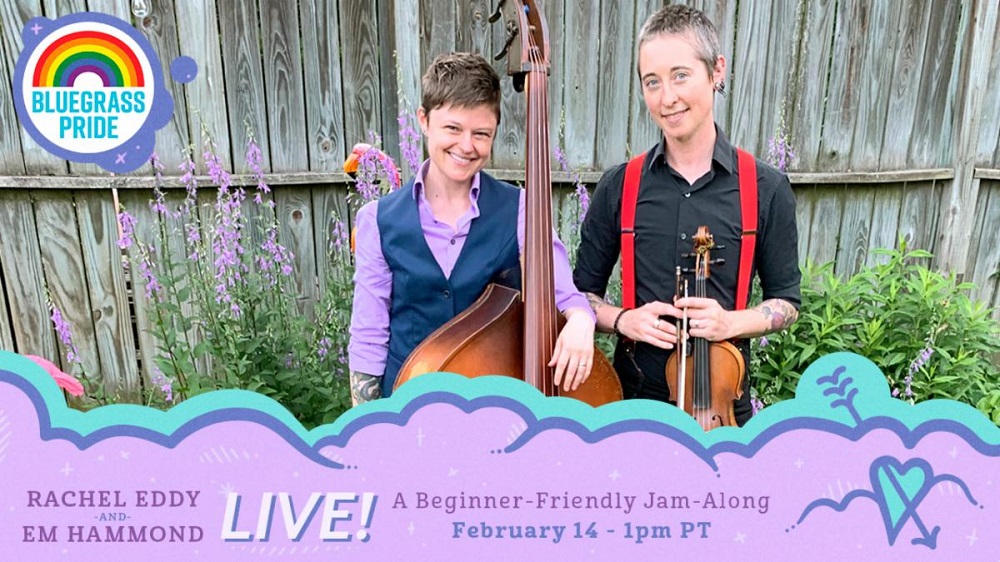
Bluegrass Pride invites public to join them for a special Valentine’s Day edition of their series. Photo: google
Bluegrass Pride, a 501(c)(3) dedicated to uplifting LGBTQ+ folks in American roots music, invites the public to join them for a special Valentine’s Day edition of their monthly livestream series, Live With Bluegrass Pride. On Sunday, February 14, 2021 at 1p.m. PST / 4p.m. EST old-time musicians, multi-instrumentalists, and educators Rachel Eddy & Em Hammond will lead Bluegrass Pride members and fans in a beginner-friendly jam-along of queer-centered love songs to celebrate the occasion. Viewers will be able to watch via BGP’s Facebook page,YouTube channel, and website. (IVPR, 2021)
Live With Bluegrass Pride benefits each month’s featured artists as well as supporting the ongoing work of Bluegrass Pride. The virtual event is free to attend, but there is a suggested $25 donation.
Launched in the fall of 2020 after the smashing success of Bluegrass Pride’s flagship virtual event, Porch Pride, Live with Bluegrass Pride is a periodic livestream series celebrating LGBTQ+ folks and their allies in bluegrass, old-time, country, and beyond. Most months, viewers enjoy songs and casual conversation from the Bluegrass Pride family of artists and bands, but on occasion, they like to include the public. So, on February 14, BGP and featured musicians Rachel Eddy (they/them) & Em Hammond (they/them) will also display lyrics, chords, and simple instructions so that anyone can play along and enjoy a beginner, slow-jam flow. As a holiday celebrating traditional and consumerist ideas of love and romance, BGP realizes that Valentine’s Day can leave queer folks feeling erased, left out, and isolated. As such, BGP has purposefully created this space for queer folks and roots music fans from across the country and around the world to join the music, fellowship, and celebration of queer, non-binary, non-heteronormative love.
Rachel Eddy is a native of West Virginia who grew up in a musical family steeped in the traditions of Appalachian music and dance. Now based in Washington, D.C., they are known throughout the world as both a dynamic, emotionally powerful performer and an engaging, thoughtful teacher. Eddy’s soulful singing and multi-instrumental finesse—including fiddle, banjo, guitar, and mandolin—may be heard on numerous solo and collaborative recordings as well as at dances and jam sessions, where they are dedicated to fostering community and sharing a love of music with others. Eddy will be joined by special guest, their partner, multi-instrumentalist Em Hammond.
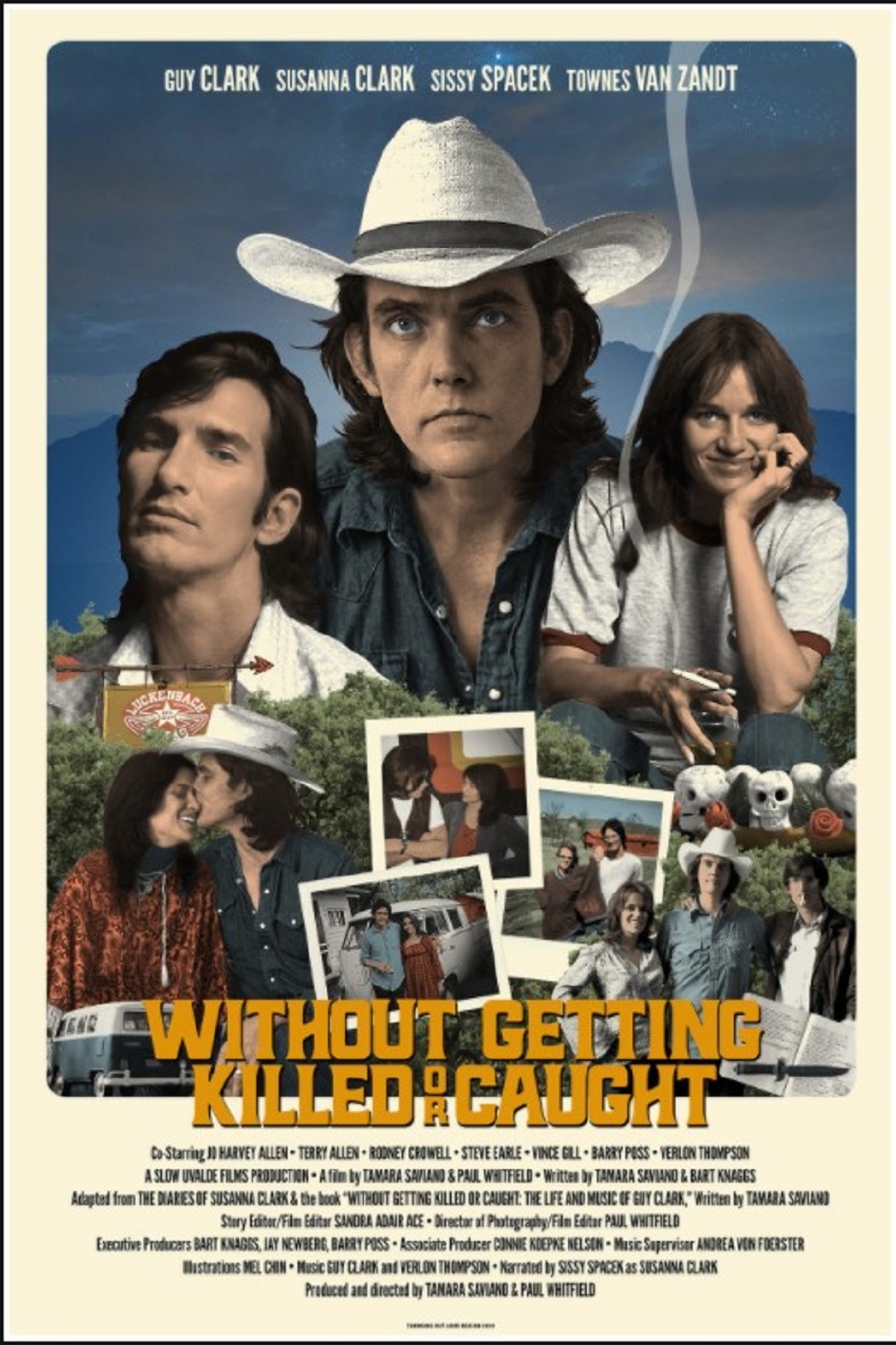
Without Getting Killed or Caught will premiere at 2021 SXSW Film Festival. Photo: google
Without Getting Killed or Caught is a remarkable documentary film about the mythical, complicated relationship between legendary songwriters Guy Clark, Susanna Clark, and Townes Van Zandt, and the art it inspired; a film with enough charm to create new fans of Clark and his music and enough depth to appease long-time followers. Without Getting Killed or Caught—which will make its virtual World Premiere at the 2021 SXSW Film Festival March 16-20—was produced and directed by longtime Americana music producer and executive Tamara Saviano and filmmaker Paul Whitfield. The film was originally scheduled to debut at SXSW in 2020 before the pandemic shuttered the festival, and for those not already attending SXSW 2021, stay tuned for additional information on public screenings with Kessler Presents, YETI, SiriusXM Outlaw Country, and more. (IVPR, 2021)
Without Getting Killed or Caught is the true story of Guy Clark, the dean of Texas songwriters, who struggles to write poetic, yet indelible songs while balancing a complicated marriage with wife Susanna, and a deep friendship with singer-songwriter Townes Van Zandt, on whom Susanna forged a passionate dependence. Clark, who died in 2016, wrote and recorded unforgettable songs (“L.A. Freeway,” “Desperados Waiting for a Train”) for more than forty years. His lyrics and melodies paint portraits of the people, places, and experiences that shaped him, and no one inspired Guy more than his wife, painter, and songwriter Susanna Talley Clark, and their best friend, fellow songwriter Townes Van Zandt.
Narrated by Academy-Award winner Sissy Spacek, Without Getting Killed or Caught follows Guy, Susanna, and Townes on their journey from obscurity to reverence: Guy, the Pancho to Van Zandt’s Lefty, struggling to establish himself as the Dylan Thomas of American music, while Susanna writes hit songs and paints album covers for top artists and Townes spirals in self-destruction after writing some of Americana music’s most enduring and influential ballads. Based on the diaries of Susanna Clark—the film tells the saga from Susanna’s point of view—and Saviano’s 2016 book “Without Getting Killed or Caught: The Life and Music of Guy Clark,” which No Depression called “an intimate, affectionate, sometimes sad, often hilarious, and vibrant chronicle of one of our most memorable artists.”
The film uses Clark’s songs, family photographs and archives, vintage film footage, and radio talk shows on which Clark appeared solo and in tandem with Van Zandt. The real emotional impact, though, comes from Susanna’s pained remembrances, taken from her private journals and secret audio diaries, as well as taped conversations that Susanna made of the trio and of the “salon” that regularly gathered around them—all serving as witnesses to this seemingly fated intersection of love, art, and tragedy.
Taco Cabana’s specials this month make celebrating Galentine’s Day, Valentine’s Day, Mardi Gras, and National Margarita Day so much sweeter. Photo: Giant Noise for Taco Cabana, used with permission.
In celebration of Galentine’s and Valentine’s Day, Mardi Gras and National Margarita Day, Taco Cabana is expanding its margarita offerings with new limited-time flavors. (Taco Cabana, 2021)
Starting on Friday February 12, 2021, enjoy Taco Cabana’s “Love Potion” margarita, made with pomegranate and lavender; available through Monday, February 15, 2021 for $2. Sweeten the deal with the purchase of the “Be Mine” bundle for $19.99, featuring two “Love Potion” margaritas (or any flavor), 12 chicken flautas, an order of small chips, three quesos, and 5 pecan sandies cookies.
Getting into the Mardi Gras spirit? From February 14-18, 2021, stop by Taco Cabana to try the MardiGraRita for $3. The MardiGraRita is a colorful and flavorful blend of strawberry, blue curacao, mango, and lime. This is a great way to toast and celebrate Mardi Gras.
Celebrate National Margarita Day all weekend February 19-22, 2021 with limited-time Mango Jalapeño and Strawberry Mint margaritas for just $2. TC guests can also enjoy lime, strawberry, mango, strawberry mango and mangonada margaritas for $2, or go all-in with the purchase of a lime, strawberry or mango margarita gallon for $29.99. Guests can add chamoy to any margarita for no extra charge.
Hungry too? Enjoy a soft taco (choose from Ground Beef, Shredded Chicken, Chicken Fajita or Bean & Cheese) + any choice of margarita flavor for $3.
New menu items will be available for in-store, drive-thru and online ordering in participating Texas locations in Austin, San Antonio, DFW, Houston and El Paso.
• Galentine’s & Valentine’s Day Specials: February 12-15, 2021
• Mardi Gras Specials: February 14-18, 2021
• National Margarita Day Weekend Specials: February 19-22, 2021
Taco Cabana, a subsidiary of Fiesta Restaurant Group, Inc. (NASDAQ: FRGI), was founded in 1978. The brand specializes in Tex-Mex-inspired food including enchiladas, fajitas, quesadillas, flautas, tacos, flour tortillas and a selection of made-from-scratch salsas and sauces. Restaurants feature open-display cooking, a selection of beer and tequila margaritas, patio dining, drive-thru windows, curbside pick-up, and delivery. As of Jan. 1, 2021, Taco Cabana operates 143 company-owned restaurants in Texas.
Fiesta Restaurant Group, Inc., owns, operates and franchises Pollo Tropical and Taco Cabana® restaurant brands. The brands specialize in the operation of fast casual/quick service restaurants that offer distinct and unique flavors with broad appeal at a compelling value. The brands feature fresh-made cooking, drive-thru service, and catering.
On a more personal note, I consider myself first and foremost a writer even though I came into the game in my later years but as most people, I kept journals while growing up. I also took art classes and joined my school’s choir for a couple of years and in college, I took art and music appreciation. Art has always been a big part of who I am. I have always known I have an artistic eye, whether drawing or writing. As far as writing is concerned, I have had some of my poetry published and I enjoy blogging to keep people connected and informed.
Now during this pandemic, when most people are spending more time at home, I found myself with more time on my hands. In July, my husband and I made the choice to relocate to my hometown in the Rio Grande Valley, Los Fresnos to be more specific. I left my job to do this big move and to have more time to do the necessary renovations to our new home. This was the perfect time to dive into painting and put into canvas the many images I have clogging up my head. I have done several already and submitted a couple to local art shows and now I want to share them here.
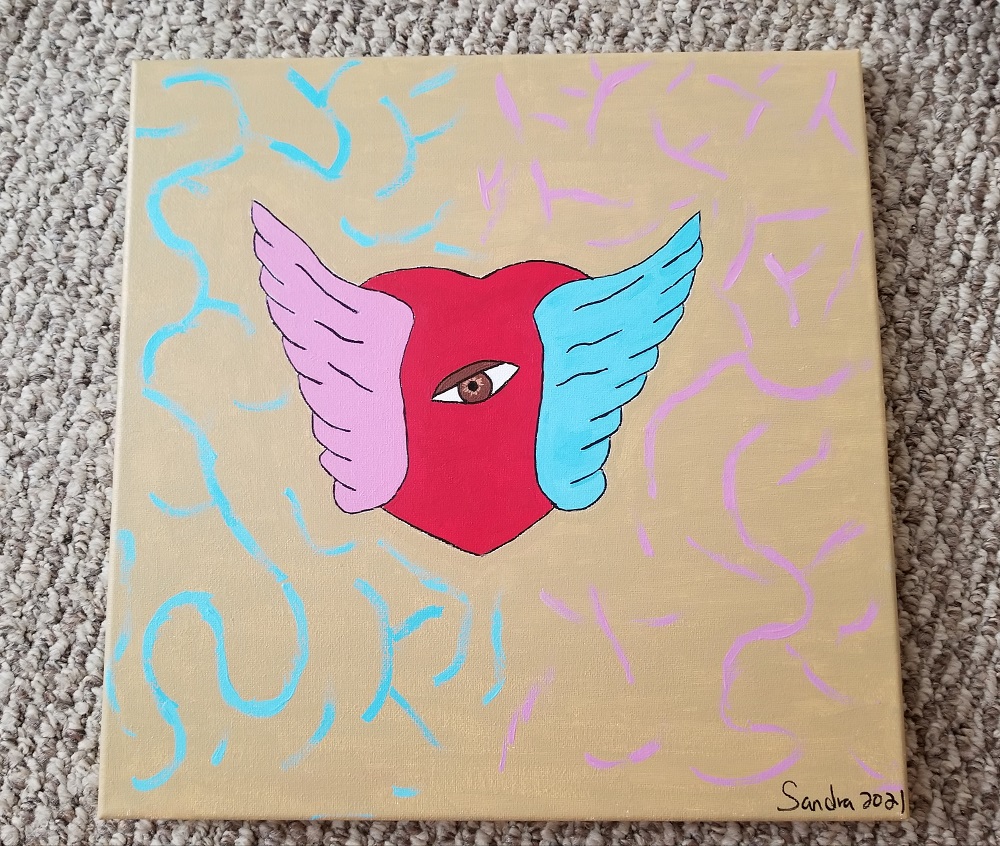
This most recent one does not have a title yet, but that is okay, not all of them must have a title to make an impact. I have always believed in the duality of life: good/bad, yin/yang, etc. This is my version of it; I already painted a self-portrait, so this is similar in a way. I have always had dreams where I am flying and for anyone who has never had one, they feel awesome. The feeling of flying and freedom that comes with it is exhilarating, so I am obsessed with wings. This is me, a brown-eyed woman with wings and a big heart. The wings are pink/blue to represent the male/female side of me and the squiggly lines around the whole thing, well, they represent the bloodlines in the heart.
Cody Garcia as Willy Wonka and company. Roald Dahl’s ‘Charlie and the Chocolate Factory.’ Photo: Jeremy Daniel, used with permission.
rth Park Lexus Broadway in San Antonio announces the return of touring Broadway to the Majestic Theatre this fall. The season relaunches with seven shows, as previously anticipated, including rescheduled engagements of ‘Disney’s The Lion King,’ ‘Mean Girls,’ and ‘Summer: The Donna Summer Musical,’ plus an eighth show addition of ‘Hamilton’ for its two-week return. ‘Rent’ and ‘Beautiful – The Carole King Musical’ rejoin the lineup as season options. Unfortunately, Broadway in San Antonio was unable to reschedule ‘To Kill a Mockingbird’ or Season Option ‘Riverdance.’ ‘To Kill a Mockingbird’ will make its San Antonio premiere in a future season. Season tickets are on sale now. (North Park Lexus Broadway in San Antonio, 2021)
‘My Fair Lady’ – September 21-26, 2021 From Lincoln Center Theater that brought you ‘The King & I’ and ‘South Pacific,’ comes Lerner & Loewe’s ‘My Fair Lady.’ Director Bartlett Sher’s glowing production is “thrilling, glorious and better than it ever was” (The New York Times).
‘Disney’s The Lion King’ – October 21-November 7, 2021 San Antonio’s best-loved musical returns to the Majestic Theatre. Winner of six Tony Awards®, including Best Musical, this landmark musical event brings together one of the most imaginative creative teams on Broadway. Tony Award®-winning director Julie Taymor brings to life a story filled with hope and adventure set against an amazing backdrop of stunning visuals.
‘Charlie and the Chocolate Factory’ – December 7-12, 2021 Roald Dahl’s ‘Charlie and the Chocolate Factory’ amazing tale is now the Alamo city’s golden ticket. It is the perfect recipe for a delectable treat: songs from the original film, including “Pure Imagination,” “The Candy Man,” and “I’ve Got a Golden Ticket,” alongside a toe-tapping and ear-tickling new score from the songwriters of Hairspray
‘Hamilton’ – January 5-16, 2022 (Make it an 8-show package) ‘Hamilton’ is the story of America then, told by America now. Featuring a score that blends hip-hop, jazz, R&B and Broadway, ‘Hamilton’ has taken the story of American founding father Alexander Hamilton and created a revolutionary moment in theatre ─ a musical that has had a profound impact on culture, politics, and education. With book, music and lyrics by Lin-Manuel Miranda, direction by Thomas Kail, choreography by Andy Blankenbuehler, and musical supervision and orchestrations by Alex Lacamoire, ‘Hamilton’ is based on Ron Chernow’s acclaimed biography.
‘Tootsie’ – March 1-6, 2022 This laugh-out-loud love letter to the theater tells the story of Michael Dorsey, a talented but difficult actor who struggles to find work until one show-stopping act of desperation lands him the role of a lifetime. Featuring a hilarious Tony®-winning book by Robert Horn and an outrageously clever score by 2018 Tony-winner David Yazbek, this The New York Times Critic’s Pick is “a joyful delight.”
‘Summer: The Donna Summer Musical’ – April 19-24, 2022 She was a girl from Boston with a voice from heaven, who shot through the stars from gospel choir to dance floor diva. But what the world did not know was how Donna Summer risked it all to break through barriers, becoming the icon of an era and the inspiration for every music diva who followed. With a score featuring more than 20 of Summer’s classic hits including “Love to Love You Baby,” “Bad Girls” and “Hot Stuff,” this electric experience is a moving tribute to the voice of a generation.
‘Jesus Christ Superstar’ – July 5-10, 2022 ‘Jesus Christ Superstar’ is an iconic musical phenomenon with a world-wide fan base. In celebration of its 50th Anniversary, a mesmerizing new production comes to North America. Originally staged by London’s Regent’s Park Open Air Theatre and helmed by the acclaimed director Timothy Sheader and award-winning choreographer Drew McOnie, this production won the 2017 Olivier Award for Best Musical Revival garnering unprecedented reviews and accolades.
‘Mean Girls’ – August 9-14, 2022 The story of a naïve newbie who falls prey to a trio of lionized frenemies, ‘Mean Girls’ “delivers with immense energy, a wicked sense of humor and joyful inside-jokery.” Direct from Broadway, ‘Mean Girls’ is the hilarious hit musical from an award-winning creative team, including book writer Tina Fey, composer Jeff Richmond, lyricist Nell Benjamin, and director Casey Nicholaw.
‘Rent’ – March 18-20, 2022 (Season Option) For a quarter of a century, ‘Rent’ has inspired us to choose love over fear and to live without regret. This Tony Award and Pulitzer Prize-winning phenomenon has become more than a musical – it is a cultural touchstone and a source of joy and strength for millions. ‘Rent’s’ 25th Anniversary “Farewell Season of Love” is your FINAL CHANCE to experience this celebrated touring production.
‘Beautiful – The Carole King Musical’ – June 10-12, 2022 (Season Option) ‘Beautiful’ tells the Tony® and Grammy® Award-winning inspiring true story of King’s remarkable rise to stardom, from being part of a hit songwriting team with her husband Gerry Goffin, to her relationship with fellow writers and best friends Cynthia Weil and Barry Mann, to becoming one of the most successful solo acts in popular music history. Along the way, she made more than beautiful music, she wrote the soundtrack to a generation.
North Park Lexus Broadway in San Antonio season packages are now available starting at $335. Once you purchase a 7-show package, you will have priority access later this Spring to secure your same package seats for ‘Hamilton.’ For more information, patrons can visit BroadwayInSanAntonio.com or call Broadway in San Antonio at 800-215-7469, from 9a.m. to 5p.m., Monday through Friday.
The well-being of theatre patrons, performers, touring, and local teams is top priority. Prior to each performance, Broadway in San Antonio and the Majestic Theatre will communicate the current COVID-19 health and safety plan and protocol in accordance with local, state, and federal governmental guidelines.
“We could not be happier to share this news and are thrilled that it was possible to reschedule nine of the previously postponed or canceled titles and add the special return engagement of ‘Hamilton.’ This relaunch brings more than 11 weeks of the best of Broadway to the Majestic and Houston Street. We’re optimistic and grateful for the support of our patrons, partners, and team throughout this extended intermission.” – Emily Smith, general manager, Majestic Theatre
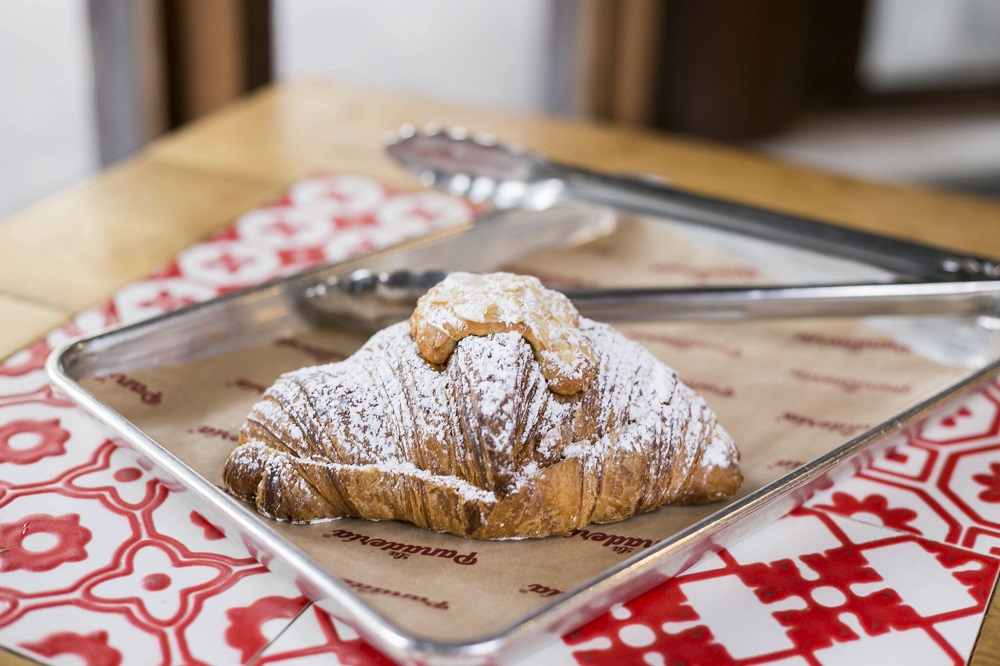
La Panaderia’s Tequila Almond Croissant. Photo: La Panaderia, used with permission.
National Almond Day is coming up on Tuesday February 16, and there is no better way to celebrate than with one of La Panadería’s signature Tequila Almond Croissants. La Panadería’s staple Tequila Almond Croissant has a golden, flaky exterior and is dusted with powdered sugar and topped with slices of roasted almonds with a creamy tequila almond filling guaranteed to make National Almond Day sweet. (La Panadería, 2021)
The pastry was created when Chef David Cáceres was experimenting with the traditional almond croissant recipe and did not have rum handy. He instead reached for a bottle of 1800 Reposado Tequila, and the rest is delicious history. The Tequila Almond Croissant is now one of the San Antonio bakery’s best sellers and customers can place orders online for pickup, enjoy in-store or via statewide shipping in Texas.
Brothers José and David Cáceres opened bakery-café La Panadería in 2014 to share their Mexican heritage and love for baking with the people of their adopted hometown of San Antonio, Texas. The Cáceres’ passion for baking began when they were young boys selling loaves of their mother, Doña Josefina’s fresh baked bread on the streets of Mexico City. Eventually José and David took over their mother’s homegrown business and started baking on a large scale, supplying bread and pan dulce for businesses throughout Mexico. After finding financial success in Mexico, the brothers realized they wanted to get back to the basics, and they decided to bring their passion for bread cultura to Texas.
‘Thurgood’ is back for encore performances for Black History Month. Photo: The Public Theater of San Antonio, used with permission.
The hit production of Thurgood is back for four special encore performances this month. Celebrate Black History month with this historical production. If you missed Thurgood the first time or want to see it again, join The Public Theater of San Antonio for this online performance. (The Public Theater of San Antonio, 2021)
To purchase your streaming link to see the encore performances of Thurgood, click on one of the links below. The encore performances are $10.00.
Thurgood by George Stevens, Jr. is a story rich in history, humanity, and humor and depicts the life of Thurgood Marshall, the first African American Supreme Court justice and his role in the historic decision on the Brown v. Board of Education case. He was an influential leader of the civil rights movement and his legacy lives on in the pursuit of racial justice. **This performance may contain themes and content not suitable for all audiences.**
‘The Entrepreneur’s Faces’ by Jonathan Littman and Susanna Camp. Photo: google
Jonathan Littman is the author of ten books, including “The Art of Innovation” and “The Ten Faces of Innovation.” His bestselling books have sold 750,000 copies worldwide and have been published in 20 languages. He is an adjunct professor at the University of San Francisco where he teaches ‘Innovation, Creativity, and Applied Design.’ Susanna Camp is an editor and journalist specializing in emerging technology and business trends. She is the Editor-in-Chief of SmartUp.life and a consultant for CEOs and others wanting to build their social media footprint. Susanna was an early team leader at Wired magazine, where she led the creation of one of the first online communities. In their new book “The Entrepreneur’s Faces: How Makers, Visionaries and Outsiders Succeed,” the authors take readers through the world of ten authentic entrepreneurs from around the world and show how each gets their edge and how they make their way in the business world in the hopes of inspiring the entrepreneurial spirit in them.
In the Introduction to “The Entrepreneur’s Faces,” Jonathan Littman and Susanna Camp explain their goal in writing this book is to “help you to identify the ten essential entrepreneurial types to propel your professional growth, and better gauge potential partners on the journey.” The ten entrepreneurs showcased throughout this book range from a concert pianist, to a physicist, a Stanford Law student and more. They are divided into ten types of workers: The Maker, The Outsider, The Conductor, The Accidental, The Collaborator, The Guardian, The Leader, The Visionary, The Evangelist, and The Athlete. Even though they all have their own individual journey to travel, they all pass through the same seven essential stages, which the authors call The Arc. These stages include: The Awakening, The Shift, The Place, The Launch, The Money, The Test, and The Scale. Each stage makes up a chapter where they describe how each entrepreneur handles the different stages. In the Epilogue, they stress that getting to identify the different entrepreneurial types is an excellent way to maximize a person’s potential but the types are in no way set in stone. People often exhibit more than one of these characteristics and it is usually necessary to adapt and change to maximize growth.
The world of entrepreneurship, like people, is constantly changing and challenging. Even though Littman and Camp focus on ten types of entrepreneurs, they emphasize that these states of mind are not always static. This book was written during COVID, when the business world is being challenged in ways no one thought possible – “The global pandemic is a huge Test for us all…Taking bold, new steps is never easy.” The stories presented, though inspiring, are merely a guide for entrepreneurs and innovators to help them through the 7 major phases of business growth. One chapter that stands out is ‘3: The Place’ because it brings up how the pandemic has made remote working necessary and “Those who quickly adopted these new skills at creating and collaborating online had an edge.” It brings modern reality into the mix. The chapters are short and the language is not too complicated in terms of business lingo and the authors speak directly to the reader: “At heart, you’ve got to make your own luck.” Business owners can also benefit in the sense that this valuable information can help them better understand themselves and their workers. By focusing on personality traits, this unique approach to business growth and management speaks to the heart of what makes individuals strive to succeed. “The Entrepreneur’s Faces” is an immensely useful business guide for both entrepreneurs and established organizations and is recommended for readers who appreciate business advice focusing on individual personalities and strengths.
“History proves that recessions, downturns, and yes, pandemics, demand that we respond to the threat with tremendous creativity and innovation.”
*The author received a copy of this book for an honest review. The views and opinions expressed here belong solely to her.
Normal Isn’t Normal is Rod Abernethy’s new album. Photo: google
Rod Abernethy is the 2019 Winner of American Songwriter’s Bob Dylan Song Contest for his riveting performance of “Oxford Town.” His last album The Man I’m Supposed To Be—produced by the legendary Don Dixon (REM, Marti Jones, The Smithereens, Marshall Crenshaw)—reached the top 10 in 2018 on the Folk DJ Chart. As a composer, he has scored and produced music for over 80 video games including the Electronic Art’s blockbuster hit “Dead Space” which won a BAFTA Award in 2009 for Best Original Score, and Tolkien’s “The Hobbit” for Vivendi Universal which won Video Game Soundtrack Of The Year in 2003. Now, Abernethy is proud to add his new full-length album Normal Isn’t Normal Anymore to his vast catalog of works and is available for purchase here. (IVPR, 2021)
Normal Isn’t Normal Anymore is a mixture of guitar virtuosity and world-class songwriting, most of which happened on Abernethy’s last year of touring. The album has received praise from fans and critics alike, including The Wall Street Journal, who complimented his “impressive guitar-picking.” According to American Songwriter, the lead single Another Year, is “a message as poignant as it is heartwarming…this idea of unity, so valuable and necessary in these times of polarization and strife, is so beautifully done.”
Abernethy’s knack for songcraft spans from finding excitement in the mundane day-to-day to making sense of the heavier bits of life; the latter being apparent in “My Father Was A Quiet Man” and the former in the rollicking “Birds In The Chimney.” The album also features two of Abernethy’s lively, intricate guitar instrumentals like “Over The Fence,” a rollicking six-string instrumental adventure about the family coonhound who jumps the fence and roams the downtown area for hours. With star performances from some of Nashville’s finest including Will Kimbrough on guitar, it should be noted that Normal Isn’t Normal Anymore is just as much about musicianship as it is songwriting, and neither take the back seat to the other.
Normal Isn’t Normal Anymore Track Listing: 1. Just Around The Corner 2. It’s Always Something 3. Whiskey & Pie 4. My Father Was A Quiet Man 5. Birds In The Chimney 6. When Tobacco Was King 7. Normal Isn’t Normal Anymore 8. Changing 9. Just Get In The Car 10. Another Year 11. Over The Fence 12. Oxford Town
Nitty Gritty Dirt Band gathers all-star cast for a timely cover of Bob Dylan’s The Times They Are A-Changin. Photo: google
Nitty Gritty Dirt Band gathers an all-star cast for a timely cover of Bob Dylan’s The Times They Are A-Changin’. In the fifty-seven years since Bob Dylan released his career-altering folksong, the times he sang of did seem to change. But now, in another period of national unrest, a President refusing to concede defeat or peacefully transfer power, and a renewed fire for justice in the long-fought battle for civil rights, Nitty Gritty Dirt Band’s new version of Dylan’s classic sounds more poignant and insistent than ever before. On Friday, JamBase shared NGDB’s star-studded version of Dylan’s classic and is available for “name your price” purchase on the band’s Bandcamp page with all proceeds going to Feeding America. On February 8, the song will become available on digital service providers with those proceeds also going towards Feeding America’s cause. (IVPR, 2021)
Amidst the compounding, pleading verses of Scottish ballad by way of Greenwich Village, the Dirt Band’s distinguished musical guests—Jason Isbell, Rosanne Cash, The War And Treaty, and Steve Earle, all of whom are no strangers to writing and singing their beliefs on record, each step to the microphone to contribute a verse with Isbell also adding slide guitar—carry the same tone and energy in their voices as the song’s writer did almost six decades ago; an unfortunate but earnest reaction to the all too evident parallels between now and then. “It moved me deeply then and that hasn’t changed,” NGDB founding member and lead singer Jeff Hanna notes. “The lyrics are as relevant today as they were when Dylan wrote it. Maybe even more so.”
Produced by Ray Kennedy, “The Time’s They Are A-Changin’” was collectively recorded up and down the east coast. John Leventhal recorded his wife, Rosanne Cash’s vocals in their New York City home studio and Steve Earle contributed his verse via the world-famous Electric Lady Studios in Greenwich Village. In Nashville, NGDB and guests joined Kennedy in his Room & Board Studio. Rounding out the already outstanding cast of characters on this track are all the current members of NGDB—Jeff Hanna (lead vocals and acoustic guitar), Jimmie Fadden (drums), Bob Carpenter (accordion), Jim Photoglo (electric bass), Jaime Hanna (electric guitar), and Ross Holmes (fiddle and mandolin)—as well as Fred Eltringham (Sheryl Crow, The Wallflowers) on additional drums and Nashville songwriting legend—and Jeff Hanna’s better half—Matraca Berg on harmonica and harmony vocals. “We’ve got great admiration for all of these folks, not only as artists, but more importantly, as people,” says Hanna.
“I’ve been a fan of Bob Dylan’s since I was a teenager, living in California. I was fortunate enough to see him sing The Times They Are A-Changin’ in concert the year the song was released: 1964.” – Jeff Hanna.