Weekly Book Recommendations: Transformative Reads for Entrepreneurs, Leaders, and Seekers

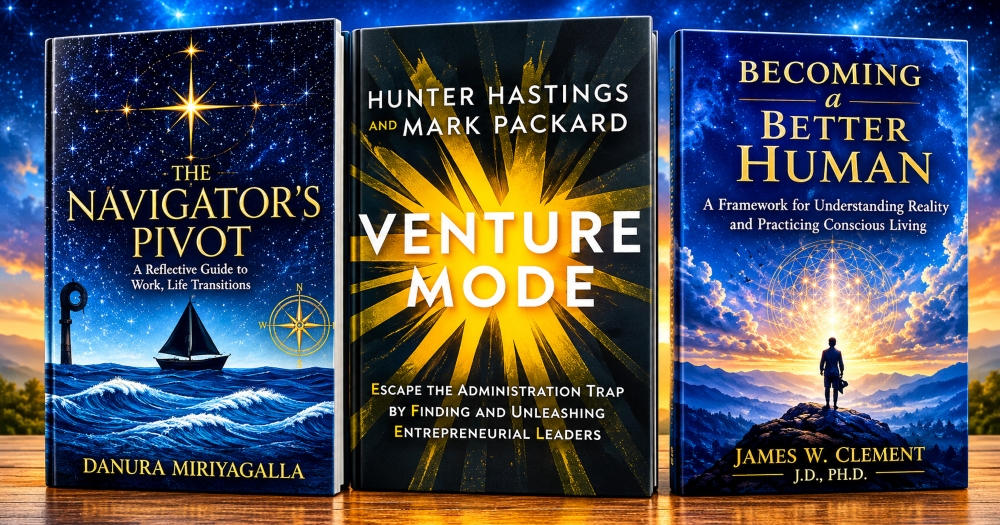
Three books to rethink how you lead, work, and live. Photos: Barnes & Noble/Gemini

Weekly Book Spotlight

Whether you are navigating a major career crossroads, challenging outdated business conventions, or seeking greater clarity in your daily life, the right book can offer a powerful new lens. In this week’s Book Spotlight, I explore three thought-provoking reads designed to help you rethink how you lead, work, and live. From trading rigid corporate bureaucracy for bold entrepreneurial action to quietening ego-driven fear and finding your bearings during periods of professional uncertainty, these titles invite you to step back, shift your perspective, and chart a more intentional path forward.

1. The Navigator’s Pivot: A Reflective Guide to Work-life Transitions

By Danura Miriyagalla

At various points in every working life, progress alone stops being enough. The familiar map no longer explains the terrain. Decisions feel heavier, direction less certain, yet nothing may be visibly “wrong.” The Navigator’s Pivot is a reflective guide for those moments. (Barnes & Noble, 2026)

Drawing on ancient seafaring wisdom and decades of lived experience across cultures, countries, and careers, The Navigator’s Pivot offers a new way of understanding work-life transitions: not as problems to solve, but as voyages to navigate within an international ecosystem. Using the timeless language of navigation—stars, winds, boats, and waves—it introduces an inspirational, practical, and human approach for finding direction when certainty fades.

Instead of offering formulas or quick fixes, the book invites readers to slow down and learn how to read the signals around and within them. Through illustrative examples, metaphors, and practical frameworks, including the Transition Map, Transition Compass, Boats Framework, and Four Periscopes, it helps readers realign purpose, identity, and perspective before choosing their next course or during a transition.

This isn’t a book about escaping uncertainty. It’s about learning to move through it with calm, integrity, and trust in the navigator within, recognizing that for many, the most meaningful pivots occur not by leaving, but by realigning and contributing more deeply where they already stand.

About the Author

Dr. Danura Miriyagalla is an international development and management specialist whose experience spans policy, business, research, teaching, coaching, and creative practice. Having lived and worked across Asia, Africa, Australia, the Pacific, and the US, his career has unfolded at the intersection of international public, private, and non-government organizations, academia, complex systems, cultural contexts, and human transitions.


2. Venture Mode: Escape the Administration Trap by Finding and Unleashing Entrepreneurial Leaders

By Hunter Hastings and Mark Packard

It’s time to take the “A” out of MBA.

Venture Mode is a bold call for an overhaul of modern business leadership and the higher education system that staffs it. It exposes the bureaucratic mindset that dominates modern organizations, especially universities, and explains the true cost of our obsession with administration in the form of suppressed economic potential. In its place, Hunter Hastings and Mark Packard champion venture mode: a radical, entrepreneurial approach that prioritizes value creation, consumer sovereignty, and agile execution. (Barnes & Noble, 2026)

The authors take aim at traditional bureaucratic management and make the case for a new kind of leadership—entrepreneurial leadership—built to drive growth, unleash creativity, and outpace competitors. Drawing from entrepreneurial (Austrian) economics and the experiences of inspiring modern business leaders, they lay out a provocative road map to escape the administration trap and rebuild organizations around the principles of value creation. They also outline a vision for business education that replaces the ubiquitous MBA with the MBE (Master of Business Enterprise), ensuring the next generation is trained in entrepreneurial leadership instead of administration.

Whether you’re a founder, an executive, or a rebel within a legacy system, this book is a call to arms. If you’re tired of the inertia of traditional business thinking and its MBA-fueled administrative mindset, Venture Mode is your new manual for training, nurturing, and unleashing entrepreneurial leaders. The world doesn’t need more administrators, it needs entrepreneurs.

About the Authors

  • Hunter Hastings is a lifelong practitioner of venture mode. Educated in England before the country adopted the MBA, he earned a master’s degree in economics, learned the core practices of venture mode and brand building, and established a global consulting practice applying these principles across multiple companies, industries, and countries.
  • Mark Packard is an associate professor of management, Harry T. Mangurian Fellow of the Phil Smith Center for Free Enterprise, and research director of the Madden Center for Value Creation at Florida Atlantic University. He obtained his PhD from the University of Missouri in 2016, focusing his research on entrepreneurial economics and the philosophical foundations of entrepreneurship theory.

3. Becoming a Better Human: A Framework for Understanding Reality and Practicing Conscious Living

By James W. Clement

What if becoming “better” is not about improving yourself, but about reducing the fear that quietly shapes your perception of yourself and others?

Most people’s identities are reaction-based, organized around praise, criticism, success, and failure. Their lives become governed by fear: fear of losing what they have, of not being enough, or of being judged, exposed, or replaced. From that fear flow the negative emotions that dominate so much of human experience: comparison, defensiveness, envy, shame, and chronic dissatisfaction. (Barnes & Noble, 2026)

Becoming a Better Human offers a different approach. Instead of adding another layer of techniques or motivational advice, it presents a coherent model of reality and identity, clarifying the relationship between awareness, ego, and lived experience. When that relationship is understood, perception begins to change.

Readers learn to observe and supervise egoic identity rather than unconsciously obeying it. Emotional reactivity begins to diminish, not through suppression or discipline, but through a deeper structural shift in how experience is interpreted. This isn’t a promise of perfection; it’s a disciplined reorientation of perception that replaces fear-driven identity with clarity, responsibility, and conscious participation in life.

About the Author

James W. Clement, J.D., Ph.D., is a research scientist whose work explores human flourishing through the lenses of healthy life extension, metabolic health, consciousness research, and the ethical use of emerging science and technology. For more than two decades, he has studied the biology of aging and the science of human longevity. He is best known for launching the Supercentenarian Research Study in 2010 with Professor George Church of Harvard Medical School—a project featured in The New York Times by Pulitzer Prize–winning journalist Amy Harmon.
The Future of Work and Money: 3 Essential Books Every Executive Should Read

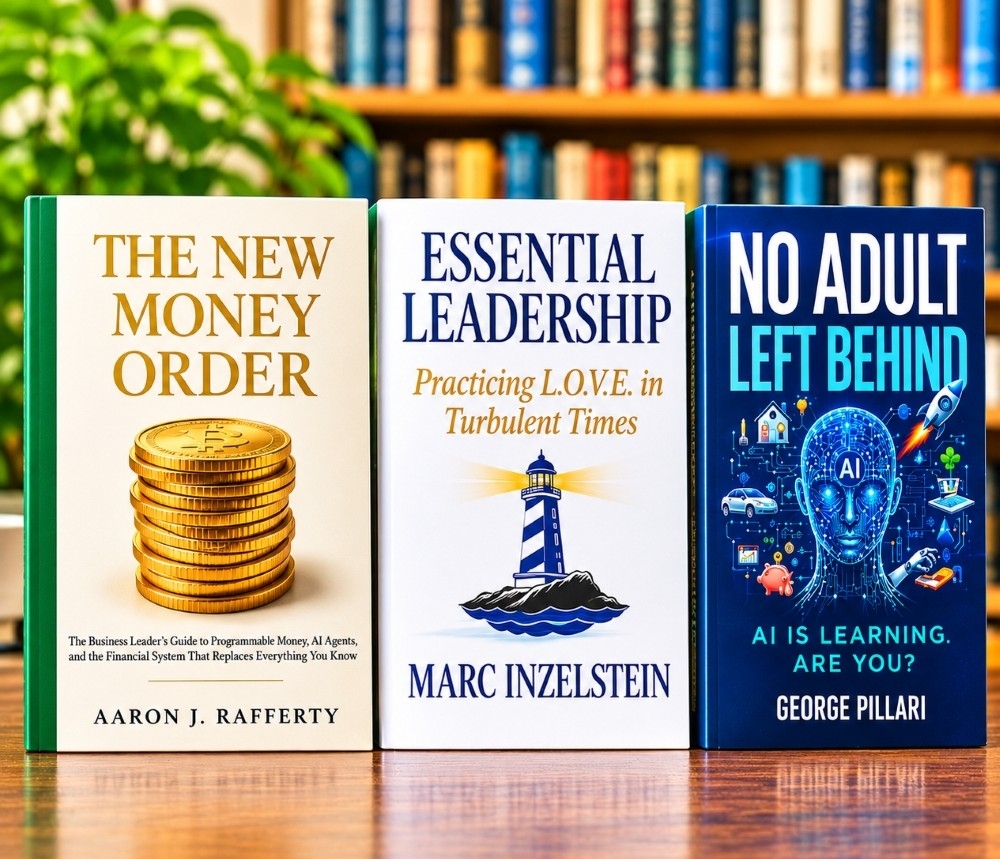
This week’s books explore mastering AI, programmable money, and executive leadership. Photos: Barnes & Noble

Books of the Week: Navigating the Future of Money, Leadership, and AI

Welcome to this week’s book spotlight! Whether you are looking to decode the emerging digital economy, revolutionize how you lead under pressure, or finally demystify artificial intelligence for your day-to-day life, these three essential reads offer practical playbooks from seasoned experts. (Barnes & Noble, 2026)

1. The New Money Order: The Business Leader’s Guide to Programmable Money, AI Agents, and the Financial System That Replaces Everything You Know

By Aaron J. Rafferty

About the Book

Money is becoming software and software follows instructions.

In The New Money Order, entrepreneur and researcher Aaron J. Rafferty maps the collision of two technological revolutions: programmable money and artificial intelligence. He shows business leaders exactly how this convergence is already reshaping real estate, financial services, philanthropy, the creator economy, and every industry that moves value from one place to another.

This isn’t just theory; Rafferty built the systems he writes about:

  • Co-founded a media company reaching over 1 million subscribers.
  • Launched an AI venture studio generating real revenue.
  • Created the EAT token (a “cause coin”) that has funded nearly 10,000 meals through everyday trading activity rather than traditional donations.

From watching a Filipino contractor wait three days for a wire transfer to launching a token on a WeWork whiteboard in Irvine, Rafferty grounds complex technological shifts in real lived experience. Drawing on Ray Dalio’s 150-year geopolitical cycles and Carlotta Perez’s frameworks for technological revolutions, he traces the arc from the 1910 Jekyll Island meeting to today’s open-source protocols.

BlackRock tokenizing treasury bonds, JPMorgan issuing programmable deposits, Wyoming granting legal standing to decentralized organizations, and AI agents operating digital wallets, the signals are everywhere. The New Money Order provides the framework to read them and the playbook to act on Monday morning.

About the Author

Aaron J. Rafferty is a behavioral scientist turned serial technology entrepreneur who builds companies at the intersection of technology and social impact. As an NIH-funded behavioral scientist, he published one of the earliest peer-reviewed studies on AI-powered health interventions in the Journal of Medical Internet Research before leaving his PhD program to build businesses. Through his parent company, Standard, Rafferty manages a portfolio spanning AI data products, programmable impact infrastructure, and media.


2. Essential Leadership: Practicing L.O.V.E. in Turbulent Times

By Marc Inzelstein

About the Book

What if the way you’ve learned to lead is exactly what’s holding you back?

You’re performing, delivering, and solving problems. By every external measure, you’re doing everything right. So why does it feel like you’re carrying more while creating less of what truly matters?

Many high-achieving leaders fall into a quiet pattern: under pressure, they push harder, exert more control, and take on extra burden. It works, until it doesn’t. Over time, this leads to strain, disconnection, and a persistent sense that something is missing.

In Essential Leadership, executive advisor Marc Inzelstein offers a fundamentally different path based on a simple truth: you don’t control what happens, but you always have a choice in how you respond.

Key insights from the book include:

  • The Space Between Stimulus and Response: How to access awareness, presence, and deliberate action in high-stakes moments.
  • The Leadership Heartset: Moving beyond control-and-performance models to integrate both mindset and heartset.
  • Leading Through Complexity: Sustainable strategies for leaders who are succeeding on paper but feeling the physical and emotional weight of how they lead.

If you’re ready to lead with greater clarity, steadiness, and impact under pressure, Essential Leadership provides the roadmap.

About the Author

Marc Inzelstein is an executive advisor and leadership strategist to senior leaders of global organizations. With over 25 years of experience, he works closely with executive teams to navigate complexity, align around core priorities, and translate strategy into meaningful action. His work focuses on how leaders show up under pressure and shape the culture around them.


3. No Adult Left Behind: AI is Learning. Are You?

By George Pillari

About the Book

If you have been watching the AI conversation from a distance wondering if the window to get on board is closing, this book was written for you.

George Pillari spent his career in crisis management, where reading dense contracts and presenting to corporate boards were standard routines. When consumer AI arrived, he approached it like any working adult: using it to solve immediate, everyday problems—from a confusing stereo receiver and prescription labels to reviewing candidate resumes.

What he learned along the way became No Adult Left Behind. Pillari writes like a knowledgeable friend who has done the homework and wants to save you months of trial and error:

  • Honest & Practical: Written in plain, conversational language with zero coding required.
  • Real-World Focus: Teaches you how to integrate AI directly into your work and daily life.
  • Skeptical & Grounded: Cuts through tech hype to focus strictly on what works.

If you have been waiting for an approachable, non-technical guide to embrace artificial intelligence, this is the book to get you started.

About the Author

George Pillari holds a B.S. in Mathematical Sciences from the Whiting School of Engineering at The Johns Hopkins University. He has served as a crisis manager for more than 100 companies, acting as a source of truth for boards, investors, and lenders in high-leverage situations. Through analyzing failing businesses, he identified recurring errors in executive judgment, organizing them into a framework known as The Seven Deadly Stupidities. His insights have been featured on CNN and quoted in The Wall Street Journal, The New York Times, and The Washington Post.

Inside The Means of Prediction and Why the Future of AI Depends on Who Owns It

The Means of Prediction by Maximilian Kasy explains how power, not technology, will define life with AI. Photo: The University of Chicago Press

Book Spotlight: The Means of Prediction by Maximilian Kasy

Publication Date: November 4, 2025
Publisher: University of Chicago Press

“An eye-opening examination of how power—not technology—will define life with AI.”

Artificial intelligence is everywhere. It filters what we see online, screens us in job interviews, and even factors into decisions about justice and warfare. Its presence has become so vast that many people feel resigned to its rule, believing AI is simply our collective destiny. (The University of Chicago Press, 2025)

In The Means of Prediction: How AI Really Works (and Who Benefits), economist Maximilian Kasy challenges that narrative. He argues that AI is not an inevitable or uncontrollable force, it’s a human creation, shaped by the choices and interests of those who own and operate it.

Kasy makes a bold claim: AI isn’t especially mysterious or complex. What makes it powerful and dangerous is who gets to control it. The “means of prediction,” as he calls them, consist of the essential ingredients of AI: data, computing power, expertise, and energy. These are the levers through which ownership and influence are exercised.

Inside the Book

Some of the chapters include:

  • The Story of Humans Versus Machines
  • What is Artificial Intelligence?
  • The Means of Prediction
  • Automation
  • The Ancient Questions Behind AI

Across these chapters, Kasy offers both a primer on how AI really works and a powerful critique of how it’s governed. He cuts through the noise of technical debates to ask the fundamental question:

Who controls AI’s objectives and how is that control maintained?

A Call for Democratic Control

Rather than treating AI as an unstoppable technological wave, Kasy invites readers to see it as a political and social choice. In a world already shaped by inequality, he argues that AI will deepen existing divides unless it’s placed under public and democratic control.

His framework is analytical and visionary, a blend of economics, ethics, and practical insight into how society might reclaim agency over one of the most consequential technologies of our time.


About the Author

Maximilian Kasy is a professor of economics at the University of Oxford and previously taught at Harvard University. His research explores machine learning and the social impact of AI, focusing on how technology intersects with power, equity, and governance.

Making it as a streamer

Black flat screen computer monitor on wooden desk. Photo: Roberto Nickson/Pexels.

While it used to be something on the outskirts of the culture, now streaming is a hugely popular thing to do. Not only that, it can even be very lucrative, with many people making quite a lot of money this way. You can approach streaming in so many different ways – gaming is a particularly popular genre – and it’s something that you can bring your creativity to easily in order to make the most of it. Here are some tips that you may want to consider if you are trying to make it as a streamer.

Find Your Niche

First of all, you should think about finding a niche that you can get into. While you might already know the genre of streaming you want to try, you’ll ideally want to get more specific than that and land on a particular type of streaming. So rather than just gaming, are you going to be playing certain kinds of games, or talking about particular topics within gaming? These are the kinds of things you need to be asking yourself if you want to make it as a streamer. It will help you to make much more of your experience and get a lot more out of it.

Behind the scenes of a female content creator. Photo: Ivan Samkov/Pexels

Develop An Audience

It can take time to build an audience with anything, and that’s no different when it comes to streaming. But if you want to make sure that you are developing an audience as well as you can, there are quite a lot of ways in which you can do this, and it’s something that you are definitely going to want to think about. Mostly it’s a case of just doing your thing and seeing who follows, but you might also find that some practical marketing can help too, especially if you want to start making money from it.

Monetize It

Speaking of which, you’ll have to figure out what you can do to monetize the streaming that you are considering. This is something that can be quite simple to achieve, but there are a lot of potential ways to do it and you’ll have to make sure that you are aware of what approach is best for you. As well as that, you’ll need to put the systems in place to accept money. Knowing how to accept credit cards as an adult entertainer is going to help a lot, and it’s worth looking into as soon as possible.

Keep Going

Ultimately, with this kind of thing you really then just need to persist. If you can do that, and keep going, you are going to find that it helps you to make it as a streamer much more effectively, and it’s amazing how much that can help. So make sure that you are keeping at it no matter how hard it seems to get. If you can do that, you’ll find that you end up in a situation where you are really able to make it work for you.

Collaborative Post


Book review: ‘A Digest on Cryptocurrency’ by Ansh Verma

‘A Digest on Cryptocurrency’ is the new book by Ansh Verma and an in-depth look at cryptocurrency. Photo: Amazon

Ansh Verma is a researcher + author + philosopher based in Dhanbad, Jharkhand (India). He researches almost everything that can be observed, felt and/or read, including but not limited to technology, politics, divine, war, behavioral, engineering, investing, military, finance and mathematics. Post graduation, Verma has almost 20 years of experience in thinking/making sense of the world. His new book “A Digest on Cryptocurrency” covers a wide range of topics – the history of cryptocurrency, the different types of cryptocurrencies, and cryptocurrency and the future of finance, that provide a comprehensive understanding of cryptocurrency.

“A Digest on Cryptocurrency” – This expanded digest gives readers a comprehensive and detailed exploration of the diverse aspects of cryptocurrency. Newcomers and seasoned enthusiasts will find it equally helpful, as it includes recent developments in the field. Ansh Verma defines cryptocurrency, covers the history behind it, describes the different types of cryptocurrencies, lists the challenges and concerns surrounding it, which include environmental concerns due to its significant energy consumption, and how it can be used in industries such as gaming and space exploration.

He begins in Introduction to Cryptocurrency by defining it “a revolutionary form of digital or virtual currency that operates on the principles of cryptography and blockchain technology.” He explains the concept, how blockchain technology makes it work, and its basic decentralized structure. In History of Cryptocurrency, he gets deep into the history of this digital currency, including the early beginnings of Bitcoin and the background of Satoshi Nakamoto, its creator. For anyone really interested in Blockchain Technology, this chapter goes heavily into how it works, its core features, and how it can be used to ensure security and transparency in cryptocurrency.

The rest of the book is divided as such:
Cryptocurrency Mining
Popular Cryptocurrencies
Cryptocurrency Exchanges
Crypto Wallets
Cryptocurrency Investment and Trading
Decentralized Finance (DeFi)
Cryptocurrency Regulations
Cryptocurrency and the Future of Finance
Cryptocurrency and Environmental Concerns
Cryptocurrency in Everyday Use
Challenges and Opportunities in Cryptocurrency
Cryptocurrency in the Media and Public Perception
NFTs (Non-Fungible Tokens)
Cryptocurrency and Space Exploration
Cryptocurrency and Gaming Economies
Quantum Computing and Cryptocurrency Security

Overall, “A Digest on Cryptocurrency” is an extremely helpful guide to all matters concerning cryptocurrency. From the history of this innovative digital currency, to the wide variety of uses in various industries – as well as its challenges and concerns, readers will no doubt find these topics informative. The chapters are short and structured to make it convenient to re-read those of particular interest at any given time. Ansh Verma has a way of making any topic easy to follow and understand and this one is no different. If you are looking for a book that fully explains all the concepts of cryptocurrency, then this one is a must-read.

*The author was contacted for an honest review of this book. The views and opinions expressed here belong solely to her.

Rating: 4 out of 5.

New book release: ‘Martian Economics: A Guide to Redesigning Monetary Theory on Earth’ by Joseph Thomas Plummer

‘Martian Economics: A Guide to Redesigning Monetary Theory on Earth’ is the new book by Joseph Thomas Plummer. Photo: Amazon

Economics is a social science that studies the production, distribution, and consumption of goods and services. (Google) If learning more about economics with a link to the possibility of life on Mars sounds intriguing, consider today’s new book release: “Martian Economics: A Guide to Redesigning Monetary Theory on Earth” by Joseph Thomas Plummer. This new guide has the power to reshape our future and enhance the quality of life for every Earth inhabitant. Don’t miss the chance to be part of a revolution in economic thinking – pick up your copy today on Amazon.

Joseph Thomas Plummer is an economist and author. He is an alumnus of Virginia Tech and Babson College with graduate degrees in Business, Education, and Natural Resources. His new book thought-provoking book, “Martian Economics: A Guide to Redesigning Monetary Theory on Earth” he guides readers through a cosmic thought experiment, drawing parallels between the potential life on Mars and the intricate complexities of our earthly monetary system. (Joseph Thomas Plummer, 2024)

“Martian Economics: A Guide to Redesigning Monetary Theory on Earth”

Attention, Earthlings! Prepare to embark on a mind-bending journey through the cosmos of economics written by the brilliant Joseph Thomas Plummer.

Imagine a world where the very foundation of our economic understanding is redefined. Just as you might ponder the characteristics of a distant planet, the author challenges us to reconsider the fundamental principles of monetary theory. In this compelling exploration, he takes us beyond the boundaries of Earth, presenting a fresh perspective that could revolutionize our economic landscape. How much money should exist on Earth? The answer lies in shedding preconceived notions and venturing into uncharted intellectual territory.

Join him on this visionary quest, where science, engineering, and economic theory converge. As we contemplate the dynamics of a colonized Mars, we unlock a framework for reimagining monetary systems, trade, conflict, and governance on our very own planet.

Read it now and be a pioneer in the next frontier of economic understanding!

Our journey to a brighter economic future begins here.

Sponsored Post

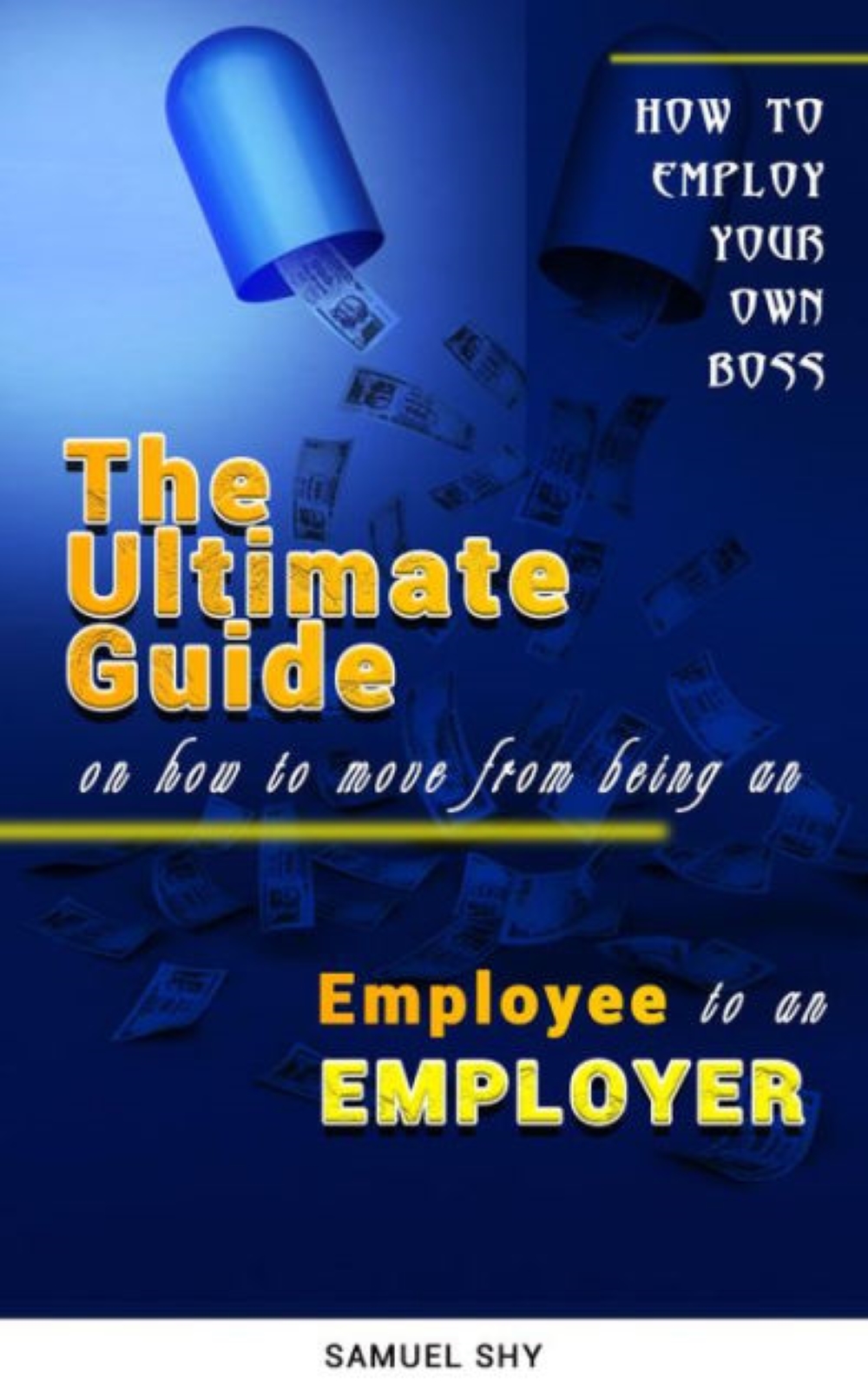
Book of the week: ‘How To Employ Your Own Boss: The Ultimate Guide on How To Move From Being An Employee To Employer’ by Samuel Shy

‘How To Employ Your Own Boss: The Ultimate Guide on How To Move From Being An Employee To Employer’ is Samuel Shy’s book about entrepreneurship. Photo: Amazon

From time to time, everyone at one point or another has fantasized about being their own boss. Regardless of what type of job you have, if you work for someone else, it can be exhausting and soul crushing because jobs most require getting up early, long commutes to work, and working at least eight hours a day, which means being cooped up in an office all day and missing out on life’s important events and spending time with loved ones; not to mention stressful office politics and overly critical managers who often demean more than praise employees. When it comes down to it, do you really know what it means to be your own boss? In his new book “How To Employ Your Own Boss: The Ultimate Guide on How To Move From Being An Employee To Employer,”  Samuel Shy writes about this important topic that is frequently in every worker’s mind after a long stressful day at work. (Samuel Shy, 2023)

“How To Employ Your Own Boss: The Ultimate Guide on How To Move From Being An Employee To Employer” – is available only as an e-book and is only 62 pages long but it features the basic concepts you should know when considering being self-employed. This includes the definition of an employee, the types of employees, and most importantly, what is self employment. He lists the advantages, disadvantages, and examples of self employment and how to move from being an employee to being self employed. Once you decide that this is the right move for you, he also explains how to start and run your own business along with the advantages and disadvantages of being your own boss which serves as a reality check. He also includes the characteristics that define someone who can be their own boss: could this be you? Are you ready to take the plunge?

This guide dealing with entrepreneurship, business, and economics is available through Lulu.

Sponsored Post